Object number1960.9.25
Sampler
Date1790
Artist
Currently Unidentified
CultureGerman
MediumSilk threads on linen ground
DimensionsSight (tall rectangle): 43 1/4 x 15 in. (109.9 x 38.1 cm)
Framed: 45 1/4 x 17 in. (114.9 x 43.2 cm)
Framed: 45 1/4 x 17 in. (114.9 x 43.2 cm)
Credit LineGift of Mrs. James W. Packard (Elizabeth Gillmer, class of 1894)
On View
Not on viewPeriod18th c
Classification(s)
InscribedTCB TRB/ 17 90 / TBK CCK
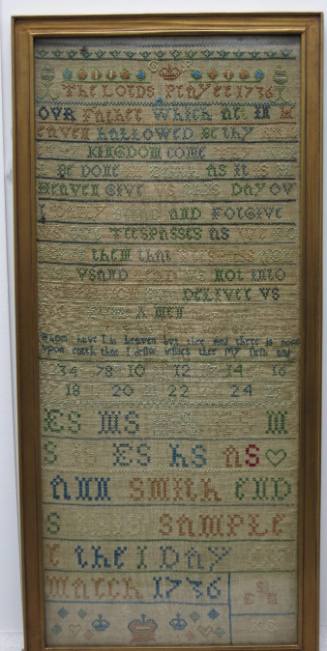
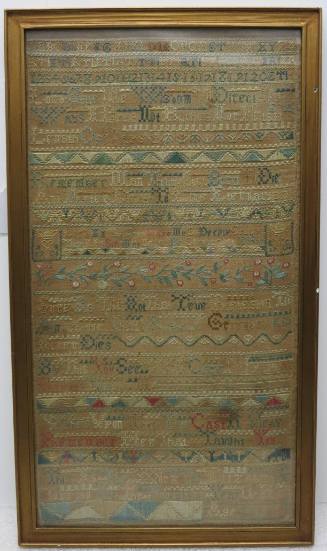
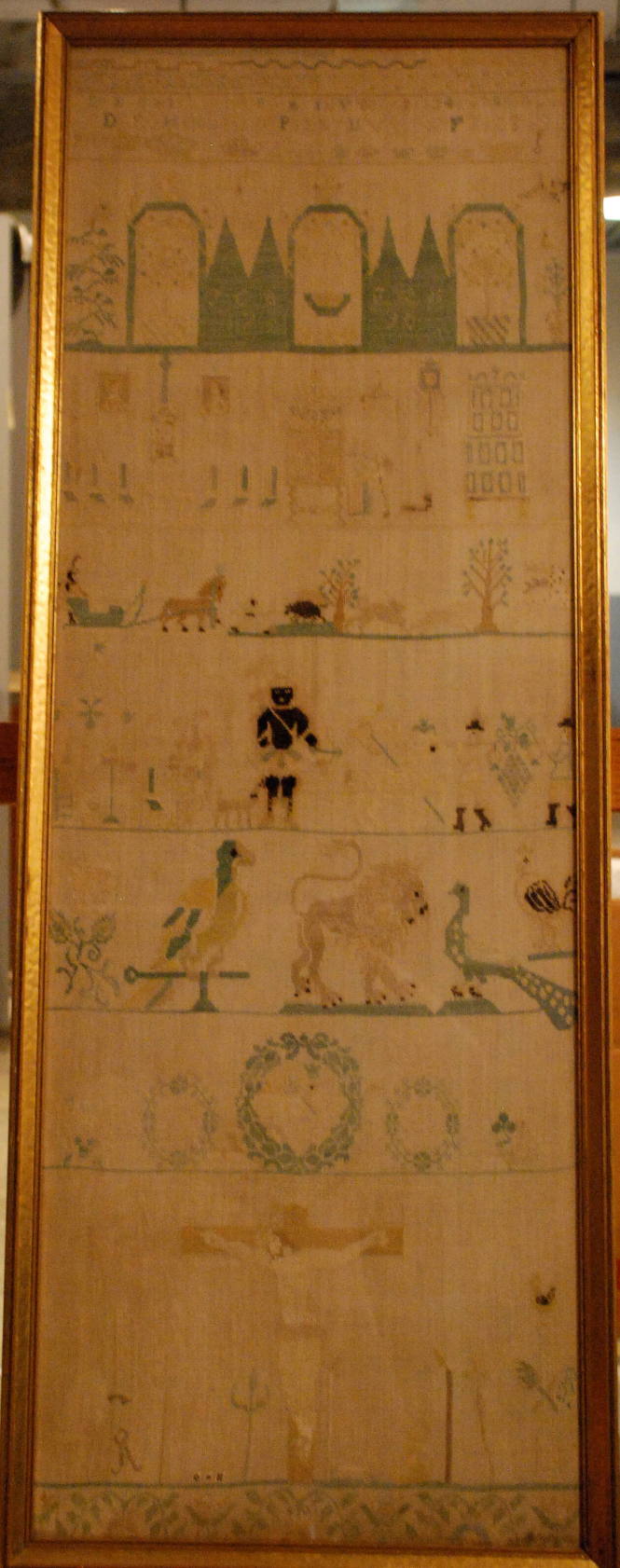
DescriptionThis south German long band sampler consists of a top and bottom border, 2 alphabets and a number sequence 1 - 10, a row od crowns and coronets and eight decorative and figural bands. The first band below the alphabets displays 3 geometric arches containing a fountain and floral arrangements in urns . The arches are divided by two pint arched inscription plates solidly stitched in green cross stitch each with a set of three initials stitched in white. The band below is an arrangement of domestic furnishings - portraits, a domestic shrine, old-fashioned high back chairs, chests on stands, and a wall clock. A woman with a broom wlks next to dog. In the nest band is a linear landscape with a horse pulled sled, and a hunting scene with a boar, rabbits (dogs?) trees and deer. Centered on a black figure in tribal garb, the next band displays traditional small motifs including a spinning monkey, an agnus dei, and spies of Canaan. The next band is a row of animals - a parrot on a perch, a lion. a peacock, and a rooster. A green garland encircling an agnus dei, flanked by smaller garlands with initials, each surmounted by crowns makes up the next band. At the beginning of the row is a flaming heart with arrows . Another indecipherable, probably religious, motif is at the end. The last band is a depiction of the crucifixion flanked by instruments of the passion. A honeysuckle band along the bottom completes the composition. Executed primarily in greens, blues, yellow and black, this sampler is an excellent example of a group of similar long band samplers worked in Catholic areas of south Germany during the last decade of the 18th Century. Terms
Object information is a work in progress and may be updated as new research findings emerge.
To help improve this record, please email
loebcollections@vassar.edu