Object number1960.9.29
Sampler
Date1811
Artist
Elizabeth Taylor
(British, b.1801)
CultureBritish
MediumSilk threads on linen ground
DimensionsSight: 17 7/8 × 18 7/8 in. (45.4 × 47.94 cm)
Credit LineGift of Mrs. James W. Packard (Elizabeth Gillmer, class of 1894)
On View
Not on viewPeriod19th c
Classification(s)
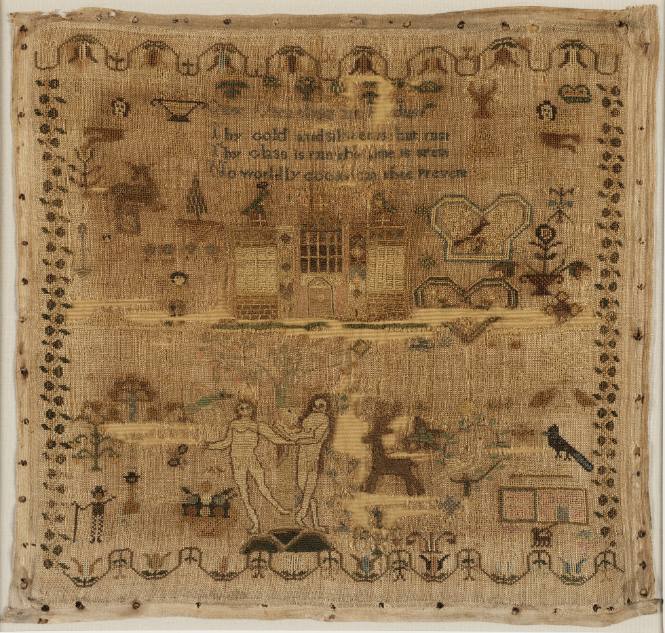
SignedElizabeth Taylor 1811
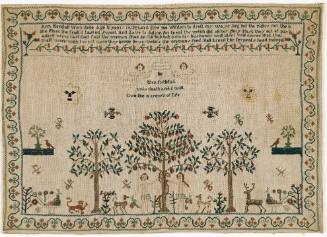
Inscribed Osee Osee thou art but dust / Thy gold and silver is but rust / Thy glass is run thy time is spent / No worldly goods can thee prevent/ Elizabeth Taylor Her work In the year of our Lord 1811 And in the 10 year of her age
BibliographyThanks be to my Friends: Selected Samplers from the Collection of the Frances Lehman Loeb Art Center (Poughkeepsie: FLLAC, 2004)
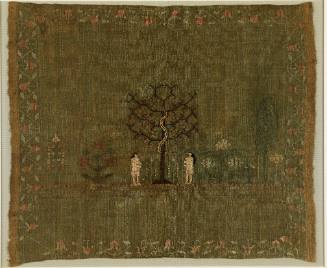
Sampler ("Osee Osee thou art but dust....")Exhibition HistoryPoughkeepsie, New York, FLLAC, Vassar College, "Thanks be to my Friends: Selected Samplers from the Collection of the Frances Lehman Loeb Art Center," June 5-July 18, 2004DescriptionFrom top to bottom the central tableaux of the 1811 Elizabeth Taylor sampler represent the theme of Paradise from the angel flanked verse reinforcing the transience of earthly life to Solomon's Porch or The Gates of Heaven to the depiction of Adam and Eve below. Surrounding these scenes is a seemingly random display of motifs of mixed style and scale - deer in various poses, birds, crowns, hearts, baskets, florals and foliage, and small human figures. Tulip bands form the border at top and bottom and smaller stylized columns of flowers and foliage delineate the side borders. The Adam and Eve figures appear to be derived from "Orbus Pictus", an illustrated textbook for children by John Amos Comenius, a Czech educator, first published in 1658 and widely translated over Europe. The word "Osee" in the verse is probably a form of Hosea.
Object information is a work in progress and may be updated as new research findings emerge.
To help improve this record, please email
loebcollections@vassar.edu