Object number1941.1.14
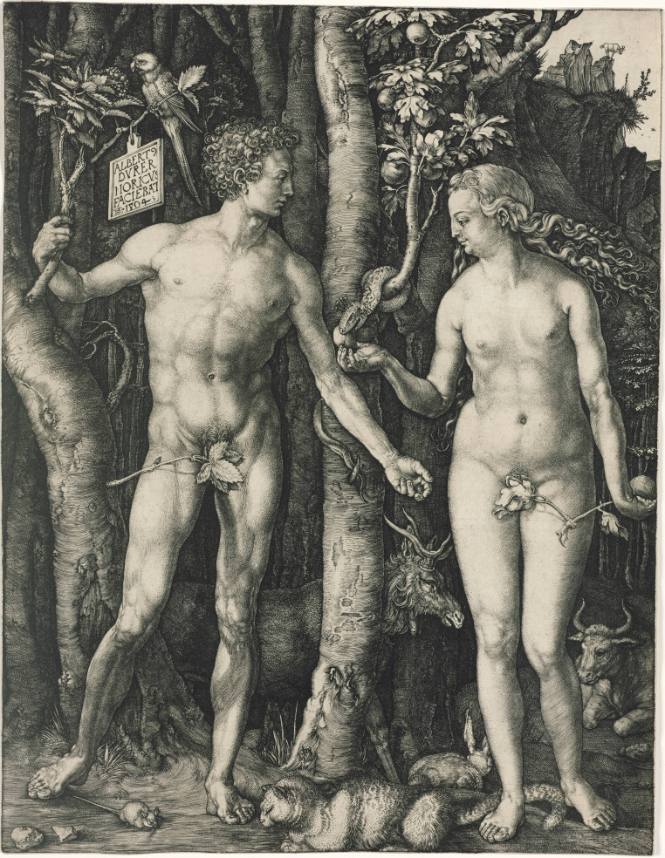
Adam and Eve
Date1504
Artist
Albrecht Dürer
(German, 1471-1528)
CultureGerman
MediumEngraving on cream laid paper
DimensionsImage: 9 3/4 x 7 1/2 in. (24.8 x 19 cm)
Matted: 21 15/16 x 15 15/16 in. (55.7 x 40.5 cm)
Matted: 21 15/16 x 15 15/16 in. (55.7 x 40.5 cm)
Credit LineGift of Mrs. Felix M. Warburg and her children
Period16th c
Classification(s)
SignedSigned: ALBERT(VS) / DVRER / NORICVS / FACIEBAT / AD
MarkingsWatermark: bull's head (Meder 62); stamped "F.M.W." on verso
Catalogue raisonnéBartsch/Meder 1; Panofsky 108; Strauss 42BibliographyMundy, James, The Frances Lehman Loeb Art Center: Vassar College The History and Collection (New York: Prestel Publishing, 2007), p. 32, p. 33 repr.; Limouze, Dorothy and Susan Kuretsky. The Felix M. Warburg Print Collection: A Legacy of Discernment. Poughkeepsie, N. Y.: The Frances Lehman Loeb Art Center, Vassar College, 1995. fig. 1
Bartsch/Meder 1; Panofsky 108; Stauss 42; Limouze 1ProvenanceCollections: Karl Edward von Liphart (1808-91, Lugt 1687); Felix M. and Frieda Warburg, New YorkVassar Exhibitions
Exhibition HistoryPoughkeepsie, New York, FLLAC (Prints and Drawings Gallery), Vassar College, "Revealed Anew: Selections from Permanent Collections," 7 November - 4 January 2008;"Master Printmakers: Albrecht Dürer and the Renaissance in Germany," Worcester Art Museum, Worcester, MA, 21 December 1991 - 15 March 1992;
Poughkeepsie, New York, FLLAC "Albrecht Durer: Impressions of the Renaissance", 14 November 2009- 24 December 2009.
DescriptionThis large engraving by Dürer is a technical tour de force and, at the time of its execution, Dürer’s summa on the subject of printmaking, extending his powers of illusion in this art form far beyond that of any practitioner to date. The delicate hatching that forms the shading of the abdomen of Adam, for example, is composed of small organized universes of lines completely under the control of a master. The figure’s proportions and pose are derived from the sculpture of classical antiquity, an early appearance of this in- fluence in the art of Germany. In this print, the Garden of Eden is trans- formed into a northern European forest inhabited by a number of animals at rest, in addition to the First Parents succumbing to the temptation of the serpent. These animals have been interpreted as symbolizing each of the four classical humors or fluids that, according to medicine of the time, dic- tated the personalities of individuals when out of balance. Adam and Eve was one of over one hundred and fifty works of art donated by the family of Felix M.Warburg to Vassar in 1941 following the great banker and philanthropist’s death. The Vassar gifts were dominated by prints by Dürer and Rembrandt, and form the core of a very strong Old Master print collec- tion.
Object information is a work in progress and may be updated as new research findings emerge.
To help improve this record, please email
loebcollections@vassar.edu