Object number1870.1.1
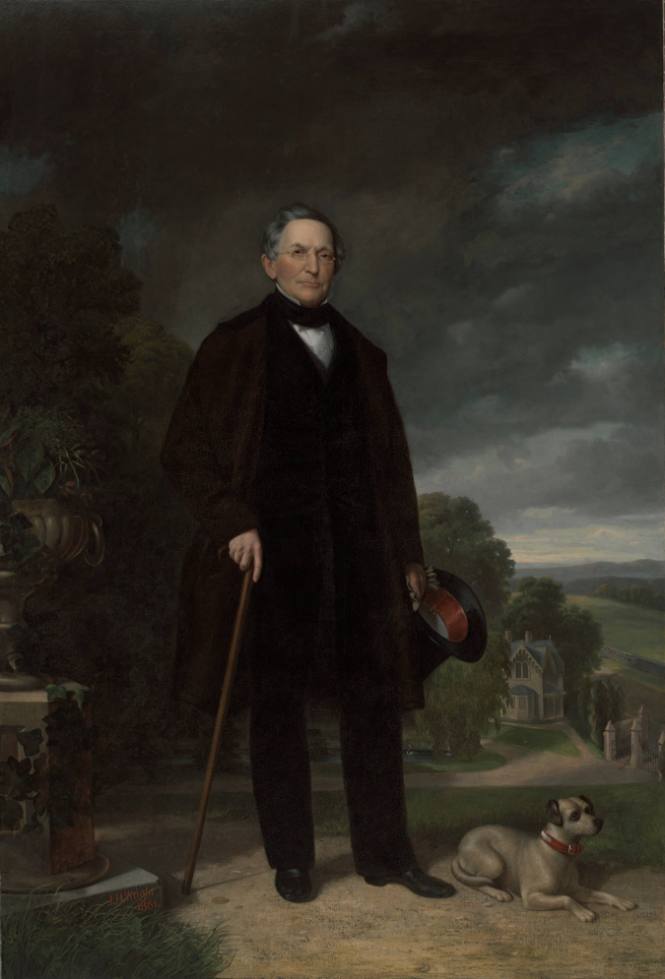
Portrait of Matthew Vassar
Date1861
Artist
James Henry Wright
(American, 1813-1883)
CultureAmerican
MediumOil on canvas
DimensionsFramed: 103 3/4 x 72 1/4 x 3 1/2 in. (263.53 x 183.52 x 8.89 cm)
Unframed: 97 x 65 3/4 in. (246.38 x 167.01 cm)
Unframed: 97 x 65 3/4 in. (246.38 x 167.01 cm)
Credit LineGift from the estate of Matthew Vassar
On View
Not on viewPeriod19th c
Classification(s)
SignedSigned and dated (LL): J. H. Wright 1861.
BibliographyMundy, James, The Frances Lehman Loeb Art Center: Vassar College The History and Collection (New York: Prestel Publishing, 2007), p. 80-81, p. 81 repr.
Humanzing Landscapes: Geography, Culture, and the Magoon Collection, (Poughkeepsie: FLLAC, 2000),p.92, repr.
Lewis, Candace J., The Hudson River and Matthew Vassar: Creating a College Art Collection, in Reflections on a River: Dutchess County Historical Society Yearbook (Poughkeepsie: Dutchess County Historical Society, 2009), repr. p. 15, fig. 2.Vassar Exhibitions
Exhibition HistoryPoughkeepsie, NY, The Frances Lehman Loeb Art Center, Vassar College, "Humanizing Landscapes: Geography, Culture and the Magoon Collection" 5 Oct. - 20 Dec. 2000. Cat. no.70, repr. p.92Poughkeepsie, New York, The Frances Lehman Loeb Art Center, Vassar College, "American Stories 1800 - 1950," January 29 - April 17, 2016
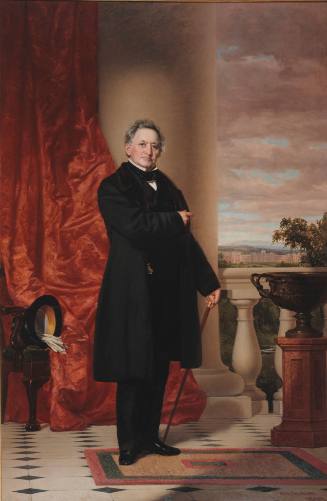
DescriptionThe two full-length portraits of Matthew Vassar, the founder of Vassar Female College, cannot be studied independently because they provide complementary images of the man, the age in which he lived, and conventions in portraiture in general. Both paintings were executed in the same year, that of the founding of Vassar College and during the first year of its construction, as well as the first year of the American Civil War. The paintings are the same size and both were exhibited first in the autumn of 1861 in the Central Baptist Church in Poughkeepsie, where they were painted. They are, however, very different in appearance and intention. Elliott’s painting is the quintessence of the ‘official’ state portrait, executed by the then reigning master of formal portraiture in America. Born in the small upstate New York hamlet of Scipio, Elliott received his artistic training in New York City in 1829, painting in the studio of the genre specialist John Quidor for six months. He returned to the Syracuse area, where he spent the next ten years painting portraits. His return to New York quickly established him as a talented portraitist at a time when this art form was at its height in America. There he exhibited almost annually at the National Academy of Design, submitting portraits of such distinguished sitters as William H. Seward, General J. C. Frémont, James Fenimore Cooper, and William Cullen Bryant, to name just a few. In 1861, the trustees of Vassar College commissioned Elliott to paint Matthew Vassar, for which he was paid the very generous sum of $1,200. He is shown in the ‘Grand Style’ presentation of the European masters, magisterially pointing from an impressive classical portico at a seemingly completed James Renwick-designed Main Building of Vassar College. In truth, the building was little more than a foundation at the time. The pose was captured, according to Benson Lossing, writing in July 1862, during an interview with Vassar when he was asked by Elliott if he thought his enterprise to build the college would succeed. “Succeed, Sir! I know it will succeed — it shall succeed. What can prevent its success?” In this animated manner he answered Elliott’s question and unconsciously assumed the position in which he stands in the picture. Mr. Elliott smiled, and said, “That is sufficient, Mr. Vassar. I have the design for the portrait, and the Expression I wished; we will now begin the picture.” Vassar holds a gold-headed cane and has rested his top hat and gloves on the chair, which is partially hidden by the sumptuous red satin curtain. A copy of the Warwick Vase, a famous Roman antiquity, stands on the pedestal to his left.
The Wright portrait presents a very different Matthew Vassar, less Romantic, with fewer and homelier trappings. He is shown on the path above the gatehouse of his ‘country’ residence, Springside, designed by the noted landscape architect A. J. Downing, but, like Vassar College in 1861, yet unfinished. A reviewer for the Poughkeepsie Telegraph wrote in November, 1861, that Wright captured Vassar “as his friends know him and daily meet him,” without the formal affectations of wealth and rank found in the Elliott portrait, and with his small dog, Tip, resting at his feet. This portrait was not an ‘official’ commission but a private one from Vassar himself, for which he paid Wright half the fee commanded by Elliott. While Elliott was known for using photography as a frequent source of reference for his portraits, in this case it is Wright’s that seems much truer to the photographic likenesses of Vassar than is Elliott’s more Romantic version.
Object information is a work in progress and may be updated as new research findings emerge.
To help improve this record, please email
loebcollections@vassar.edu

![[Mailboxes in Maine]](/internal/media/dispatcher/18618/thumbnail)