
Object number1966.23.9
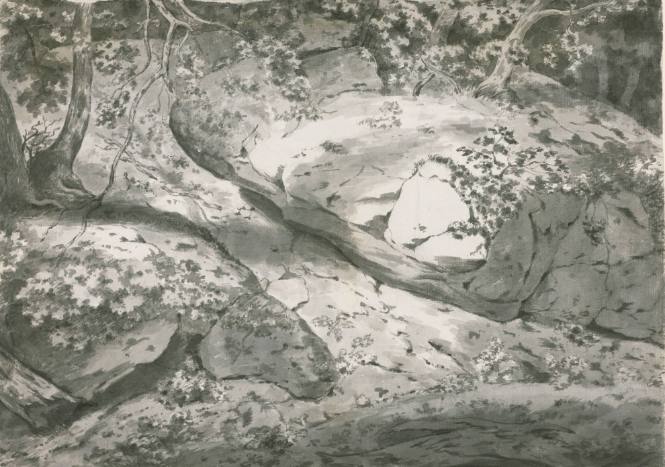
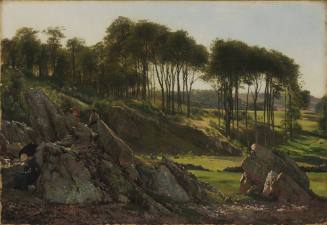
Study of Rocks and Trees
Date1774/1775
Artist
Joseph Wright of Derby
(British, 1734 - 1797)
CultureBritish
MediumPencil and wash on paper
DimensionsSheet: 14 15/16 x 21 3/8 in. (37.94 x 54.29 cm)
Credit LinePurchase, Suzette Morton Davidson, class of 1934, Fund
On View
Not on viewPeriod18th c
Classification(s)
Vassar Exhibitions
Exhibition HistoryPoughkeepsie, NY, The Frances Lehman Loeb Art Center, Vassar College, "Humanizing Landscapes: Geography, Culture and the Magoon Collection" 5 Oct. - 20 Dec. 2000. Cat. no.72, repr. p.54Poughkeepsie, New York, The Frances Lehman Loeb Art Center, Vassar College, "Past Time: Geology in European and American Art," September 21 - December 9, 2018. Cat. no. 15, repr.
Ithaca, New York, Herbert F. Johnson Museum of Art, Cornell University, "Past Time: Geology in European and American Art," February 16 - May 12, 2019. Cat. no. 15, repr.
DescriptionAlthough trained as a painter by Thomas Hudson in London, Joseph Wright returned to his hometown of Derby in central England to live and work. There, he was part of a group of scientists, intellectuals, inventors, and artists known as the Lunar Society owing to their habit of meeting on Monday evenings as close as possible to the time of the full moon. This group included notables such as Josiah Wedgwood, James Watt, and Joseph Priestly. Their scientific investigations inspired some of Wright’s best- known paintings. Wright made one journey to Italy, arriving in February 1774 and departing in June of the following year. While there he sketched regularly, often in the company of his student Richard Hurleston. A portfolio of these drawings was sold at auction in 1966, from which Vassar acquired two large sheets, one of the entrance to a Roman ruin, and this delightful and carefully observed study of light washing over rocks covered with what seems to be leaves and lichen. Behind and to either side are small trees that have rooted themselves in the rocks. This study, while grist for Wright’s painterly mill, is also a fine document of the wonder with which he, like his fellow members of the Lunar Society, viewed the natural world, its rock formation offering clues to the Earth’s age and its manner of creation.
Object information is a work in progress and may be updated as new research findings emerge.
To help improve this record, please email
loebcollections@vassar.edu

Peter Henry Emerson
1886
Culture: English

The Master of the Johnson Assumption of the Magdalen
Early 1500s
Culture: Italian