
Object number1864.1.206
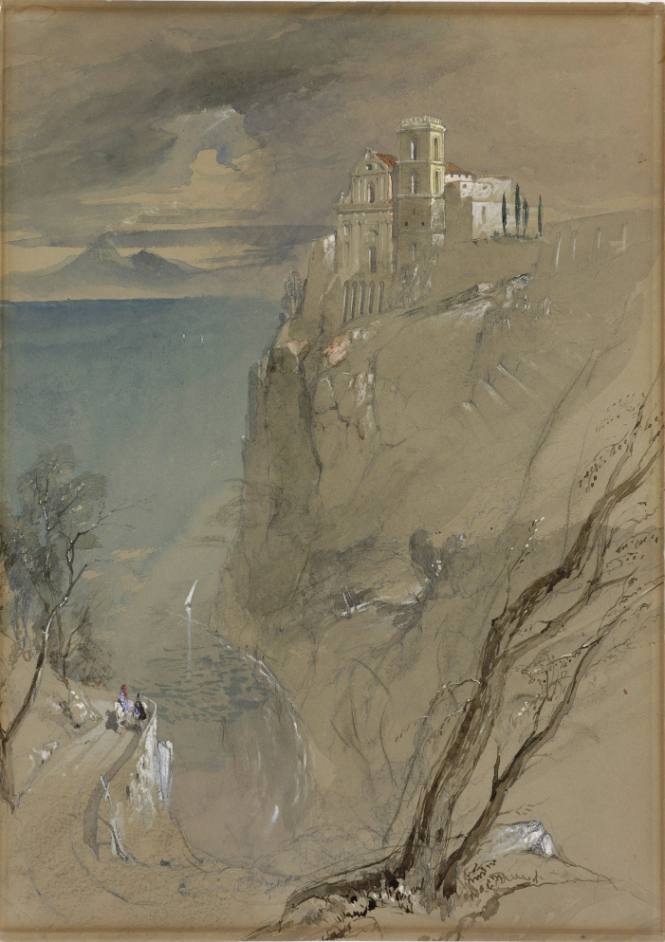
Church of the Annunciation at Vico Equense on the Bay of Naples
Date1841
Artist
John Ruskin
(English, 1819-1900)
CultureEnglish
MediumBrush and watercolor, ink, adn gouache over graphite on blue-gray wove paper
DimensionsSheet: 15 5/8 x 11 1/4 in. (39.69 x 28.58 cm)
Credit LineGift of Matthew Vassar
On View
Not on viewPeriod19th c
Classification(s)
SignedNot signed or dated
Bibliography1869 Catalog, #302; 1939 Catalog, p. 47, pl. 38;
Kinney, Vilma, "The Vicotrian Rebellion," (Lakeview Center for the Arts and Sciences, Peoria, Illinois, 1971), Checklist no. 83, p. 73, p. 53, repr., fig. 83;
Elzea, Rowland and Betty, "The Pre-Raphaelite Era: 1848-1914," (Delaware Art Museum, Wilmington, Delaware, 1976), p. 12, p.13, repr., fig I-6;
Frances Lehman Loeb Art Center, "Humanizing Landscapes" Geography, Culture and the Magoon Collection," (Vassar College, Poughkeepsie, New York, 2000), Cat. no. 57, frontispiece illustration;
Frances Lehman Loeb Art Center, "Catching Ligh: European and American Watercolors form the Permanent Collection," (Vassar College, Poughkeepsie, New York, 2009), checklist no. 42, p. 2, repr.;
Lowe Art Museum, "The Revolt fo the Pre-Raphaelites," (University of Miami, Cora Gables, Florida, 1972), Cat. no. 103, p. 48, repr.;
Manthorne, Kathie E., "Bay of Naples," The Elias Magoon Collection, Arts Magazine, Vol. 55, no. 1, p. 12;
British Romantics Calendar by Clive Williams (ICI Pharmaceuticals, Germany, 1993);
Patrica Phagan, "Drawings at Vassar to 'Illustrate the Loftiest Principles and Refine the Most Delishte Hearts'," Master Drawings (Summer 2004), p. 135;
Mundy, James, The Frances Lehman Loeb Art Center: Vassar College The History and Collection (New York: Prestel Publishing, 2007), p. 71, p. 70 repr.
Phagan, Patricia, Past Time: Geology in European and American Art, (London: D Giles Limited, 2018) p.120-121. repr. p.121, fig. 46.
ProvenanceCollections: Elias MagoonVassar Exhibitions
Exhibition HistoryNew York, National Academy of Design, "A Study of Near Naples," 1855 (lent by Rev. E. L. Magoon);Milwaukee, Milwaukee Art Institute, "Three Centuries of British Painitng," October 18-December 1, 1946;
"British Watercolors in Amerian Collections," American Federation of Arts, Traveling February 1962-February 1963 (Minneapolis, Minnesota, Minneapolis Institue of Art; Seattle, Washington, Frye Art Museum; Currier Gallery of Art, March 7-28, 1962, University of North Carolina, October 9-28, 1962);
Peoria, Illinois, Lakeview Center for the Arts and Sciences," The Victorian Rebellion," September 12-October 26, 1971;
Delaware, Wilmington, Delaware, "The Pre-Raphaelite Era:1848-1914," April 12-June 6, 1976
Poughkeepsie, New York, The Frances Lehman Loeb Art Center, Vassar College, "Humanizing Landscapes: Geography, Culture and the Magoon Collection," October 5-December 20 2000;
Poughkeepsie, New York, Frances Lehman Loeb Art Center, Vassar College, "Catching Light: European and American Watercolors from the Permanent Collection," May 8- July 26, 2009.
Poughkeepsie, New York, The Frances Lehman Loeb Art Center, Vassar College, "Past Time: Geology in European and American Art," September 21 - December 9, 2018. Cat. no. 46, repr.
Ithaca, New York, Herbert F. Johnson Museum of Art, Cornell University, "Past Time: Geology in European and American Art," February 16 - May 12, 2019. Cat. no. 46, repr.
DescriptionJohn Ruskin was the most influential art critic and theorist of the nineteenth century who wrote in English. He was a great admirer and collector of the work of Joseph Mallard William Turner. He was also a compulsive draughts- man from an early age, but came to the realization that he could never achieve greatness by his art. His great powers of observation and keen analytical mind yielded drawings of great beauty and visual intensity. Ruskin was acquainted with the Reverend Elias Lyman Magoon, the guiding spirit behind the first Vassar art collection. Magoon acquired seven of Ruskin’s drawings for the collection, including this one and a more controversial study made by the critic as a young boy. The identification of this view as the fourteenth-century church of the Annunciation at Vico Equense and its reconstructed sixteenth-century bell tower is a recent one. The village lies roughly three miles north of Sorrento and twenty-two miles south of Naples on the coast of the Bay of Naples. Ruskin journeyed there only once, in 1841. There are two entries in his diaries that refer to this location. The first on 26 February 1841:
A lovely drive yesterday from Castellamare to Sorrento. I could not see it well out of our close rattling carriage, but it was very perfect: all lovely rock promontory, orange and olive, and Vico placed ad captandum — thoroughly delicious.
And the second on 1 March:
Stopped at Vico to get a sketch, and failed, and bored myself.
It is altogether likely that his watercolor of Vico and its church was made on one of these occasions.
Object information is a work in progress and may be updated as new research findings emerge.
To help improve this record, please email
loebcollections@vassar.edu


![[Mailboxes in Maine]](/internal/media/dispatcher/18618/thumbnail)

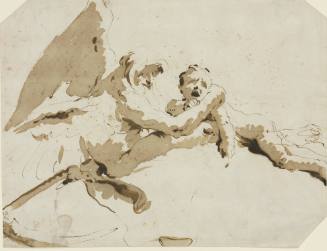
Giovanni Battista Tiepolo
c. 1750
Culture: Italian