
Object number1935.3
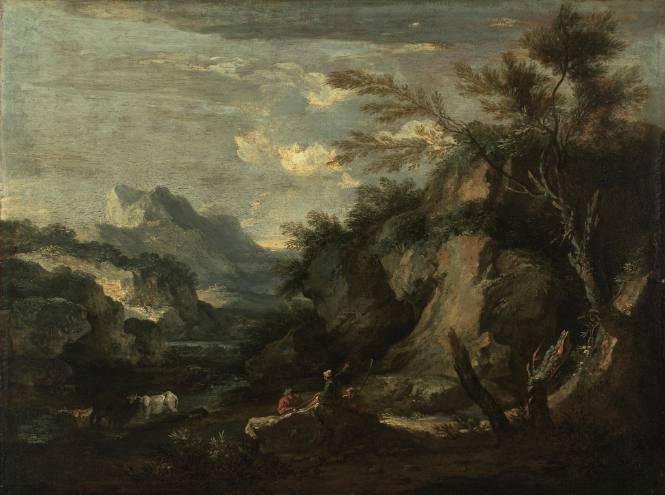
Landscape with Herdsmen
Datec. 1661
Artist
Salvator Rosa
(Italian, 1617-1673)
CultureItalian
MediumOil on canvas
DimensionsUnframed: 29 1/2 x 39 1/2 in. (74.93 x 100.33 cm)
Credit LineGift of Mrs. William Levitt (Janice Loeb, class of 1935)
On View
Not on viewPeriod17th c
Classification(s)
SignedNot signed
BibliographyMundy, James, The Frances Lehman Loeb Art Center: Vassar College The History and Collection (New York: Prestel Publishing, 2007), p. 51 repr.ProvenanceCollections: Lord Jersey, Osterley ParkThis work has been examined by the Provenance Project, 05-06Vassar Exhibitions
Exhibition HistoryPoughkeepsie, NY, FLLAC, Vassar College, "An Exhibition in Memory of Agnes Rindge Claflin 1900-1977," April 30 - June 4, 1978.DescriptionSalvator Rosa was trained as an artist in Naples and by 1635 was working in Rome. Between 1640 and 1649 he was painting in Florence. In addition to being a painter, he received recognition for his printmaking, poetry, and act- ing. While he painted his share of religious subject matter, he made his greatest contribution as a landscape artist, often including a subsidiary story within an evocative or emotionally charged landscape. Such subjects could be taken from ancient history or mythology, literary sources such as the writings of Tasso, or images of bandits and brigands on the land. His landscapes were not classically beautiful like those of Claude Lorrain or Gaspard Dughet, but rather rugged and occasionally stormy, often setting a psychological tone for the moment depicted. Rosa was also drawn to darker subjects of a violent nature, including unusual portrayals of witches’ Sab- baths and battles. This painting is fairly typical of his more romantic land- scapes, placing a pair of herdsmen and their animals in a carefully con- structed, diagonally organized landscape where the curving forms of the trees and rocky cliff almost take on the appearance of a wave breaking on the shore. Devices such as these and the blasted tree trunks were the elements that impressed nineteenth-century American landscape painters such as Thomas Cole and encouraged their assimilation of the Baroque tradition in the depiction of a largely fictive natural world.
Object information is a work in progress and may be updated as new research findings emerge.
To help improve this record, please email
loebcollections@vassar.edu
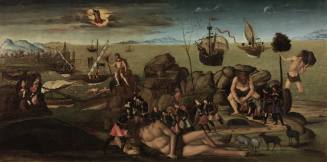
The Master of the Johnson Assumption of the Magdalen
Early 1500s
Culture: Italian
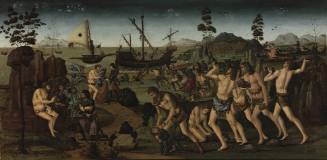
The Master of the Johnson Assumption of the Magdalen
Nd
Culture: Italian

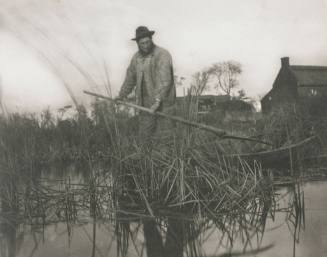
Peter Henry Emerson
1886
Culture: English