Object number1957.3
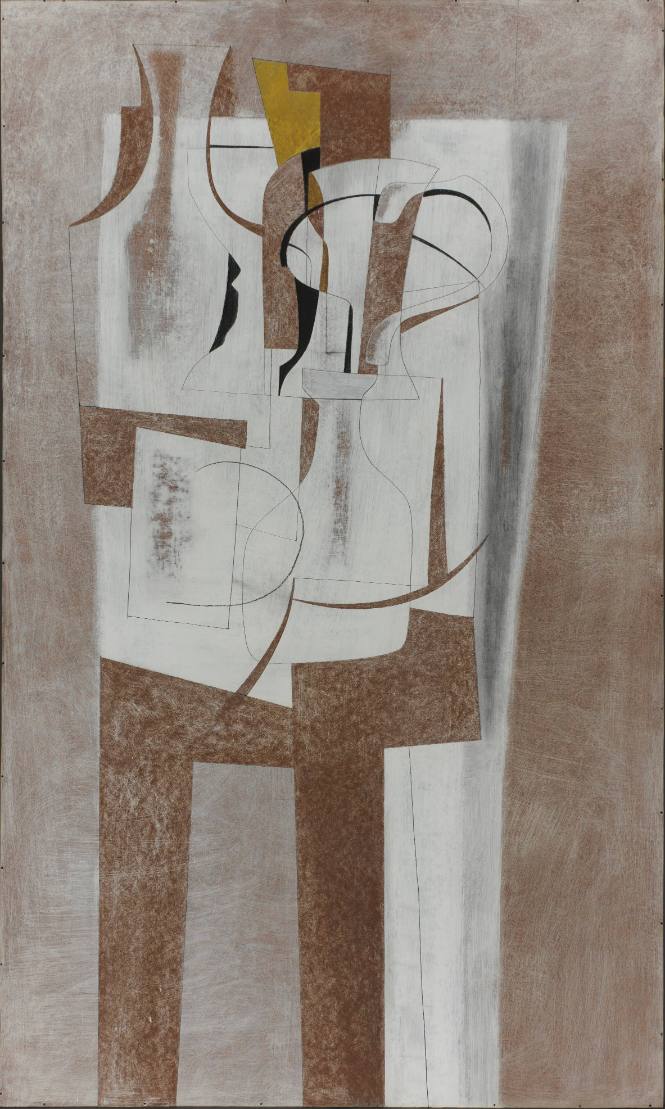
Graffito
Date1955
Artist
Ben Nicholson
(English, 1894-1982)
CultureEnglish
MediumOil and pencil on masonite
DimensionsUnframed: 60 x 36 in. (152.4 x 91.44 cm)
Framed: 62 1/4 x 38 1/8 x 2 1/4 in. (158.12 x 96.84 x 5.72 cm)
Framed: 62 1/4 x 38 1/8 x 2 1/4 in. (158.12 x 96.84 x 5.72 cm)
Credit LinePurchase, Mrs. John D. Rockefeller 3rd (Blanchette Hooker, class of 1931) Fund
On View
Not on viewPeriod20th c
Classification(s)
SignedSigned (verso): Ben Nicholson
InscribedInscribed (verso): March 1955 Graffito
BibliographyMundy, James, The Frances Lehman Loeb Art Center: Vassar College The History and Collection (New York: Prestel Publishing, 2007), p. 132, p. 133 repr. ProvenanceDurlacher Brothers, New YorkExhibition HistoryDurlacher Brothers, New York, October 1956 Sao Paulo, Brazil, “4th Biennial Exhibition,” September-December, 1957
Vassar College Art Gallery, “Art Since 1923: An Exhibition in Honor of Agnes Rindge Claflin,” May 5-June 16, 1965
Williams College Museum of Art, Williamstown, MA, “Williams-Vassar Exchange Exhibition,” February 28-March 18, 1966
Vassar College Art Gallery, “An Exhibition in Memory of Agnes Rindge Claflin 1900-1977,” April 30-June 4, 1978
Des Moines Art Center, “Art in Western Europe: The Postwar Years 1945-1955.” September 19-October 29, 1978
Brooklyn Museum of Art (through Albright-Knox Gallery), “Nicholson Retrospective,” March 17-May 13, 1979
DescriptionBen Nicholson came from a family of English artists. Both his father and mother were successful painters. His career followed a fairly predictable path for a young artist in the twentieth century — some formal training fol- lowed by extensive travel and, finally, a return to England, where he particip- ated in exhibitions in London from the early 1920s onward. He gained an international reputation following the Second World War featuring many in- dividual and group shows in Paris, Athens, Prague, Brussels, Hamburg and Amsterdam, to name a few cities. His art was championed in the United States by Durlacher Brothers, whose director, Kirk Askew, was the step- father of Pamela Askew, a Vassar graduate herself and an important mem- ber of the art faculty beginning in the 1950s. A number of European artists otherwise little known at the time in the United States made their way into Vassar’s collection via this route. Around 1950, Nicholson began a series of major still-life paintings that attempted to integrate Synthetic Cubism with the pure abstraction of Mondrian. It was also a time when the artist was reaching the height of his creative powers. Graffito comes at the very end of this group of paintings but, unlike the others, it is painted on brown masonite that is allowed to show through and becomes an active composi- tion element. The surface is strongly textured and looks ahead to the next phase of abstract reliefs produced after 1955. While Nicholson was well known for his lack of interest in a painting’s title, stating that titles were “literature, not art ... merely a tag,” his choice of a title in this case does lend itself to more a more specific reference to the surface of the painting.
Terms
Object information is a work in progress and may be updated as new research findings emerge.
To help improve this record, please email
loebcollections@vassar.edu


![[Mailboxes in Maine]](/internal/media/dispatcher/18618/thumbnail)