Object number1995.13.6
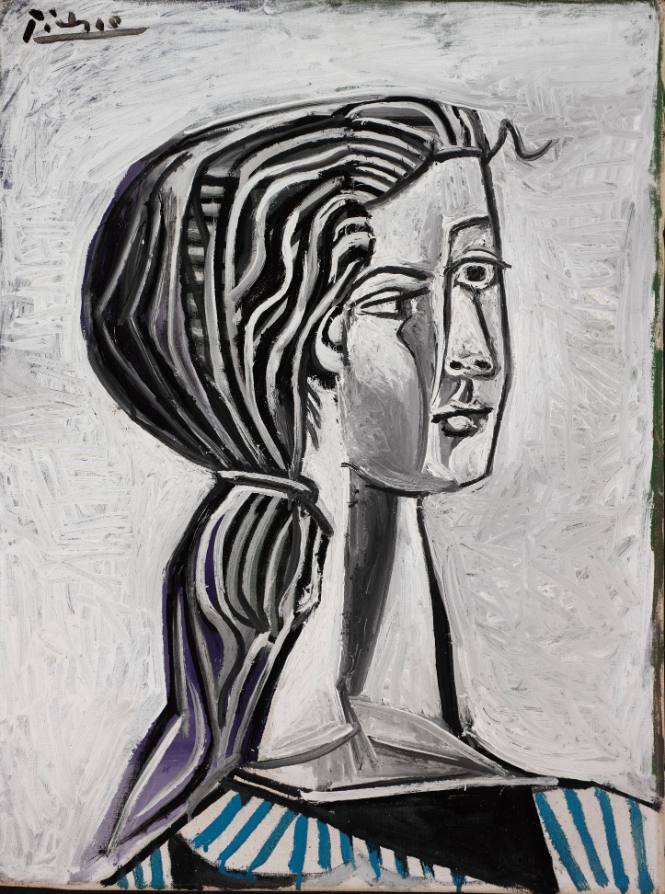
Tête de femme
Date1953-1954
Artist
Pablo Picasso
(Spanish, 1881-1973)
CultureSpanish
MediumOil on canvas
DimensionsFramed: 34 3/4 x 28 7/8 in. (88.27 x 73.34 cm)
Unframed: 24 x 18 in. (60.96 x 45.72 cm)
Unframed: 24 x 18 in. (60.96 x 45.72 cm)
Credit LineGift from the collection of Mr. and Mrs. Alexander E. Racolin
On View
On viewPeriod20th c
Classification(s)
SignedSigned (ULC): Picasso
InscribedInscribed (verso, in charcoal on canvas): 24.3.53. / 23.5.54.; (remnants of purple ink stamp: two on canvas, one on right side of canvas edge); (Three labels on top stretcher): (1 - in pencil): D.110; (2): Perls Galleries / 1016 Madison Ave., New York 21, N.Y. / No. 5862 / Artist Picasso / Tête de Sylvette / d.1954; (3 - torn in half): Galerie L___(missing) / 29 bis, Rue ___(missing) 372 / Pabl___(missing) / Tête de___(missing) 61 x / Photo No. 52844___(missing); (LL stretcher, in white chalk (?)): Mrs. Racolin ___(illegible); (on center stretcher, in black conté): II (in circle); (on top stretcher, in red/pink conté): 12 P; (on top stretcher, in black conté): K
BibliographyMundy, James, The Frances Lehman Loeb Art Center: Vassar College The History and Collection (New York: Prestel Publishing, 2007), p. 110 repr. DescriptionAccording to an inscription in charcoal on the back of this canvas, Picasso worked on the painting from 24 March 1953 until 23 May 1954. It was at this time that Picasso became interested in a young woman named Sylvette David, who worked at a ceramic studio near Picasso in Vallauris, and painted her a number of times. Over the years, the Vassar painting has been ex- hibited under the title Tête de Sylvette and Tête de Femme. While the woman’s ponytail is somewhat suggestive of Sylvette’s Brigette Bardot-like mane, her features, even in Picasso’s most painterly presentations, were finer. Hence, it is more likely that this head is of a more generic sort, painted at a time when Picasso’s position vis-à-vis the women of his life (the departure of Françoise Gilot and the arrival of Jacqueline Rocque) was in a state of significant transition for the seventy-two-year-old artist.
Object information is a work in progress and may be updated as new research findings emerge.
To help improve this record, please email
loebcollections@vassar.edu

![[Mailboxes in Maine]](/internal/media/dispatcher/18618/thumbnail)