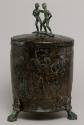
Object numberCC54.001
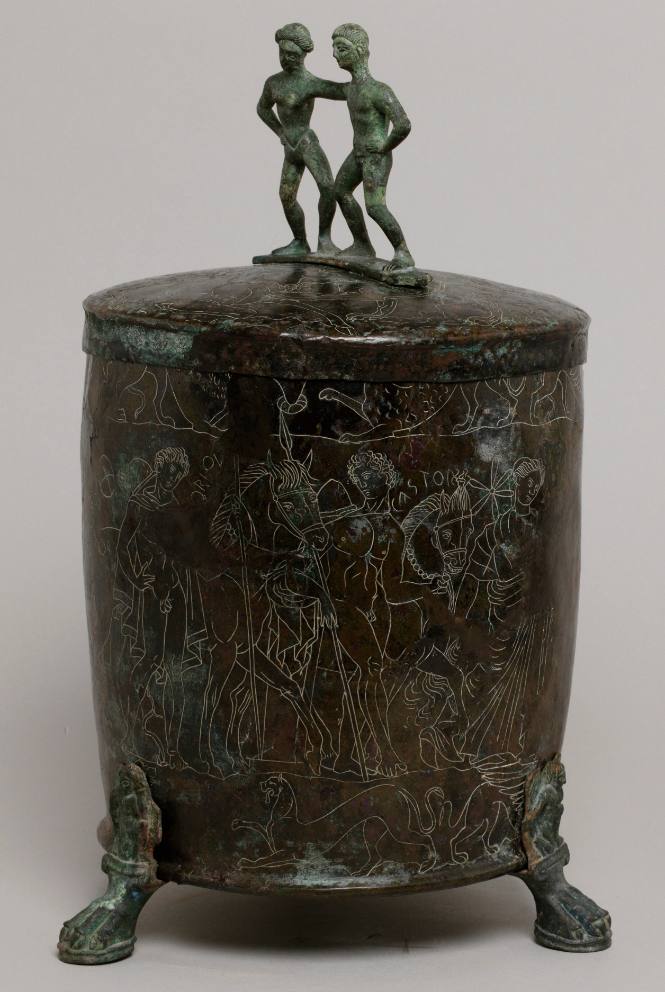
Praenestine cista
Date3rd c BCE
Artist
Italian (Etruscan)
(Italian (Etruscan), NA)
CultureEtruscan
MediumBronze
DimensionsOverall: 14 1/4 × 8 × 8 in. (36.2 × 20.3 × 20.3 cm)
Credit LineTransfer from Vassar College Classics Department, 1968
On View
On viewPeriod3rd c BCE
Classification(s)
Vassar Exhibitions
DescriptionThis bronze container from the ancient city of Praeneste in Etruria (present day Palestrina) is one of over a hundred similar objects discovered in excavations near the site of the once famous temple dedicated to Fortuna. Conventional wisdom holds that they were used exclusively as cosmetic cases for wealthy women, though there is increasing support for the view that they were also used as funerary urns since some have been found to contain ashes. The distinctly masculine iconography of the Vassar cista includes wrestling figures on the handle who could be Peleus and Atalanta grappling at the funeral games of Pelias; figures leading horses labeled “Castor” and “Pollux” (in the archaic spelling “[P]ORLOU[CES]”), and other figures including Silenus with his wineskin, Jupiter (identified as “Dies Pater”), Juno, and Diana. The winged figure leading the procession could be Lasa (or Nemesis), the Etruscan deity of Destiny. The unusual combination of characters and the mistakes in labeling suggest an amalgamation of several narrative prototypes. The cista came to Vassar when it was purchased from the sale of the William Randolph Hearst Collection in 1941. The graceful incised drawing suggests the model from which both Cocteau and Picasso found inspiration for their highly linear styles in the 1930s and 1940s.Terms
Object information is a work in progress and may be updated as new research findings emerge.
To help improve this record, please email
loebcollections@vassar.edu
![[Mailboxes in Maine]](/internal/media/dispatcher/18618/thumbnail)
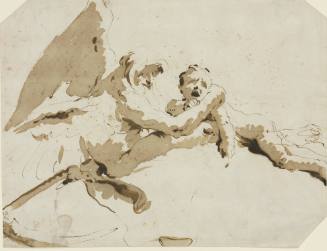
Giovanni Battista Tiepolo
c. 1750
Culture: Italian