Object number1990.14
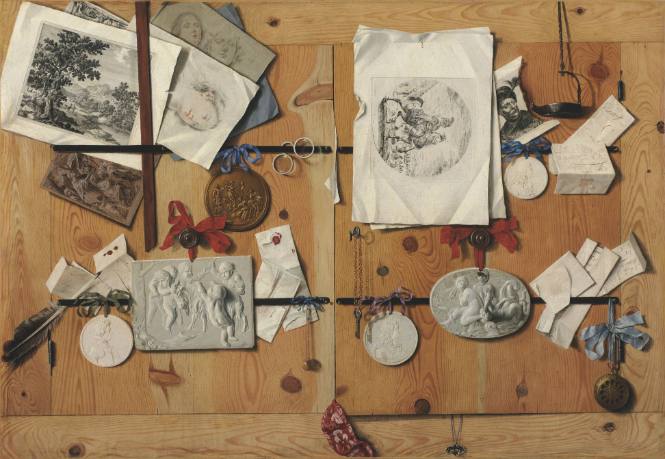
Trompe l'oeil Still-Life of a Letter Rack
DateNd
attributed to
Domenico Remps
(Italian / German, c. 1620–1699)
CultureItalian, German
MediumOil on canvas
DimensionsUnframed: 31 7/8 x 46 1/4 in. (80.96 x 117.48 cm)
Credit LineGift of Henrietta Roig, mother of Josephine Roig Humphrey, class of 1945
On View
Not on viewPeriod18th c
Classification(s)
MarkingsExamined 6/5/06. No further evidence.
BibliographyMundy, James, The Frances Lehman Loeb Art Center: Vassar College The History and Collection (New York: Prestel Publishing, 2007), p. 55 repr.
Ellis, Margaret Holben, ed. Historical Perspective in the Conservation of Works of Art on Paper, (Los Angeles: The Getty Conservation Institute, 2014). repr. ProvenanceGift to FLLAC from Henrietta Roig, mother of Josephine Roig Humphrey ‘45.Vassar Exhibitions
Exhibition HistoryPoughkeepsie, FLLAC, Vassar College, “Second Sight: Originality, Duplicity and the Object,” Jan. 14-Apr. 10, 2005.DescriptionThis is one of a group of paintings of card racks and small objects set against pine cupboards designed to fool the eye by their verisimilitude. They were produced in Italy at the end of the seventeenth and beginning of the eighteenth centuries by a number of little known artists working in a very similar fashion in cities in central and northern Italy. Among the artists linked to the Vassar painting are Antonio Gianlisi the Younger (Veneto 1677–1727); Christoforo Munari (Reggio Emilia 1667–1720); Domenico Remps (Venice late seventeenth century); Antonio Cioci (Florence ca. 1732–1792); Jacopo Palmieri (Turin 1737–1809). The connections derive from the use of the same medals, prints, drawings, and reliefs, as well as other elements, in two or more of the paintings. For example, the small relief plaque of the putti and the goat on the left of the Vassar painting also appears in one by Cioci, as do other elements such as the eyeglasses hanging on the rack, and the red and black chalk drawing of a head of a woman. The prints by Stefano della Bella also turn up in drawings by Palmieri. The keys, timepieces, similarly addressed letters and the staple of trompe l’oeil—the simulated housefly resting on the plaster medallion portraying Glaucus and Scylla — occur in many of these works. In the Vassar painting, there are a number of references to Florence and the Medici, including the appearance of the prints by Stefano della Bella and Jacques Callot, who both worked for the Medici, as well as the plaster medallion in the lower left depicting Francesco de’ Medici (1614–1634), who died of disease at the age of twenty fighting in the Thirty Years’ War. The other medallions portray, in the lower right, Louis XIV of France (1638–1715), the grandson of Marie de’ Medici, and, in the upper right, Cosimo III de’ Medici (1642–1723).
Object information is a work in progress and may be updated as new research findings emerge.
To help improve this record, please email
loebcollections@vassar.edu


![[Mailboxes in Maine]](/internal/media/dispatcher/18618/thumbnail)