Object number1967.27
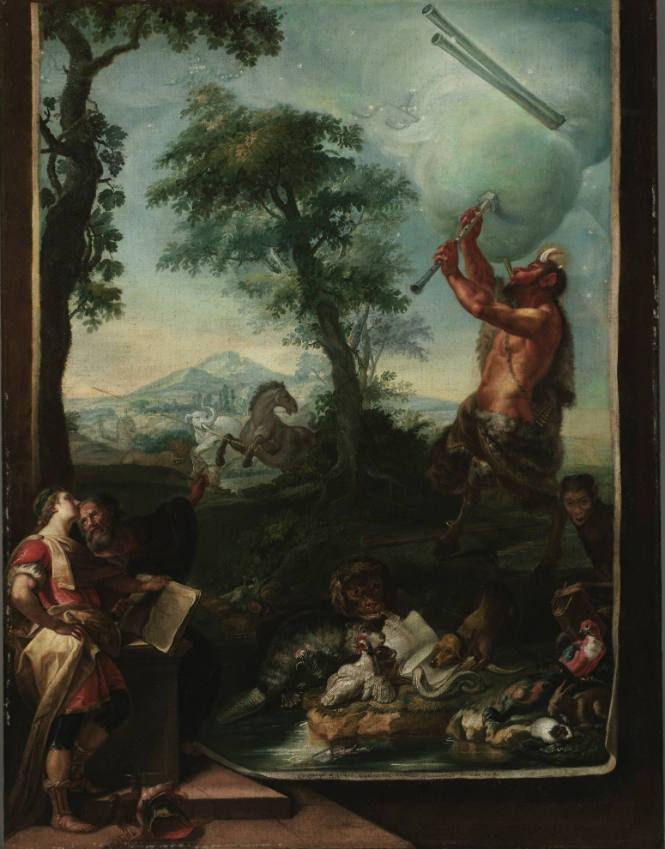
Folly Changing the Course of the Universe
Datebefore 1772
Artist
Felice Boscaratti
(Italian, 1721-1807)
CultureItalian
MediumOil on canvas
DimensionsFramed: 55 1/4 x 45 3/4 x 3 1/2 in. (140.34 x 116.21 x 8.89 cm)
Unframed: 49 1/2 x 38 in. (125.73 x 96.52 cm)
Unframed: 49 1/2 x 38 in. (125.73 x 96.52 cm)
Credit LinePurchase, Friends of Taylor Hall Art Gallery Fund
On View
Not on viewPeriod18th c
Classification(s)
MarkingsNo further evidence. (Examined 6/12/06).
BibliographyMundy, James, The Frances Lehman Loeb Art Center: Vassar College The History and Collection (New York: Prestel Publishing, 2007), p. 56, p. 57 repr.
Lazaro Riveria, La educatione virile nelle quattro tavole inventate dal signor Lazaro Riveria (Verona, 1774). French version dated 1773;
Diego Zannandreis, Le vite dei pittori scultori e architetti veronesi pubblicate e corredate di prefazione e di due indici da Giuseppe Biadego, (Verona, 1891), p. 415;
Thieme-Becker, Kunstler Lexikon (Leipiz, 1910), IV, p. 385;
Francis Haskell, Patrons and Painters, A Study in the Relations between Italian Art and Society in the Age of the Baroque (New York, Knopf, 1963), pp. 326-327; no. 3, p. 327;
Patricia Elesen, ed., “College museum notes,” Art Journal, v. 28, no. 2 (Winter 68/9), p. 190; fig. 6;
“Accessions of American and Canadian Museums, July - September 1968,” Art Quarterly, v. 32, no. 1, p. 75, illus. p. 73;
Loredana Olivato, “Politica e retorica figurativea nella Venezia del Settecento. Alla riscoperta di un pittore singolare: Felice Boscarati,” Arte Venezia, XXXI, 1977, p. 145-156; illus. of dell’Acqua engravings pp. 148-149.ProvenanceCommissioned by Lazaro Rivera. Charles Morrison collection (artist thought to be Lazaro Riveria); sold at Christie’s, July 20, 1956, no. 132 (photograph negative taken at time of sale labelled “An Allegory of Philosophy”); purchased by Arcade Gallery and resold, “Settecento Painting,” February - March, 1957; bought by Goldstein (purchasing agent for Julius Weitzner) at Sotheby’s sale, February 21, 1962, no. 114 (attribution corrected to Boscaratti at this time); purchased by VC Art Gallery by Friends of Taylor Hall Fund from Julius H. Weitzner.Exhibition HistoryNew York, New York, IBM Gallery of Science and Art, July 13 to September 11, 1993, “Highlights from the Vassar College Collection.”
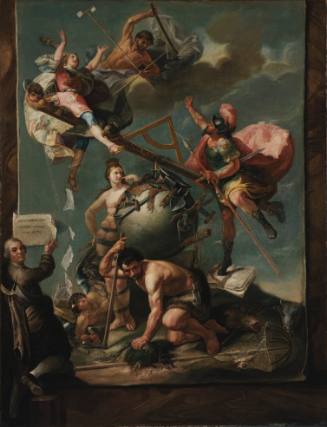
DescriptionThese two paintings comprise half of a commission given to the Veronese painter Felice Boscaratti by a local doctor, Lazzaro Riviera. Their subject mat- ter consists of an allegorical system of almost incomprehensible subtlety drawn up by the commissioner as a series of philosophical lessons for young men. They were so difficult to understand that Riviera had copies engraved after the four original paintings and inscribed with Latin texts. He also pub- lished a pamphlet, La Educazione Virile, in 1773 in an effort to explain the paintings. The paintings were taken to Venice when Boscaratti moved there and they were there when he became the official painter of Giorgio Pisani, who was elected Procurator in 1780. Upon his election, the paintings were hung along a processional route, but their abstruse symbolism was inter- preted by the local Inquisitors as subversive. Fearing sedition, they arrested Pisani four days later, and his artist was directly affected by the disgrace of his patron, at whose trial he was required to testify. While the overall content of the paintings remains obscure, we are able still to understand, in the first painting, the warning contained in the figure of Mars, who treads on a learned tome, unbalancing the equilibrium of the world, while in the other painting, Pan plays his bassoon-like instrument and dances, as wild animals rend apart another expensive volume of learning. Thus, martial and sensual pursuits are the enemies of scholarship, and the arts are victimized by the excesses of passion when it triumphs over reason. These scenes are painted as simulated unstretched canvasses, introduced to the viewer in the Atlas allegory by a contemporary gentleman, who affixes an inscribed sheet of paper to the canvas, and in the Pan allegory by a pair of ancient philosophers or scholars. In the second trompe l’oeil canvas, the curling, unpainted and exposed edge carries an inscription mentioning Lazzaro Riviera.
Object information is a work in progress and may be updated as new research findings emerge.
To help improve this record, please email
loebcollections@vassar.edu
![[Mailboxes in Maine]](/internal/media/dispatcher/18618/thumbnail)