Object number2001.5
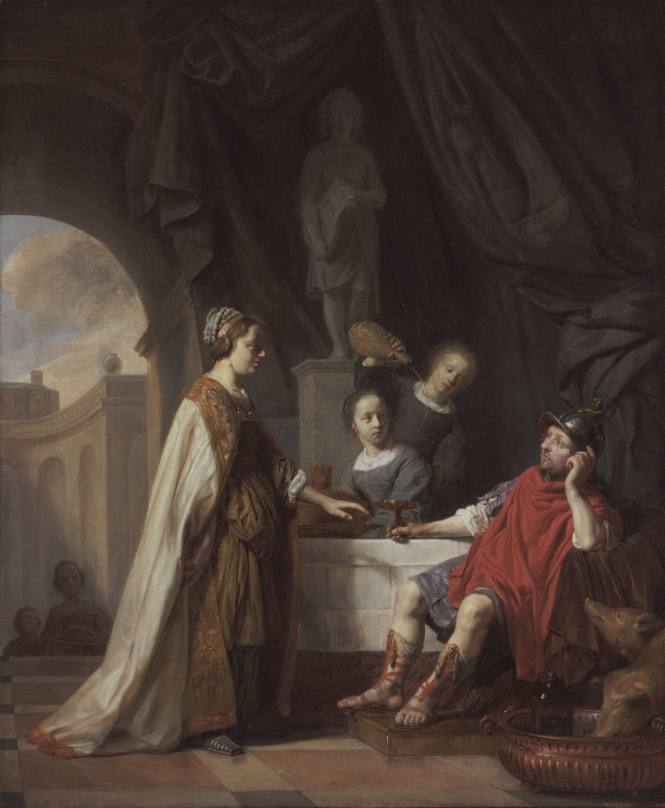
Odysseus and Circe
Datec. 1650
Artist
Salomon de Bray
(Dutch, 1597-1664)
CultureDutch
MediumOil on canvas
DimensionsSight: 43 1/2 × 36 in. (110.5 × 91.5 cm)
Framed: 55 1/8 × 47 5/8 × 3 1/8 in. (140 × 121 × 8 cm)
Framed: 55 1/8 × 47 5/8 × 3 1/8 in. (140 × 121 × 8 cm)
Credit LinePurchase, Pratt Fund; Francis Woolsey and Helen Silkman Bronson, class of 1924, Fund; Betsy Mudge Wilson, class of 1956, Memorial Fund; Suzette Morton Davidson, class of 1934, Fund
On View
Not on viewPeriod17th c
Classification(s)
MarkingsOn verso of stretcher (top):
1. Black stencil reading: 3 3 7 E 0;
On right side of stretcher, verso:
1.Two red wax seals, one with circle and crown reading (?) LI[?]NT VERIT, other upside-down on stretcher with coat of arms bearing a shield and fleur de lys. (See sketches);
2. Paper label reading: 14857.
BibliographyFrans Grijzenhout, "Ferdinand Bol's portrait historie in the Hermitage: Identification and Interpretation," Simiolus, vol. 34, 2009/10, no. 1, p. 45, fig. 9
Mundy, James, The Frances Lehman Loeb Art Center: Vassar College The History and Collection (New York: Prestel Publishing, 2007), p. 46-47, p. 47 repr. ;
J.W. von Moltke, "Salomon de Braij", in: Marburger Jahrbuch für Kunstwissenschaft 11/12 (1938/1939), no. 57, fig. 65;
E.J. Sluijter, De 'Heydensche Fabulen' in de Noordnederlandse schilderkunst, circa 1590-1670, Leiden 1986 (dissertation), pp.54, 55 note 1;
A. Blankert, "Le 'Realisme' de la peinture d'histoire hollandaise au XVIIe siècle", in exh.cat.: Tromph und Tod des Helden, Cologne, Wallraf-Richartz Museum, Zürich, Kunsthaus, Lyon, Musée de Beaux-Arts, 1987-1988, pp.55-56, fig. 24;
A. Blankert, "Onverdragelijk lelijk: het realisme van de Hollandse historieschilderkunst van de 17de eeuw," in: De Eeuwwenden. Deel 3, Utrecht 1990, pp. 23-24, fig. 8;
F. Lammertse, in: exh.cat. Dutch Classicism in seventeenth-century painting, 1999, cat.no. 8, pp. 96-99.ProvenanceSale H. de Leth, Amsterdam, 30 September 1766, lot 7 (to Yver for 73 guilders); Sale Mr. David Fierens Kappeyne, Oudezijds Heeren Logement, Amsterdam, 25 April 1775, lot 7; Sale, Christie's, London, 27 January 1928, lot 148 (as by Pieter Lastman); W.E. Duits, London & Amsterdam; C.D. van der Vorm, Aerdenhout, 1936; Sale, Notarishuis, Arnhem, circa 1975; Private collection, The Netherlands, Albert Blankert; purchase by FLLAC with the Pratt Fund from Jack Kilgore & Co., Inc., 154 East 71st Street, New York, New York, 2001.Vassar Exhibitions
Exhibition HistoryHaarlem, Frans Halsmuseum, 1980 (on loan); Rotterdam, Museum Boijmans Van Beuningen, Dutch Classicism, 25 September 1999 - 9 January 2000;
Frankfurt, Städelsches Kunstinstitut, Dutch Classicism, 9 February - 30 April 2000.
DescriptionSalomon de Braij was born in Amsterdam but had moved to Haarlem by the time he was twenty years old. There he was a student of Hendrick Goltzius and Cornelis van Haarlem. De Braij had a varied career in Haarlem, not only painting portraits and small histories, but also designing silver work and architectural projects. Documents also refer to him as a poet. His portrayal of Odysseus and Circe, the moment when Odysseus seeks to rescue his compan- ions turned into swine by the sorceress, is presented with a high degree of classical decorum, yet also a feeling for common details of behavior, as in the way the hero slouches at the table while holding his wine glass, unable, according to Homer, to eat or drink owing to sadness over the fate of his companions. While the servant pours a long stream of wine into a goblet, the gesture of temperance according to contemporary emblem books, Circe advances, her wand hidden in the folds of her drapery. Her spells will prove ineffective on Odysseus owing to an herb he was given by Hermes to neutral- ize Circe’s powers. While the painting takes place in a classical palace decor- ated with sculpture including a figure of Apollo, the father of Circe, the figures themselves suggest the plain features of the contemporary Dutch middle-class rather than the exotic or heroic appearance of mythical charac- ters. The presence of the pigs, wine cooler, and the servants gives the scene an everyday quality. Thus, the painting is to some extent history and to an equal extent a genre presentation.
Object information is a work in progress and may be updated as new research findings emerge.
To help improve this record, please email
loebcollections@vassar.edu
![[Mailboxes in Maine]](/internal/media/dispatcher/18618/thumbnail)
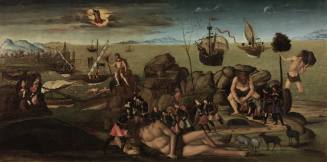
The Master of the Johnson Assumption of the Magdalen
Early 1500s
Culture: Italian
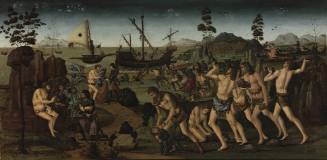
The Master of the Johnson Assumption of the Magdalen
Nd
Culture: Italian