Object number1941.1.25
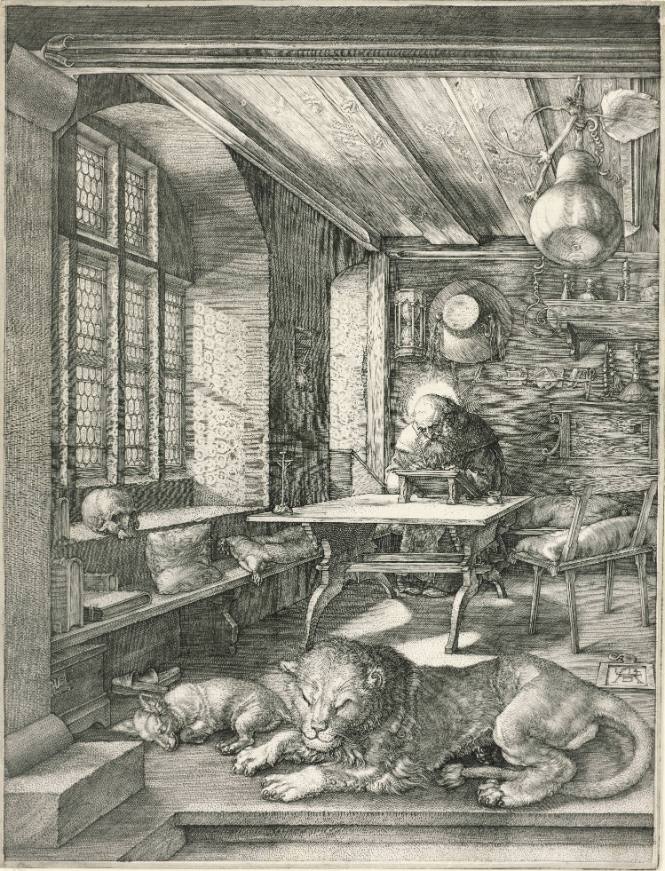
St. Jerome in his Study
Date1514
Artist
Albrecht Dürer
(German, 1471-1528)
CultureGerman
MediumEngraving on cream laid paper
DimensionsImage: 9 3/4 x 7 1/2 in. (24.77 x 19.05 cm)
Credit LineGift of Mrs. Felix M. Warburg and her children
On View
Not on viewPeriod16th c
Classification(s)
SignedSigned: AD
Catalogue raisonnéBartsch 60; Meder 59; Panofsky 167; Strauss 77BibliographyMundy, James, The Frances Lehman Loeb Art Center: Vassar College The History and Collection (New York: Prestel Publishing, 2007), p. 35, p. 34 repr.; Limouze, Dorothy and Susan Kuretsky. The Felix M. Warburg Print Collection: A Legacy of Discernment . Poughkeepsie, N. Y.: The Frances Lehman Loeb Art Center, Vassar College, 1995.
Bartsch 60; Meder 59; Panofsky 167; Strauss 77; Limouze 10ProvenanceCollections: Felix M. and Frieda Warburg, New YorkVassar Exhibitions
Exhibition History"Master Printmakers: Albrecht Dürer and the Renaissance in Germany," Worcester Art Museum, Worcester, MA, 21 December 1991 - 15 March 1992;Frances Lehman Loeb Art Center at Vassar College Poughkeepsie, NY SECOND SIGHT: Originality, Duplicity, and the Object January 14-April 10, 2005;
Poughkeepsie, New York, FLLAC "Albrecht Durer: Impressions of the Renaissance," 14 November - 24 December 2009.
Poughkeepsie, New York, The Frances Lehman Loeb Art Center, Vassar College, "Mastering Light: From the Natural to the Artificial," April 11 - June 29, 2014.
Poughkeepsie, New York, The Frances Lehman Loeb Art Center, Vassar College, "A Museum Menagerie: Highlights from the Permanent Collection," April 25 - August 13, 2017
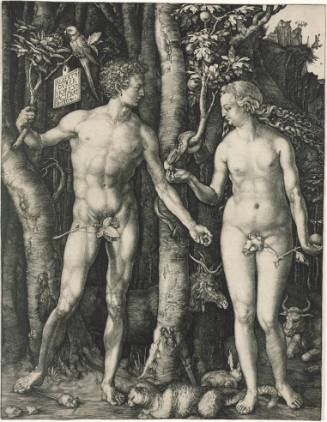
DescriptionDürer devoted the years 1513/14 largely to the art of engraving. During these years he produced three large engravings of both visual and iconographic complexity—The Knight, Death and the Devil; Melencolia I; and Saint Jerome in his Study—collectively known as the Meisterstiche (masterpieces of engrav- ing). In his image of Saint Jerome, Dürer surpasses even his Adam and Eve in terms of the subtlety of the use of his engraver’s tools to suggest not only the soft light filtering into the saint’s scholarly chamber, but also the textures of the wood grains on the interior and the soft fur of the sleeping lion and dog in the foreground. The perspectival organization of the scene is very strictly laid out according to scientific principles well known to Dürer and illustrated in the treatise on drawing that he produced late in his life. The sophistication of the dappled patterns of light playing across the surfaces of the room is far beyond that of any artist’s printmaking achievements of the day. It is no wonder that Dürer gave this print to his hosts and the dignitaries he met during his travels.
Object information is a work in progress and may be updated as new research findings emerge.
To help improve this record, please email
loebcollections@vassar.edu