Object number1981.8
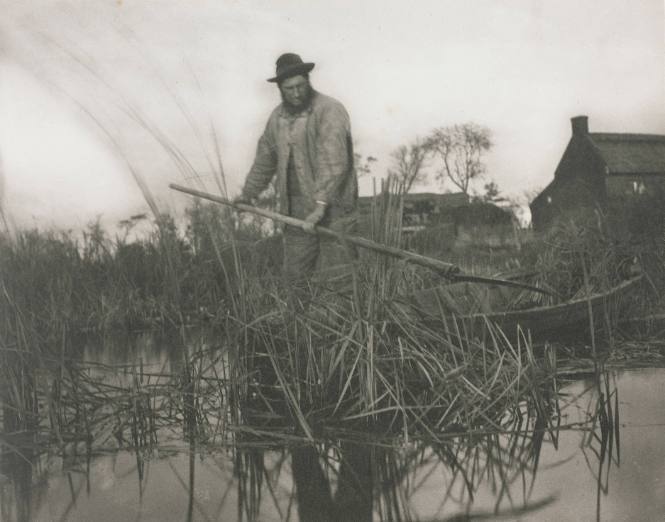
Cutting the Gladdon (from "Life and Landscape on the Norfolk Broads")
Date1886
Artist
Peter Henry Emerson
(English, 1856-1936)
CultureEnglish
MediumPlatinum print
Editionplate 32
DimensionsMatted: 16 x 22 in. (40.64 x 55.88 cm)
Sheet: 7 7/16 x 9 1/2 in. (18.89 x 24.13 cm)
Sheet: 7 7/16 x 9 1/2 in. (18.89 x 24.13 cm)
Credit LinePurchase, E. Powis and Anne Keating Jones, class of 1943, Fund
On View
Not on viewPeriod19th c
Classification(s)
SignedNot signed or dated
InscribedNot inscribed
BibliographyMundy, James, The Frances Lehman Loeb Art Center: Vassar College The History and Collection (New York: Prestel Publishing, 2007), p. 83 repr. Vassar Exhibitions
Exhibition HistoryPoughkeepsie, New York, FLLAC(Prints and Drawings Gallery), Vassar College, "Revealed Anew: Selections from Permanent Collections," 7 November - 4 January 2008;Poughkeepsie, NY, FLLAC, Vassar College, "The Friends Focus: On Photography," December 7, 1989 to February 11, 1990.
DescriptionCutting the Gladdon is one of forty studies of rural labor that comprise Peter Henry Emerson’s portfolio Life and Landscape on the Norfolk Broads (1886). The careful staging of Emerson’s genre scenes of cane workers recalls the studio- based imagery of earlier Victorian camera artists, but Emerson’s platinum prints differed crucially in their intended simulation of the qualities of human vision. In the name of what he called “naturalistic photography,” Emerson focused his camera, like an eye, upon specific details within a larger scene, thus imparting a softening burr to all surrounding phenomena. By promoting the meaningful use of selective focus, and by accepting blurred gestures as the result of photographing people in action, Emerson signaled the beginnings of a modernist mode of photography that took authenticity for its chief concern. “Never shall we attain to the true secret of happiness,” he wrote, “until we identify ourselves as part of nature.” The credo is reflected in his subject matter and methods alike: Emerson’s attention to East Anglia’s rustic fen residents and his reliance upon scientific theories of optics signal his alert, if romanticized, conception of mankind’s place in a larger scheme of nature.
Object information is a work in progress and may be updated as new research findings emerge.
To help improve this record, please email
loebcollections@vassar.edu

![[Mailboxes in Maine]](/internal/media/dispatcher/18618/thumbnail)