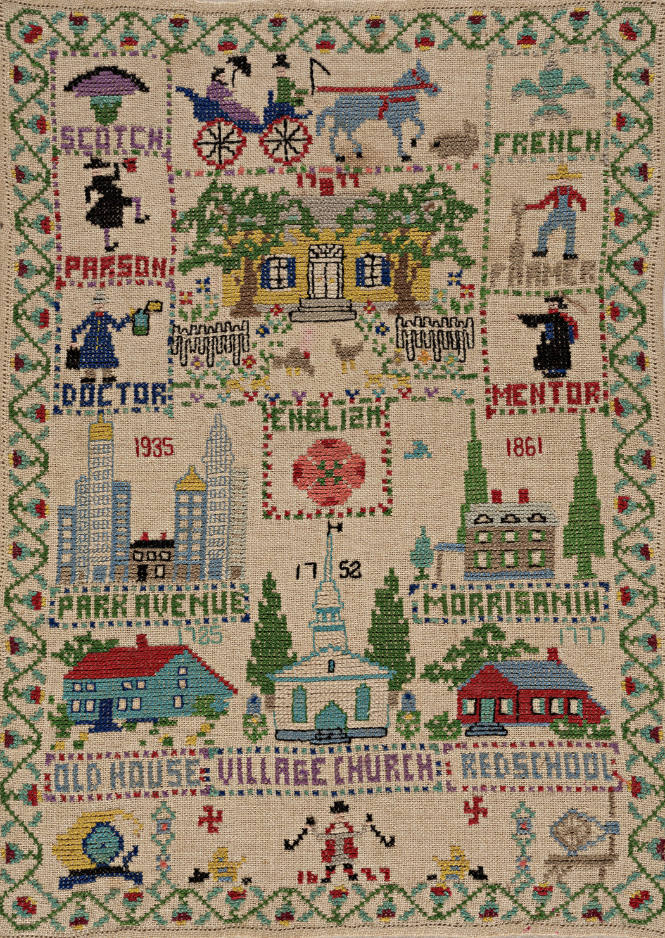
Object number1960.9.130
Sampler
Datec. 1935
Artist
Currently Unidentified
CultureAmerican
MediumCotton threads on linen ground
DimensionsOverall: 13 1/8 x 10 1/4 in. (33.3 x 26 cm)
Matted: 22 x 16 x 1/4 in. (55.9 x 40.6 x 0.6 cm)
Matted: 22 x 16 x 1/4 in. (55.9 x 40.6 x 0.6 cm)
Credit LineGift of Mrs. James W. Packard (Elizabeth Gillmer, class of 1894)
On View
Not on viewPeriod20th c
Classification(s)
InscribedSCOTCH / PARSON / DOCTOR / 1877 / FRENCH / FARMER / MENTOR / 1935 / ENGLISH / 1861 / PARK AVENUE / 1752 / MORISANIH / 1785 / 1777 / OLD HOUSE / VILLAGE CHURCH / RED SCHOOL
DescriptionA Second Colonial Revival sampler commemorating the history of New York City. The lower half depicts the following: a traditional dwelling between two skyscrapers, 1935; a Tudor rose, St. George's Episcopal Church, 1752; a red school house and federal style home, 1777; a Long Island style saltbox house 1785; a two-story mansion with dormers, 1861, with "MORRISANIH" below (probably referring to the Morris estate in the Bronx.The dates recorded are: 1697, which is the Dutch purchase of Manhattan Island; 1752, which appears below a Tudor rose and above an image of St. George's Episcopal Church, built in that year; 1777, which appears above the red school house and above the federal style house; 1785, is stitched near a Long Island style saltbox house; and 1861, below a two-story mansion with dormers and the label MORRISANIH probably referring to the Morris estate in the Bronx. 2 columns of three labeled boxes each appear along the sides in the upper half of the composition, reading from the top 1) "Scotch: below a thistle and "French" below a fleur-de-lys (these two flanking a horse and carriage) 2) a "parson" and a "farmer" 3) a "doctor" and a "mentor".
A traditional dwelling pictured between 2 skyscrapers is labeled 1935. An enigmatic circular motif in the lower left corner is contrasted with a spinning wheel in the lower right and may allude to the Perisphere, which was one of the main attractions of the 1939 New York City World's Fair. The swastikas seen on either side of a small figure in 18th-century red uniform are an ancient decorative motif found in many cultures but seem oddly out of place given the heightened sensitivities to that particular symbol in the late 1930s. The composition is completed with a red and green floral border.
Object information is a work in progress and may be updated as new research findings emerge.
To help improve this record, please email
loebcollections@vassar.edu
![[Mailboxes in Maine]](/internal/media/dispatcher/18618/thumbnail)
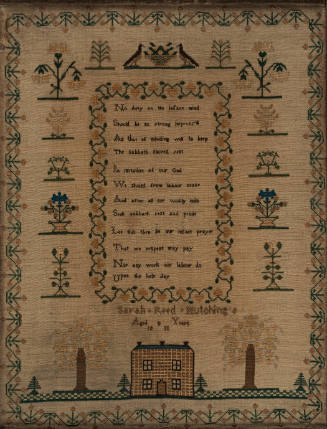

The Master of the Johnson Assumption of the Magdalen
Early 1500s
Culture: Italian
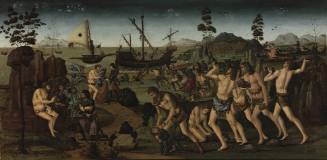
The Master of the Johnson Assumption of the Magdalen
Nd
Culture: Italian