![[Mailboxes in Maine]](/internal/media/dispatcher/18618/preview)
Object number2004.22
[Mailboxes in Maine]
Datec. 1940
Artist
Harry A. Packard
(American)
CultureAmerican
Medium137 gelatin silver prints, many with hand coloring, and newspaper clippings, mounted in album with 4 loose prints
DimensionsFolded/Closed: 10 x 13 x 1/2 in. (25.4 x 33 x 1.3 cm)
Credit LinePurchase, Horace W. Goldsmith Foundation Fund
On View
Not on viewPeriod20th c
Classification(s)
InscribedSee description
BibliographyBrier, Jessica D.. On the Grid: Ways of Seeing in Print. Poughkeepsie, NY: Vassar College in association with Scala Arts Publishers, Inc., 2022, pl. 4 ProvenancePurchased from Winter Works on Paper, Inc.Vassar Exhibitions
Exhibition HistoryOn the Grid: Ways of Seeing in Print, Frances Lehman Loeb Art Center, Vassar College, Poughkeepsie, NY, August 20 - December 22, 2022DescriptionNewspaper clippings and 137 gelatin silver prints of mailboxes mounted to black paper pages within a pressed paper-board album bound with black cord, with four additional prints and a newspaper clipping in an accompanying envelope inscribed "Florence C. Mart[au?]" in ink. Four newspaper clippings on the first two pages read: Curious And Original Mail Boxes Line Country Roads In Maine.; Portland, Maine November 3, 1940; Harry A. Packard Photos. / Top, left to right, shows the regulation parcel post box, ap- / proved by the postmaster general, but ingeniously hung by a Minot / farmer who got tired of having the snow plows push his mail box / from the post and used this well-sweep and chain to hold his box / when winter snow cover the highways. Number 2 is a nail keg / mounted on the end of the post beside the highway, so tilted that / rain does not get into the barrel and wet the letters. Number 3 / once was a five gallon oil can which had done its term of duty in / delivering the kerosene to the prosperous farm house prior to the / installation of electric lights. With one end punched out it now / receives the daily mail. / At extreme right is a more pretentious mail box in as much as / it has slab sides. First the farmer made a wooden box with a rain- / shedding peaked roof. Onto the sides of this box he fastened slabs / of birch, cutting one slab over the door way to aide the delivery man. / The box is weather defying. / Below, left, is a Waterford mail box. Here the householder has / built a trim little replica of his own cottage, framed the holes for / windows and carefully painted the box. A regulation flag is mount- / ed at the top of the cottage which raises and lowers. When the / mail man has letters or papers for the householder he pulls up the / little flag to let them know there is need of attention. / In center: Here is a large wooden box used for the parcel post / with a canvas bag (which may be seen hanging from the opening) / for the letters. The markings on the electric light pole have noth- / ing to do with the mail box although it serves a useful purpose / both to the delivery postman and the householder .When either / reach pole numbered 405-9 they are hmm or have reached this / particular mail box! / At right is a style of simple country cottage in replica as a de- / livery box for the rural mail carriers.; "Waiting for the mail!" / What romantic and exciting / histories have the mail sys- / tems of the world. From time immemorial, mankind had / kept alive the kindred ties of / his own clan by means of / sending communications back / and forth. / The mail as we now know it is / new compared to that in other na- / tions. Our own postal system does not / date back a century yet. The first ad- / hesive postage used in the United / States was in 1847 thus we have seven / years to go before the 100th anniver- /sary of the famous old 5 and 10 cent stamps. Prior to that occurrence / there were Brattleboro stamps and / stamps by the Postmaster of New / York, etc. Bur this is a story of the mail boxed Maine fold use today. / There are intersection in Maine / where there are lined-up all the way / from a dozen to 25 mail boxed all the / same shape and size. There are per- / haps more curious mail boxed in use / in Maine than these shown, but this / article merely shows a few of the / boxes in use in Oxford county, boxes / one passes in an afternoon's ride / through the Waterfords and along / Lake Kear in Lovell. Perhaps this / section of Oxford county has more of / the odd boxed than any other section. / Rural mail delivery, has, of course / changed the mail business of all the / country. Gone in most places is the / old corner grocery with its little par- / titioned postoffice corner not unlike / a telephone booth-in shape anyway! / Many lament the passing of the old / store with its box stove in the cen- / ter, with the sawdust ring build about / the legs of the stove. / The Old Squire as the late C. A. / Stephens of Norway, famous writer / for the Youths Companion, often / was called, was a good example of the / sturdy old folk who lent charm to / the oldtime postoffices. Although he / could write his check in many figures / the loveable old man would wind his / great red scarf about his neck and / plod through the snow down to Jack / Smith's store to get his evening's / mail. The more blustery the day, the / frostier the winds which swept across / Pennesseewassee the more the old / gentleman loved the tramp. Into the / store he would come bustling and / puffing, shaking the snow from his / great outside coat. That was true de- / mocracy! / Douglas Volk who painted so many / of the Lincoln Portraits, and whose / father made a cast of Abraham Lin-; coln, was one of the first in the Lake / Kezar section of put out one of these / odd mail boxes. Though he could have / bought any regulation mail box which / any concern makes under postmater / general approval Mr. Volk preferred / to have his letters, though many of / them were of great importance, de- / livered in his home-made wooden / mail box. / Bankers and broker alike along the / shore of the Maine lakes who ride / to town in high priced automobiles / with chauffeurs have erected by the / road side, a mail box knocked togeth- / er with a few boards and some birch / bark, or have apparently grabbed up / an old five gallon oil can, a nail keg / or what have you and placed it on / the end of a post set beside the high- / way. / These boxes are for the rural mal / delivery. This system of delivery of / our mail has changed the old meth- / ods of appointing the country folks / postmasters at about every cross- / roads. / True much of the romance of old / New England and our own mail dis- / appears when the RFD supersedes / the hamlet postmasters but the de- / livery service is speeded up and is / many times more efficient. The list of post offices throughout / Maine that have been discontinued / through lack of patronage and the / fact that the RFD and the Star / Routes can better service growing and / improving America is a long one. The / list is in fact so long that many Maine / persons who are philatelically inclined / now "collect" what they choose to / call "obsolete postmarks." Recently / they added Canton Point to the list / and while against this is not a story of / all the postoffices in Maine which / no longer "are" one can mane doz- / ens of them from memory. / For instance there is Grafton. / Thirty years ago Grafton had 28 fam- ; liies living within the confines of the / town. A short time ago the last of / the inhabitants ceased to be. His / house is still lstanding and it is pos- / sible that is may be inhabited but / there are probably none of his des- / cendants who will live there. When / Grafton was flourishing it was quite / a town linking North Newry with Up- / ton. Grafton postmarks are scarce / but not as scarce as some of the other / old=time centers in that section such / as "Meadows" in the Parmacheene / region of "Ketchem." / There was North Paris and Snow / Falls, and a queer one, Sucquor Har- / bor and so named because of the brook that flows through it, but an / old yellowed letter recently discover- / ed shows that the spelling used in / Civil War times was Sucquor Barbor. ? For awhile the philatelists thought / they had an explanation to the name / with the spelling sucker, like brook / suckers, but now they are more mysti- / fied than ever. / There was Greenwood City. This was / in the mud point section and destined / to become quite a place. The direct / road from Portland to Bethel is / through Norway not South Paris and / up through the northern part of the / town into Lockes Mills. The railroad / however went the other way - through / South Paris. / And thereby hangs an-/ other tale. And when the State Highway was / located through this section it was by / the way of South Paris into Sucquor / Harbor into Bryant Pont rather than / the direct route.
Terms
Object information is a work in progress and may be updated as new research findings emerge.
To help improve this record, please email
loebcollections@vassar.edu
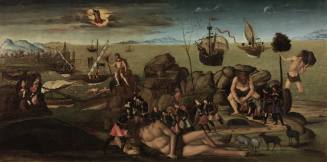
The Master of the Johnson Assumption of the Magdalen
Early 1500s
Culture: Italian
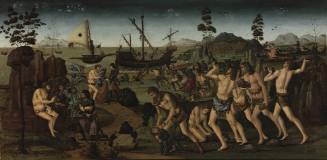
The Master of the Johnson Assumption of the Magdalen
Nd
Culture: Italian