Object number1987.4.4
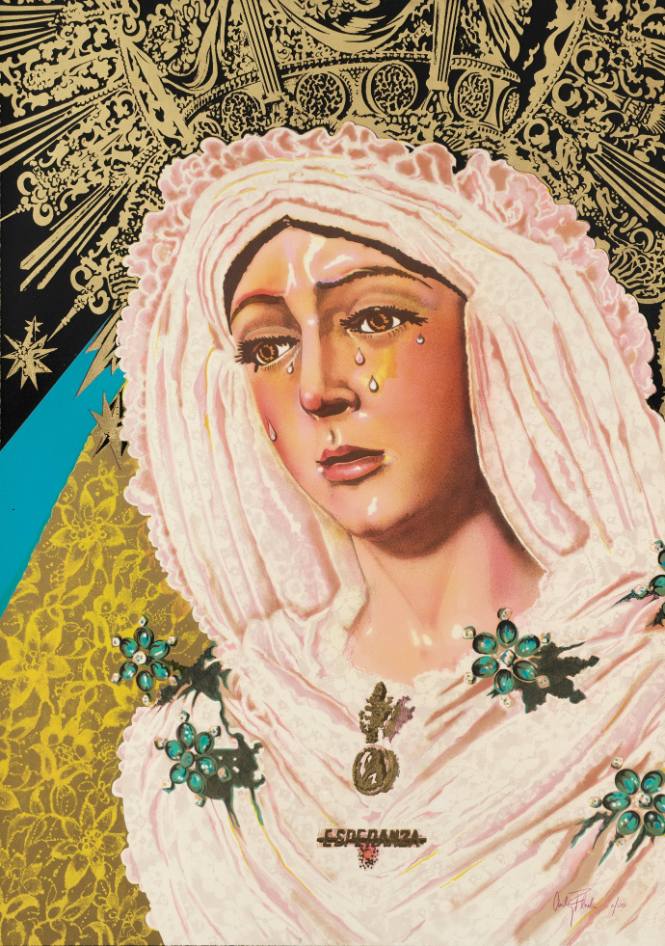
Lady Madonna
Date1972
Artist
Audrey Flack
(American, 1931- 2024)
Publisher
Shorewood Atelier, Inc.
(New York)
CultureAmerican
MediumLithograph and screenprint
EditionEdition 2 of 150
DimensionsImage: 34 x 24 in. (86.4 x 61 cm)
Credit LineGift of Dr. Samuel S. Mandel
On View
Not on viewPeriod20th c
Classification(s)
SignedOn recto, signed lower right: Audrey Flack
InscribedOn recto, by artist, lower right: 2/150
Vassar Exhibitions
Label TextSpirituality and religion can be a realm in which one receives and gives care. Often, care manifests in spiritual spaces through communal worship or through praying for the wellbeing of others. There can also be an exchange of care between the living and the dead, and more personal forms of devotion to a higher power through the use of votives and offerings.
Both Manuel Álvarez Bravo and Audrey Flack explore the theme of religious devotion. Bravo’s photograph depicts an Indigenous Mexican votive offering, while Flack’s print shows a weeping Madonna she encountered at the Cathedral of Seville in Spain. Both artists represent figures or objects used for worship. Bravo’s use of light and shadow creates a stark contrast to highlight the careful beadwork and stitches of the votive offering, while Flack focuses on a figural subject, using rich colors to adorn and highlight the Madonna. In many religions, worshipers offer candles, flowers, and other items as votive offerings, hoping for their prayers to be answered. Making an offering in the hope of having a prayer answered represents an exchange of care. Even prayer itself may serve as an act of care; one may pray for their own wellbeing or that of another person—offerings may also be made in place of or for another person. Care is then reciprocated when the worshiper’s prayer is answered.
DescriptionA bust-length depiction of the Virgin Mary with tearing dripping down her face and adorned with a golden crown and golden rays. She is veiled in a pinkish-white garment with lace-like patterning and green jewels lifting off the fabric. A gold medallion lays atop her chest and underneath is written "ESPERANZA" with a small circle of red below.
Object information is a work in progress and may be updated as new research findings emerge.
To help improve this record, please email
loebcollections@vassar.edu
Currently Unidentified
c. 1850
Culture: Indian, Pahari (possibly Guler Workshop)
Currently Unidentified
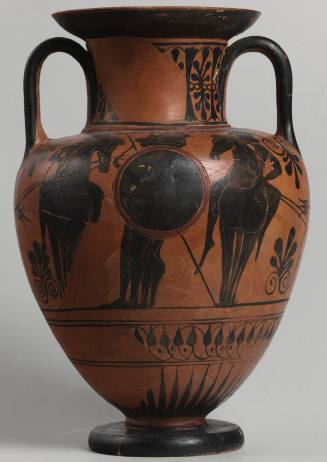
c. 540-520 BCE
Culture: Greek