
Object number2002.14.1
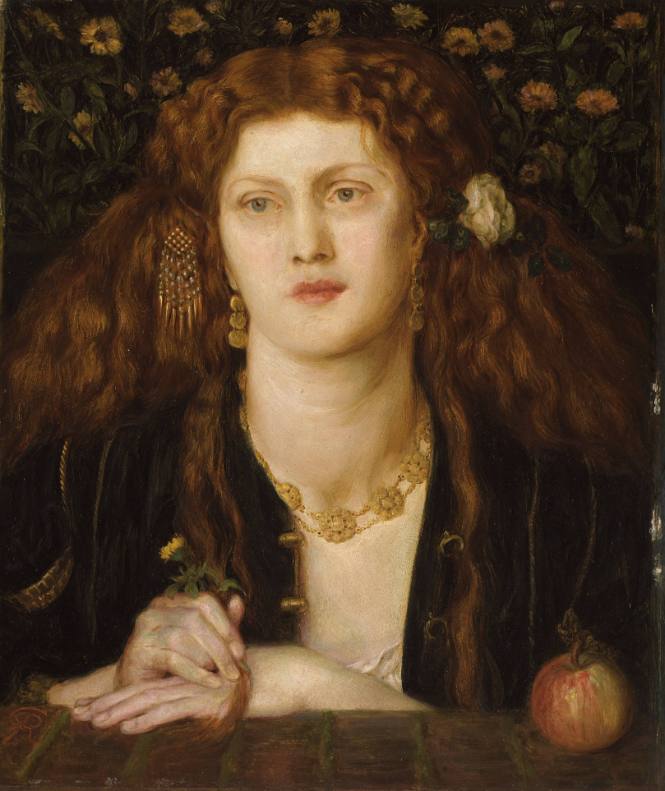
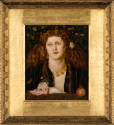
Bocca Baciata
Datec. 1897
Artist
Charles Fairfax Murray
(English, 1849-1919)
after
Dante Gabriel Rossetti
(English, 1828-1882)
CultureEnglish
MediumOil on panel
DimensionsSight: 12 13/16 x 10 3/4 in. (32.5 x 27.3 cm)
Framed: 21 7/16 x 19 3/8 x 2 3/8 in. (54.5 x 49.2 x 6 cm)
Framed: 21 7/16 x 19 3/8 x 2 3/8 in. (54.5 x 49.2 x 6 cm)
Credit LineBequest of Suzette Morton Davidson, class of 1934
On View
Not on viewPeriod19th c
Classification(s)
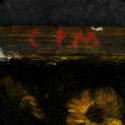
SignedOn recto under lip of frame, upper left corner in red paint: CFM
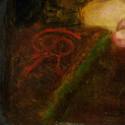
InscribedOn recto, by artist, lower left corner in red paint: DGR[monogram];
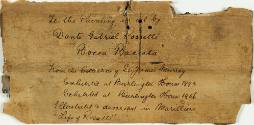
On reverse of panel, by unidentified hand, in ink: Lo the Painting in oil by / Dante Gabriel Rossetti / "Bocca Baciata" / From the Collection of Sir James Murray / Exhibited at Burlington House 1883 / Exhibited at Burlington House 1906 / Illustrated + described in Marillier's / "Life of Rossetti";
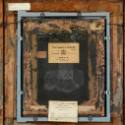
label from Agnew Galleries, London, 1961, Loan Exhibition (printed) and typed: (Artist) D. G. Rossetti / (Title) Bocca Baciata / (Owner) The Lord Nathan / (No. in Exhibition) 55.;
label from Thomas Agnew & Sons Ltd stamped no: 14685
BibliographyDelaware Art Museum. Delaware Art Museum Occasional Paper. Number Two, February 1980, p. 137;
Faxon, Alicia Craig. Dante Gabriel Rossetti. New York: Abbeville Press, 1989;
Lane, Allen. The Pre-Raphaelites. London: Tate Gallery, 1984, p. 24 (illustrated);
Mander, Rosalie. "Rossetti's Models." Apollo: The Magazine of the Arts, July 1963, p. 18 (illustrated);
Surtees, Virginia. The Paintings and Drawings of Dante Gabriel Rossetti (1828-1882): a Catalogue Raisonné. Oxford: Clarendon Press, 1971, p. 68 (partial provenance and exhibition information listed with Rossetti's original);
Parisi, Francesco, Liz Prettejohn, and Peter Trippi. Preraffaelliti: Rinascimento Moderno, Italy: Dario Cimorelli Editore, 2024, pp. 363, 541
ProvenanceSir James Murray; William Randolph Hearst (by 1952);
Agnew's in 1952 then sold to Lord Nathan;
(after 1961) Suzette Morton Davidson
Vassar Exhibitions
Exhibition HistoryLoan Exhibition of Victorian Painting 1837-1887: In Aid of the Victorian Society, Agnew's, London, November - December 1961, no. 55; Second Sight: Originality, Duplicity, and the Object, Frances Lehman Loeb Art Center, Vassar College, Poughkeepsie, NY, January 14 - April 10, 2005;
Pre-Raphaelites: A Modern Renaissance, Musei San Domenico, Forlì, Italy, February 24 - June 30, 2024
Label TextA painting with mysterious origins, Bocca Baciata (Lips That Have Been Kissed) reveals the portrait of a sensuous woman, Rossetti’s mistress and favorite model, Fanny Cornforth, with fiery red hair amidst a bed of Marigolds. On its reverse side, a section of Giovanni Boccaccio’s fourteenth century collection of tales, The Decameron, reads:
Bocca Baciata non perda ventura,
Anzi Rinova come fa la luna
(The mouth that has been kissed loses not its freshness,
Still it renews itself even as does the moon.)
The Pre-Raphaelite Dante Gabriel Rossetti painted two versions of this painting in 1859, one now in the Museum of Fine Arts Boston and the other possibly lost. Charles Fairfax Murray, an artist and collector who was Rossetti’s student from 1869 to 1870, owned one of these paintings, and copied it in 1897. It has been assumed that this is Murray’s copy owing to the appearance of his initials on the margin of the wood panel underneath the edge of the frame. In addition, questions regarding the authenticity of this work arise from close inspection of the two artists’ differing approaches to an identical subject.
DescriptionPortrait of a woman, Fanny Cornforth, with long wavy hair depicted from the chest up with her hands resting in front of her holding a small yellow flower. She's adorned with golden jewelry, wears an open black garment with gold trimmings and a white garment underneath, and has a pale colored flower pinned in her hair. An apple sits to the right of her and orangish-yellow flowers fill the background behind her head.
Object information is a work in progress and may be updated as new research findings emerge.
To help improve this record, please email
loebcollections@vassar.edu
Currently Unidentified
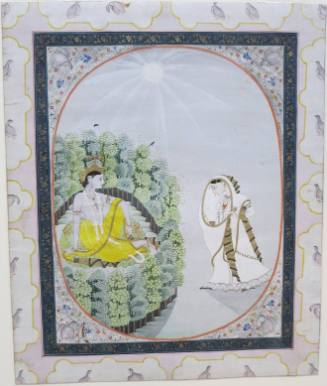
c. 1850
Culture: Indian, Pahari (possibly Guler Workshop)
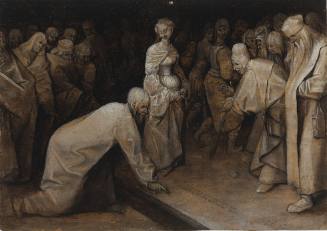
Studio of Pieter Brueghel the Younger
after 1565
Culture: Flemish