Object number2021.2
Marie Antoinette
Portfolio/Seriesfrom the Great Ladies Series
Date1973
Artist
Judy Chicago
(American, born 1939)
CultureAmerican
MediumFour-color stone lithograph on cotton paper, printed 2017
EditionEdition 19 of 20 plus 3 artist's proofs, 2 trial proofs
DimensionsImage: 19 7/8 x 19 7/8 in. (50.5 x 50.5 cm)
Sheet: 26 1/4 x 25 3/4 in. (66.7 x 65.4 cm)
Matted: 38 x 36 in. (96.5 x 91.4 cm)
Sheet: 26 1/4 x 25 3/4 in. (66.7 x 65.4 cm)
Matted: 38 x 36 in. (96.5 x 91.4 cm)
Credit LinePurchase, gift of Mrs. Frederick Ferris Thompson, by exchange
Period20th c
Classification(s)
SignedOn recto, signed lower right margin in pencil: Judy Chicago
InscribedOn recto, by artist, lower right margin: 2017; center: 19/20; lower left [underlined]: Marie Antoinette 1973/2017
ProvenancePurchased from Salon 94Vassar Exhibitions
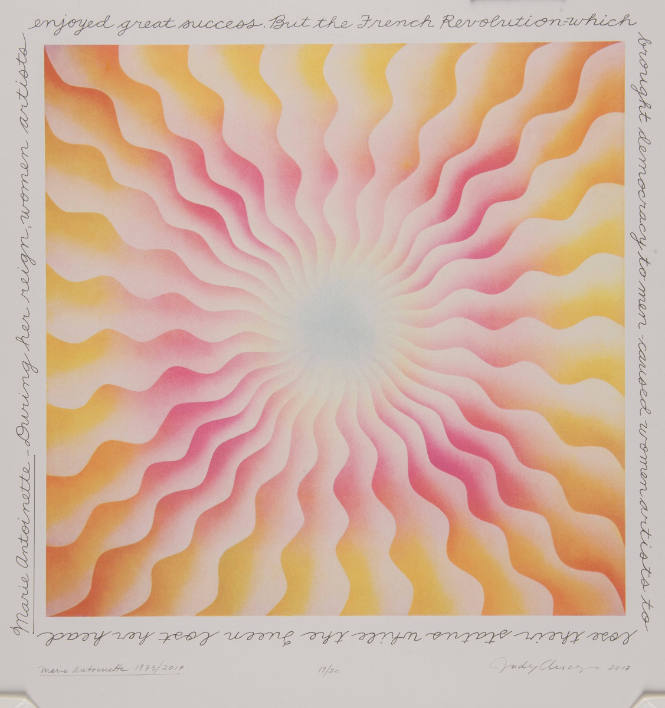
Label TextThis vivid lithograph by feminist art icon Judy Chicago is based on a sprayed acrylic painting of the same name from 1973, published as part of a Great Ladies Series paying homage to female artists and historical figures. Marie Antoinette honors the French queen who surrounded herself with a coterie of female artists such as Élisabeth Louise Vigée Le Brun (1755–1842) and Adélaïde Labille-Guiard (1749–1803).
Similar to the plates in Chicago’s landmark Dinner Party installation, the imagery is a fusion of abstraction, portraiture, biology, and butterfly forms. Written in the artist’s own cursive hand, the text framing the central image reads: “Marie Antoinette—during her reign women artists enjoyed great success. But the French Revolution—which brought democracy to men—caused women artists to lose their status while the Queen lost her head.”
DescriptionA wavy sunburst pattern of various colors including pink, yellow, orange, white, and pale blue in a square format with text around the perimeter, starting with the left edge reading "Marie Antoinette[underlined] - During her reign, women artists" upper edge reading "enjoyed great success. But the French Revolution - which" right edge "brought democracy to men - caused women artists to" lower edge "lose their status while the queen lost her head"
Object information is a work in progress and may be updated as new research findings emerge.
To help improve this record, please email
loebcollections@vassar.edu