
Object number2008.19.16
2008.19.16
Date1894
Artist
Kobayashi Kiyochika
(Japanese, 1847-1915)
Published by
Matsuki Heikichi
CultureJapanese
MediumWoodblock print (oban tate-e triptych), ink and color on paper
DimensionsSheet (each): 13 3/4 x 9 1/16 in. (35 x 23 cm)
Composition: 13 3/4 x 27 3/4 in. (34.9 x 70.5 cm)
Matted: 25 3/8 x 32 in. (64.5 x 81.3 cm)
Composition: 13 3/4 x 27 3/4 in. (34.9 x 70.5 cm)
Matted: 25 3/8 x 32 in. (64.5 x 81.3 cm)
Credit LineGift of Frances Beatty Adler, class of 1970, and Allen Adler
Period19th c (Meiji period)
Classification(s)
SignedSigned: Kiyochika; (sealed: Kiyochika)
Vassar Exhibitions
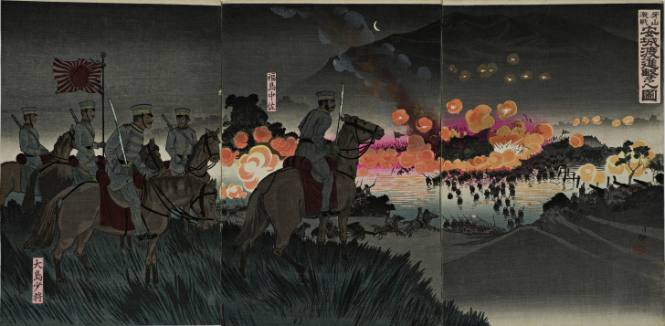
Label TextThis night scene punctuated by bomb blasts in vibrant hues of orange, pink, and yellow depicts the Battle of Asan (July 28–29, 1894), one of the first battles of the First Sino-Japanese War. Fought between July 1894–April 1895, the conflict broke out after years of struggle between China and Japan over influence in Korea. Japan viewed the Korean peninsula as a strategic location that also provided the capacity to invade China. Dated to September 1894, Kobayashi Kiyochika’s print speaks to the documentative nature of depicting news of battles on the front. Two major figures of the Imperial Japanese Army, General Ōshima Yoshimasa (left) and Lieutenant Colonel Fukushima Yasumasa (center), seated on horseback and holding swords, are identified by large pink cartouches. Lieutenant Colonel Fukushima looks out at Japanese forces being led across the Anjo River (known in Korean as the Ansong River) by Captain Matsuzaki Naomi, marked by a small white cartouche in the center left of the right sheet. Behind General Ōshima is the Rising Sun Flag, which was adopted by the Imperial Japanese Army and Navy. While the flag was in usage prior to the Meiji period as a symbol of good fortune among other attributes, it became a symbol of Japanese imperialism and colonization for Asian countries annexed or occupied by Japan.
Terms
Object information is a work in progress and may be updated as new research findings emerge.
To help improve this record, please email
loebcollections@vassar.edu
Kobayashi Kiyochika
1895
Culture: Japanese

Ogata Gekko
1895
Culture: Japanese
Utagawa Hiroshige, III
1881
Culture: Japanese
Utagawa Kunisada
1848
Culture: Japanese

Migita Toshihide
1895
Culture: Japanese