Object number2018.14.3
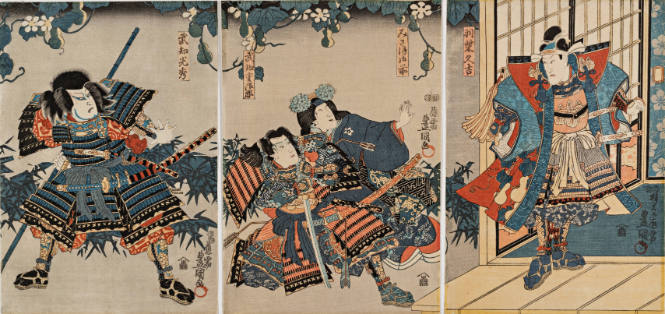
Mashiba Hisayoshi, Miaso Gozen, Buchi Gujiro, and Buchi Mitsuhide
Date1848
Artist
Utagawa Kunisada
(Japanese, 1786-1864)
CultureJapanese
MediumWoodblock print (oban tate-e triptych), ink and color on paper
DimensionsSheet (each): 14 x 9 3/4 in. (35.6 x 24.8 cm)
Matted: 20 x 38 in. (50.8 x 96.5 cm)
Matted: 20 x 38 in. (50.8 x 96.5 cm)
Credit LineGift of Katharine Gates, in memory of her brother, Peter M. Gates, class of 1980
Period19th c (Edo period)
Classification(s)
Vassar Exhibitions
Label TextKabuki theater actors faced censorship and sumptuary laws, such as prohibitions on portraying contemporary figures onstage or wearing real armor, and being required to shave their forelocks to make their appearances less appealing. These restrictions led to creative workarounds in both Kabuki itself and prints depicting it. In Hashiba Hisayoshi, Misaho Gozen, Takechi Jujirō, and Takechi Mitsuhide, Utagawa Kunisada circumvents censorship regulations in multiple ways. Due to the Tempō Reforms of 1842, portraits of actors were forbidden. Produced six years after the start of the reform, Kunisada does not name the play nor the actors it depicts. While identifying information is absent and lost to history, the play and actors would have been recognizable to their fans. The name of each character in the print’s title is a pun on a historical figure related to the government, obscured to deflect censorship. The artist depicts the actors as their characters, seen not onstage but in a night scene set in a garden. Censor’s seals on the right edge of each sheet in the print, above Kunisada’s signature, indicate that this approach worked; the prints passed inspection.
Object information is a work in progress and may be updated as new research findings emerge.
To help improve this record, please email
loebcollections@vassar.edu
Utagawa Hiroshige, III
1881
Culture: Japanese
Utagawa Kokunimasa
Nd
Culture: Japanese

Ogata Gekko
1895
Culture: Japanese