
Object number2008.19.6
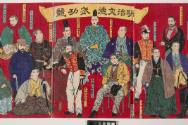
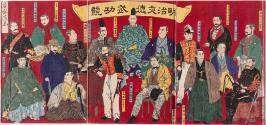
Enlightened Nobility List
Date1877
Artist
Kobayashi Eisei (古林 栄成)
(Japanese)
Published by
Hayashi Kichizo
CultureJapanese
MediumWoodblock print (oban tate-e triptych); ink and color on paper
DimensionsSheet (each): 13 3/8 x 9 1/16 in. (34 x 23 cm)
Composition: 13 3/4 x 27 3/4 in. (34.9 x 70.5 cm)
Matted: 20 x 33 x 1/4 in. (50.8 x 83.8 x 0.6 cm)
Composition: 13 3/4 x 27 3/4 in. (34.9 x 70.5 cm)
Matted: 20 x 33 x 1/4 in. (50.8 x 83.8 x 0.6 cm)
Credit LineGift of Frances Beatty Adler, class of 1970, and Allen Adler
Period19th c (Meiji period)
Classification(s)
Vassar Exhibitions
Label TextIn tandem with urban planning, clothing reform was a major part of the Meiji government’s modernization efforts. Western dress communicated progressive viewpoints, visually signifying Imperial Japan’s association with Western modernity and distinction from its East Asian counterparts. Portrait prints produced during the Meiji period reflect the changing fashions among the imperial court and associated officials, along with imperial proclamations for the Japanese public. Beginning in 1873, Emperor Meiji, his son Yoshihito, men of the imperial court, and public officials shed their traditional clothes and cut their topknots in exchange for Western attire and hairstyles to be seen as modern leaders by the West.
Object information is a work in progress and may be updated as new research findings emerge.
To help improve this record, please email
loebcollections@vassar.edu
Kobayashi Kiyochika
1895
Culture: Japanese

Ogata Gekko
1895
Culture: Japanese
Utagawa Hiroshige, III
1881
Culture: Japanese

Migita Toshihide
1895
Culture: Japanese