
Object numberX.228
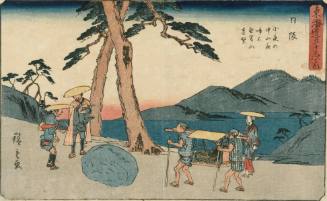
Nissaka: Sayo-no-Nakayama, the Night-crying Stone, and Mount Mugen
Portfolio/SeriesNo. 26 from the series Fifty-three Stations of Tokaido (Marusei Tokaido Series), also called the Reisho Tōkaidō
Datec. 1847-1852
Artist
Utagawa Hiroshige (歌川 広重)
(Japanese, 1797-1858)
CultureJapanese
MediumWoodblock print (nishiki-e), ôban; ink and color on paper
DimensionsImage: 8 3/4 x 13 3/4 in. (22.2 x 34.9 cm)
Sheet (Horizontal ōban): 9 1/4 x 14 1/4 in. (23.5 x 36.2 cm)
Sheet (Horizontal ōban): 9 1/4 x 14 1/4 in. (23.5 x 36.2 cm)
On View
Not on viewPeriod19th c (Edo period)
Classification(s)
SignedOn recto, within image, printed signature: 広重画 (Hiroshige ga)
InscribedOn recto, upper right, in block from right to left: 東海道 二十六 五十三次 日坂 小夜の中山 夜啼石 無間山; (The Tōkaidō Road (Tōkaidō nisaka); (Fifty-three Stations (Gojūsan tsugi); (Nisakka); (Sayo-no-Nakayama); (Yonaki ishi); (Mugenzan)
MarkingsOn recto, censors's seals within image, in block: 米良、渡辺 (Mera, Watanabe)
Catalogue raisonnéUkiyo-e shûka 14 (1981), Hiroshige list, p. 245, horizontal ôban #53.26DescriptionAn open landscape with a few large trees, travelers walking near the left and right side, mountains in the distance, and a small boulder in the foreground. This print depicts a mountain pass in Nissaka along the Tōkaidō, a road which ran from Kyoto to Edo. The rock at center is the night-crying stone, so named after the legend of a pregnant woman who was murdered by bandits and her blood fell upon the stone. In one interpretation of the legend it is said her spirit was contained in the stone and she wept each night. In another version the stone cries every night for the murdered woman. Partially legible writing on the stone is a veneration, likely "Namu Amida Butsu," or "I take refuge in Amida Buddha." This sutra is most commonly associated with the Pure Land school of Buddhism and through its recitation one can attain rebirth into the Pure Land of the Amida Buddha after death.
Object information is a work in progress and may be updated as new research findings emerge.
To help improve this record, please email
loebcollections@vassar.edu
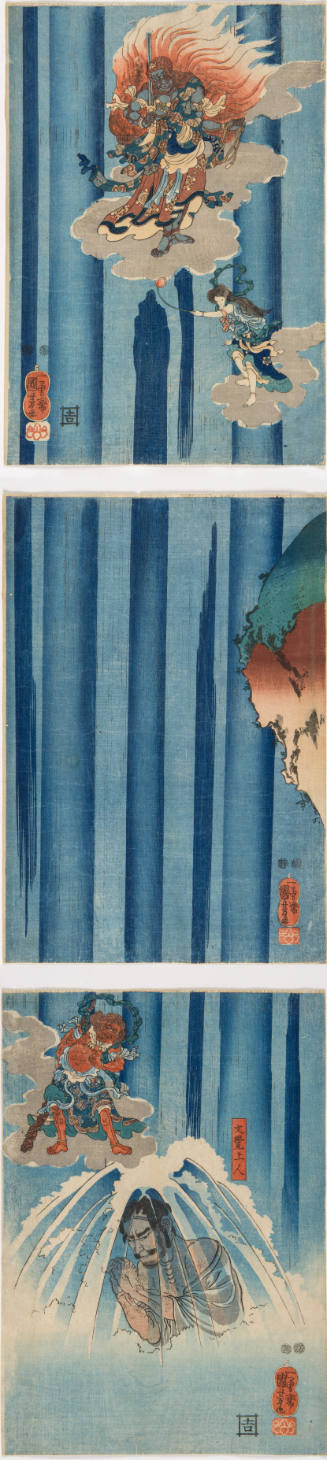
Utagawa Hiroshige (歌川 広重)
c. 1845
Culture: Japanese

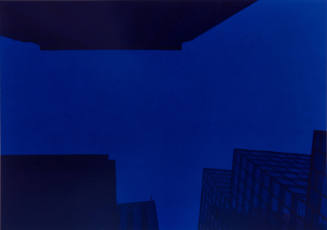
Kenji Nakahashi
1984
Culture: Japanese, American
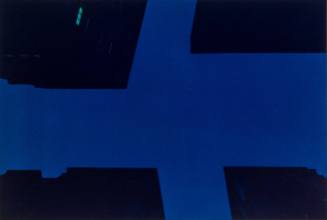
Kenji Nakahashi
1984
Culture: Japanese, American