Object number2023.11
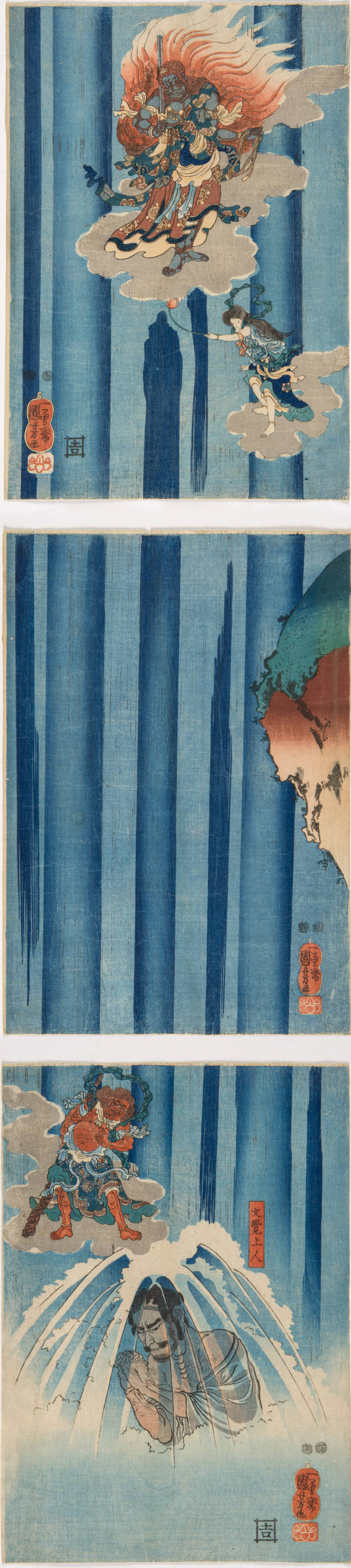
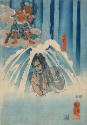
Mongaku Shônin Enacting his Penance in Nachi Waterfall
Datec. 1851
Artist
Utagawa Kuniyoshi
(Japanese, 1798-1861)
Publisher
Sumiyoshiya Masagorō
(Japanese, active c. 1847 - 1853)
CultureJapanese
MediumThree color woodblock prints with embossing on paper; ōban nishiki-e; vertical triptych
DimensionsImage (Each): 14 1/8 x 9 7/8 in. (35.9 x 25.1 cm)
Sheet (Each): 14 1/4 x 10 in. (36.2 x 25.4 cm)
Sheet (Each): 14 1/4 x 10 in. (36.2 x 25.4 cm)
Credit LinePurchase, gift of Mrs. Frederick Ferris Thompson, by exchange
On View
Not on viewPeriod19th c (Edo period)
Classification(s)
SignedTop sheet, on recto, lower left corner inside a red gourd-shaped cartouche, printed in black ink; center and bottom sheets, lower right corner: 勇斎國芳画 [Ichiyûsai Kuniyoshi ga (Picture [by] Ichiyûsai Kuniyoshi)]; below each cartouche, printed artist's seal intaglio on center and bottom sheets, relief on top sheet in red ink: [Yoshi kiri seal, an outline of a paulownia crest used by Utagawa Kuniyoshi as a seal]
InscribedTop sheet, on recto, printed bottom left within a black square; bottom sheet, bottom right: 吉 [Yoshi (publisher Sumiyoshiya Masagorô's mark)]
MarkingsTop sheet, on recto, two circular seal stamps lower left corner in black ink; center and bottom sheets, lower right: 衣笠 [Kinugasa (Nanushi (censor) seal of Kinugasa Fusajirô)] / 村田 [Murata (censor's seal)]
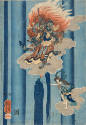
DescriptionThree rectangular sheets when stacked vertically illustrate a long waterfall and the story of monk Mongaku. Secularly known as Endô Moritô, he became a monk after accidentally killing the woman he loved, Lady Kesa, who sacreficed herself to preserve her honor as a married woman. He is depicted here in the bottom sheet partially wrapped in white cloth with his hands clasped together in prayer on his 21st day of penitence under the Nachi no Taki waterfall in Kumano (now Wakayama prefecture). As he is near freezing he grits his teeth as he recites incantations to Fudô Myô-ô, an Esoteric Buddhist deity whose two attendants, Kongara-doji and Seitaka-doji, save Mongaku from freezing to death so that he can complete the full three weeks of repentance to Lady Kesa. In the bottom of the upper sheet, Kongara-doji stands on a cloud-like form with his clothes rippling as he holds a long stem of a red lotus. At the top of the upper sheet, Fudô Myô-ô, whose name means "Unmovable," stands with his legs firmly together and holds a rope in his left hand and a sword in his right to cut through ignorance and restrain those who would block the path to enlightenment. He stands in a halo of fire around his shoulders which purifies evil wearing flowing patterned garments and has an expression of deep anger. In the bottom sheet above Mongaku is Seitaka-doji, who is traditionally depicted with red skin and leans on a staff. He also stands on a cloud-like form and has flowing garments. The middle sheet contains only the blue striations of the waterfall and a green and red land mass jutting into the composition from the right edge of the frame.
Object information is a work in progress and may be updated as new research findings emerge.
To help improve this record, please email
loebcollections@vassar.edu
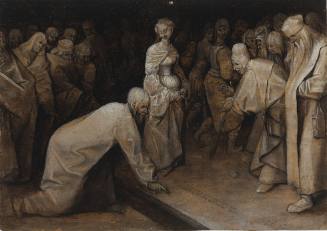
Studio of Pieter Brueghel the Younger
after 1565
Culture: Flemish
![[Mailboxes in Maine]](/internal/media/dispatcher/18618/thumbnail)