Object number2004.10
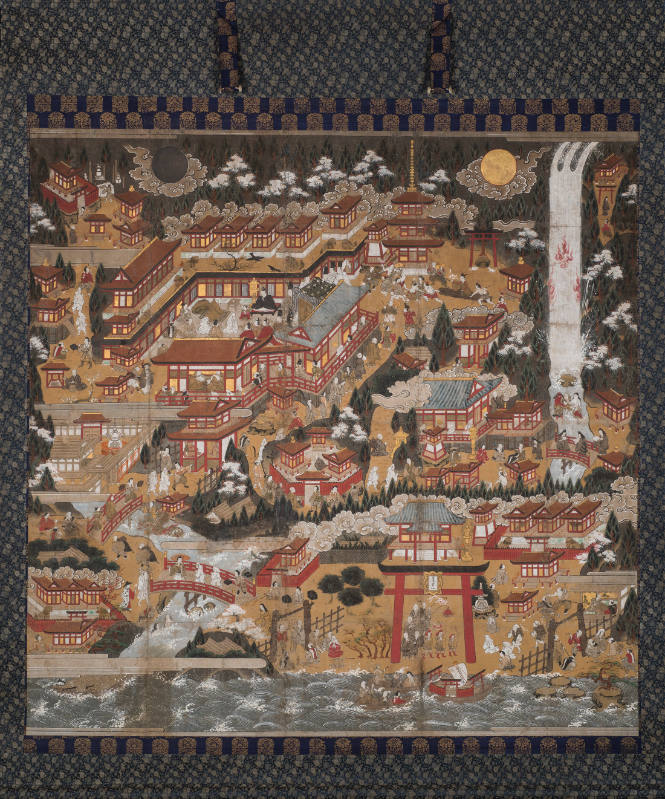
Nachi Pilgrimage Mandala
Daten.d.
Artist
Currently Unidentified
CultureJapanese
MediumInk, colors, and gold leaf on paper, mounted as hanging scroll
DimensionsImage: 59 1/16 x 59 7/16 in. (150 x 151 cm)
Overall (Open): 79 1/8 x 68 7/8 in. (201 x 175 cm)
Overall (Open): 79 1/8 x 68 7/8 in. (201 x 175 cm)
Credit LinePurchase, Pratt Fund and Betsy Mudge Wilson, class of 1956, Memorial Fund
PeriodEdo period, 16th - early 17th c
Classification(s)
Vassar Exhibitions
Exhibition HistoryPilgrimage and Buddhist Art, Asia Society and Museum, New York, NY, March 16 - June 20, 2010;Embodying Compassion in Buddhist Art: Image, Pilgrimage, Practice, Frances Lehman Loeb Art Center, Vassar College, Poughkeepsie, NY, April 23 - June 28, 2015;
Shinto: Discovering the Devine in Japanese Art, The Cleveland Museum of Art, Cleveland, OH, April 9 - June 30, 2019
Label TextLocated in the Kii Peninsula, the Nachi Shrine is one of three major pilgrimage sites of Japan's Honshu Island. Considered sacred by practitioners of Shinto, the area is home to numerous powerful kami, entities believed to reside in and influence the physical environment. As Buddhism arrived in Japan in the seventh century, interactions between the local and foreign traditions led to syncretic practices, included ascetic retreats in the mountainous landscape around Nachi. Resident monk studied these paintings to narrate the countless factual and apocryphal tales associated with the site, using the expressive vignettes of devotional activities as illustrations. More than four dozen buildings are intertwined within the environment through a winding pilgrimage path that passes the iconic Nachi no Taki waterfall, which dominates the right of the paintings. Throughout the composition, aristocrats, commoners, monks, and warriors are busily engaged in various activities, combining social reality with religious imaginary. Of the approximately thirty known Nachi pilgrimage paintings of this period, all but two are located in Japan.
Object information is a work in progress and may be updated as new research findings emerge.
To help improve this record, please email
loebcollections@vassar.edu
Nigensha Publishing Company
Early 11th c (original); 1980(reproduction)
Culture: Chinese

Currently Unidentified
c. 1440
Culture: French