Object number2024.40.2
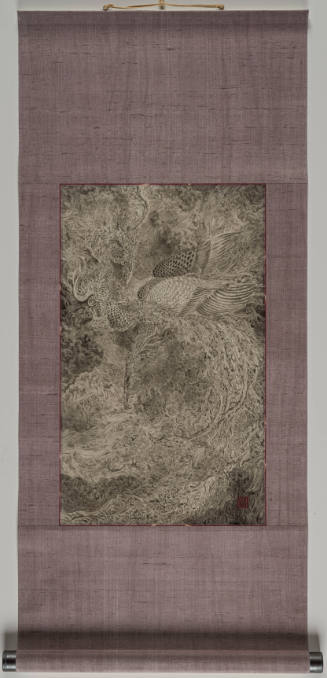
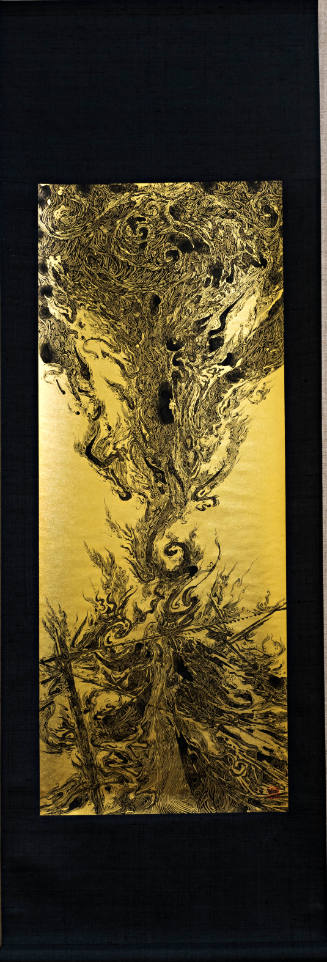
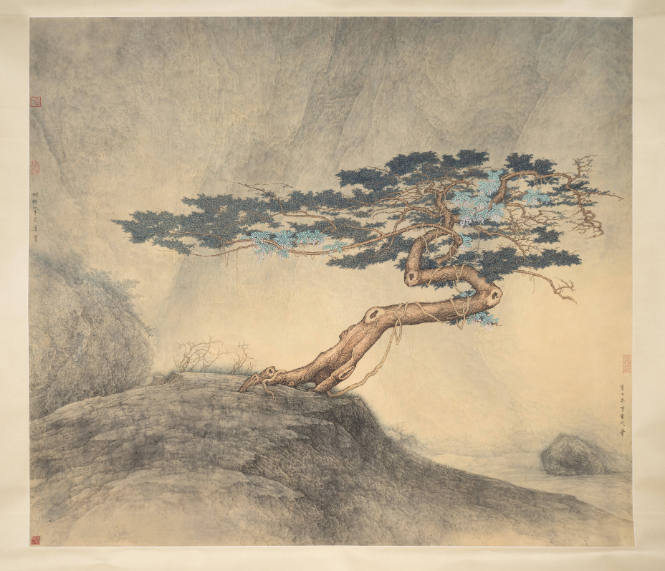
Spring Tree with Ivy
Date2001
Artist
Li Huayi
(Chinese, born 1948)
CultureChinese
MediumInk on paper mounted on a silk hanging scroll
DimensionsImage: 46 1/2 x 53 in. (118.1 x 134.6 cm)
Overall: 110 x 66 x 1 3/4 in. (279.4 x 167.6 x 4.4 cm)
Overall: 110 x 66 x 1 3/4 in. (279.4 x 167.6 x 4.4 cm)
Credit LineGift of Sandra N. Eu on behalf of A. Douglas Eu, class of 1983, Philip Eu, class of 1987, Elizabeth Hambrecht, class of 1985, and Jaime Hambrecht Eu, class of 2026
On View
Not on viewPeriod20th c / 21st c
Classification(s)
Signed
InscribedOn recto, lower-middle right edge in ink: 辛⺒李華弌筆 (Xinsi Li Huayi bi; Li Huayi painted this in the Xinsi year [2001])
On recto, upper-middle left edge in ink: 耐梅挚友清賞 (Nài méi zhìyǒu qīng shǎng)
MarkingsOn recto, seals of the artist stamped upper left in red ink: 華弌 (Huayi); middle left in red ink: 桃李不言 (Tao Li Bu Yu); lower left: 李華弌 (Li Huayi); lower-middle right: 絕出華章獨成弌格
Vassar Exhibitions
Label TextOne very important aspect of the composition of a landscape painting is movement, what the Chinese call qi, a complex term that can be translated as energy and power The artist’s qi
starts in his heart and flows through his arm to the point of the brush. That qi should also flow through the landscape.
—Li Huayi
Working to revive the monumental Northern Song (960–1127) landscape tradition, Li Huayi isolates his subject in an unusually intimate manner. The pine’s articulated bark and wind-carved geometry suggest not just decades but centuries of elemental persistence. Born in Shanghai in 1948, Li began ink painting at age six under the old apprenticeship system—grinding pigments and hanging scrolls—before producing large-scale government billboards during the Cultural Revolution (1966–1976), an experience of scale and graphic economy that would inform his mature practice. His encounter with Abstract Expressionism after immigrating to San Francisco in 1982 proved revelatory: Li recognized Franz Kline’s gestural energy as kindred to Chinese fei bai (flying white) technique, the moment when the brush lifts from paper yet continues to distribute ink through air. Li’s process layers meticulous brushwork over spontaneous underpaintings—each mark calibrated between tradition and invention, between precedent and contemporary necessity.
Object information is a work in progress and may be updated as new research findings emerge.
To help improve this record, please email
loebcollections@vassar.edu
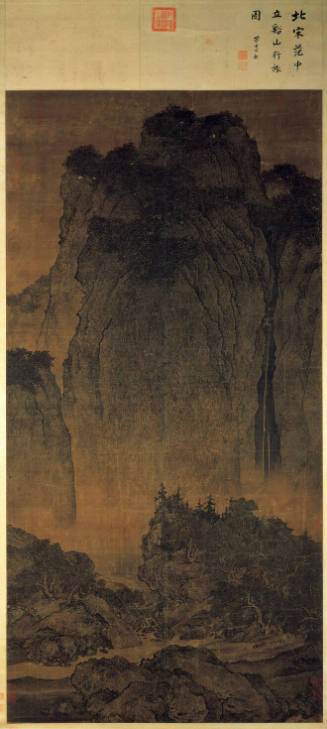
Nigensha Publishing Company
Early 11th c (original); 1980(reproduction)
Culture: Chinese