
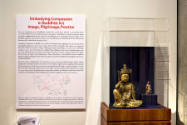
Embodying Compassion in Buddhist Art: Image, Pilgrimage, and Practice
Thursday, April 23, 2015 - Sunday, June 28, 2015
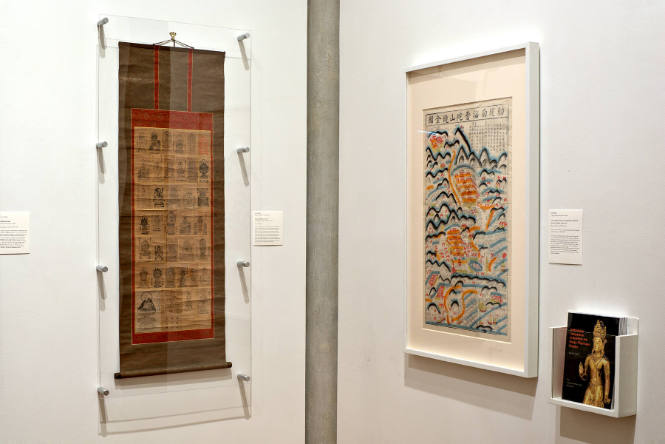
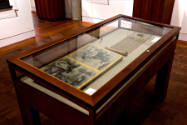
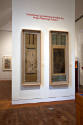
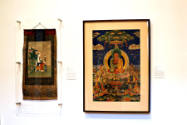
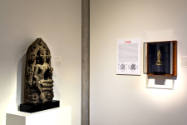
This exhibition was the first transcultural exhibition in America solely devoted to the bodhisattva Avalokiteshvara, who emerged in India two thousand years ago to become a venerated deity throughout Asia. Like all bodhisattvas, this figure selflessly leads others to enlightenment, but Avalokiteshvara’s special role is to exemplify limitless compassion, a fundamental ideal in Mahayana Buddhism. Sometimes appearing as male, sometimes female, he is known as Chenrezig in Tibet, Guanyin in China, and Kannon in Japan. This exhibition presented over 30 outstanding examples of Indian, Nepalese, Chinese, and Japanese art from prominent institutions such as The Metropolitan Museum of Art, Princeton University Art Museum, The Rubin Museum of Art, Asia Society, and The Newark Museum, augmenting objects from the Frances Lehman Loeb Art Center’s permanent collection and other sources. It demonstrated how artistic depictions of Avalokiteshvara inspire his followers through contact with auspicious images, pilgrimage, and daily spiritual practice. Providing a rare opportunity to compare different representations of Avalokiteshvara from many Asian countries, the exhibition also revealed the core Buddhist beliefs that underlie his many manifestations, and why this bodhisattva still plays such a vital role in Asian culture today.
Curated by Karen Lucic, professor of art at Vassar College, the exhibition, catalogue and digital resources were supported by E. Rhodes & Leona B. Carpenter Foundation; The Henry Luce Foundation; ASIANetwork Luce Asian Arts Program; John Stuart Gordon ’00; Elizabeth Kay and Raymond Bal; Ann Kinney ’53, and Gilbert Kinney. Institutional support at Vassar included Agnes Rindge Claflin Fund, Emily Floyd Fund Endowment, Ford Scholars Program, Carolyn Grant Endowment, Office of Religious and Spiritual Life, and Salmon Fund Endowment. There are works that appeared in this exhibition that were loans to the Loeb and therefore do not appear on this website.
Curated by Karen Lucic, professor of art at Vassar College, the exhibition, catalogue and digital resources were supported by E. Rhodes & Leona B. Carpenter Foundation; The Henry Luce Foundation; ASIANetwork Luce Asian Arts Program; John Stuart Gordon ’00; Elizabeth Kay and Raymond Bal; Ann Kinney ’53, and Gilbert Kinney. Institutional support at Vassar included Agnes Rindge Claflin Fund, Emily Floyd Fund Endowment, Ford Scholars Program, Carolyn Grant Endowment, Office of Religious and Spiritual Life, and Salmon Fund Endowment. There are works that appeared in this exhibition that were loans to the Loeb and therefore do not appear on this website.
Venues
Focus Gallery, Project Gallery