Object number2003.12
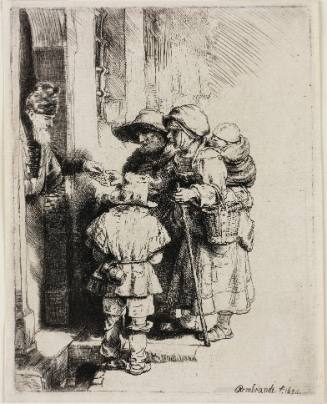
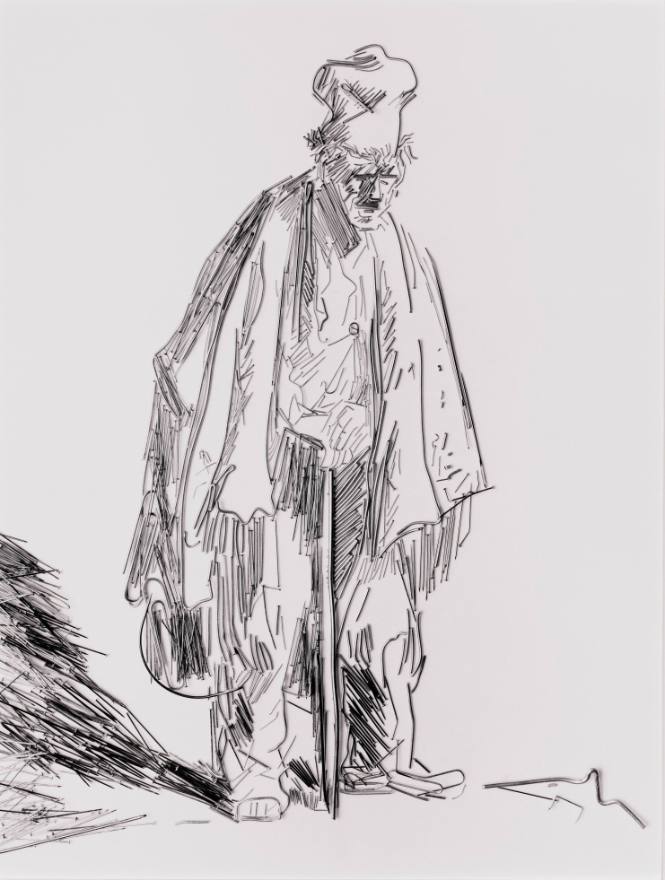
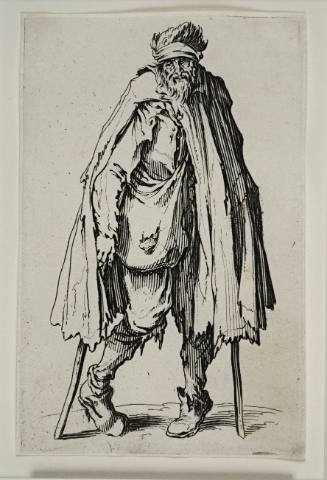
Beggar I, from Beggars after Rembrandt series
Date2001
Artist
Vik Muniz
(Brazilian, active USA, born 1961)
CultureBrazilian
MediumGelatin silver print
EditionA/P4/5
DimensionsSheet: 24 × 20 in. (61 × 50.8 cm)
Matted: 33 3/4 × 26 7/8 in. (85.7 × 68.3 cm)
Framed: 34 1/4 × 28 3/8 × 1 1/2 in. (87 × 72.1 × 3.8 cm)
Matted: 33 3/4 × 26 7/8 in. (85.7 × 68.3 cm)
Framed: 34 1/4 × 28 3/8 × 1 1/2 in. (87 × 72.1 × 3.8 cm)
Credit LinePurchase, Advisory Council for Photography
On View
Not on viewPeriod20th c
Classification(s)
Vassar Exhibitions
Exhibition HistoryPoughkeepsie, New York, FLLAC, Vassar College, "Histories of Photography," July 5 - September 21, 2003;Frances Lehman Loeb Art Center at Vassar College Poughkeepsie, NY SECOND SIGHT: Originality, Duplicity, and the Object January 14-April 10, 2005.
Poughkeepsie, NY, The Frances Lehman Loeb Art Center, Vassar College, "Master Class: Northern European Art 1500-1700 from the Permanent Collection," April 27-September 2, 2018.
DescriptionVik Muniz creates ephemeral trompe l’oeil constructions out of unlikely materials and directs them at a highly defined audience: the eye of his cam- era. For his Pictures of Wire series, the trained sculptor arranged tiny scraps of metal, including pins, needles, paper clips, and staples, on a horizontal white surface. The result, as seen here: line-for-line imitations of Rembrandt’s beggar etchings of the 1630s (a series represented in the Art Center’s Felix M.Warburg Collection). After photographing his handiwork, Muniz swept this assemblage aside and started the next. Muniz seeks to create what he cheerfully calls the “worst possible illusion”: a representation which, when examined closely, falls far short of resembling its model, yet which induces a casual eye to ‘see’ the intended image without raising the slightest suspicion. His work, entertaining as it is, prompts important insights about illusion, perception, and our propensity to ‘recognize’—that is, to know-again— the images through which we know the world.
Object information is a work in progress and may be updated as new research findings emerge.
To help improve this record, please email
loebcollections@vassar.edu
Giovanni Battista Tiepolo
c. 1750
Culture: Italian
![[Mailboxes in Maine]](/internal/media/dispatcher/18618/thumbnail)