Object number1997.7.96
Sampler
Date1830
Artist
Juli Ann Crispen
(American (Pennsylvania))
CultureAmerican
MediumSilk threads on linen ground
DimensionsSight: 17 5/8 x 16 1/2 in. (44.77 x 41.91 cm)
Unframed: 16 1/2 x 16 1/2 in. (41.91 x 41.91 cm)
Framed: 16 5/8 x 17 3/4 x 3/8 in. (42.23 x 45.09 x 0.95 cm)
Unframed: 16 1/2 x 16 1/2 in. (41.91 x 41.91 cm)
Framed: 16 5/8 x 17 3/4 x 3/8 in. (42.23 x 45.09 x 0.95 cm)
Credit LineTransfer from Vassar College Libraries, Special Collections, Martha Clawson Reed Collection
Period19th c
Classification(s)
Signed At center: Juli Ann Crispen
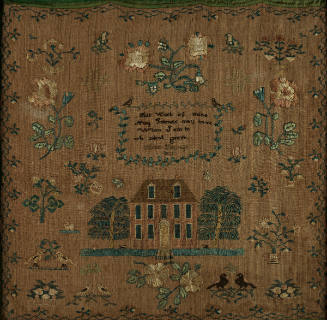
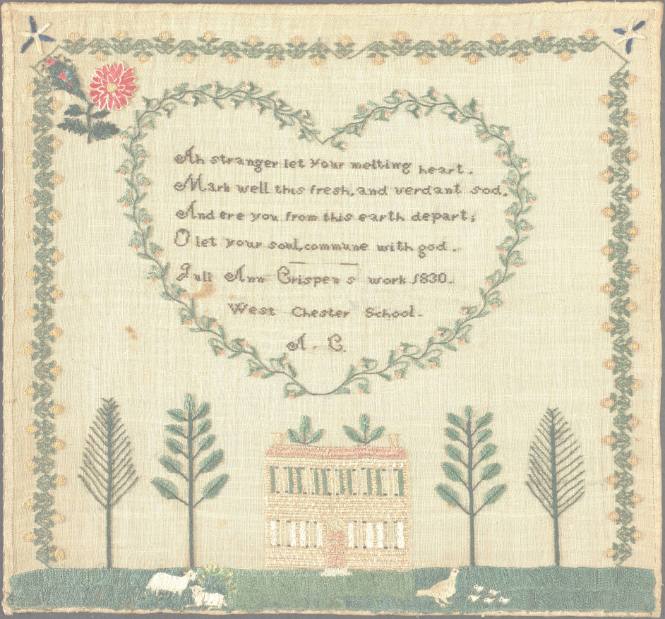
InscribedAh stranger let your melting heart / Mark well this fresh, and verdant sod, / And ere you from this earth depart; / O let your soul commune with god / Juli Ann Crispen's work 1830 West Chester School / A.C.
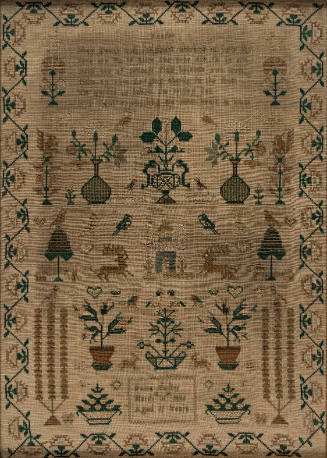
BibliographyHail Specimen of Female Art! (Princeton: Morven Museum and Garden, 2014), p. 96 (Cat. no. 82) Exhibition HistoryPrinceton, New Jersey, The Morven Museum and Garden, “Hail Specimen of Female Art! New Jersey Schoolgirl Needlework, 1726-1860,” October 3, 2014 – March 29, 2015.Label TextJuli Ann Crispen stitches a window into the interwoven nineteenth-century constructions of gender, class, religion, and race. A centuries-old practice, embroidery samplers were an essential part of the education of generations of women through a largely prescribed process of stitching text, images, and designs. This instruction was practical, expensive, and racially limited—educating white women in literacy, Christianity, and household skills, while shaping girls into future wives and mothers. Crispen offers a view into a picturesque domestic, and domesticated, scene of a brick building flanked by symmetrical trees. Sheep and chickens reside in a field of grass. Above floats a heart-shaped, vegetal frame containing verse from “Beauty’s Grave,” a well-circulated poem published in the nineteenth century, instructing the reader to “Mark well this fresh, and verdant sod.” Are we meant to reproduce the domesticated Eden the sampler depicts? As male painters looked to capture nature—wild and tamed—wealthy white women of the nineteenth century stitched fragments that reinforced another widespread view of American land, replete with Christian domesticity.
– Margo Vaughan ‘26
Disrespectful to the agency of the creator. Promotes historical bias towards sampler-making as the exclusive province of a certain class of white females and furthering only a narrow agenda. - Joanne Lukacher
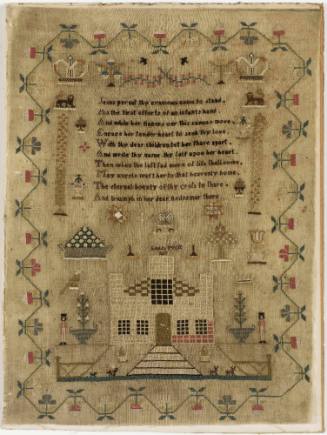
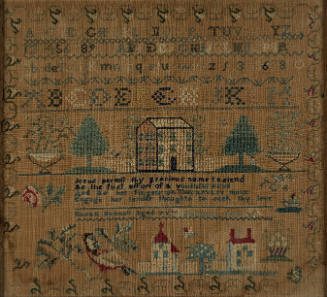
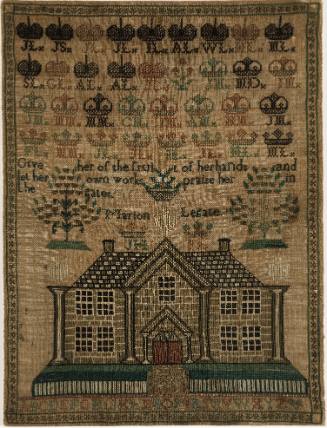
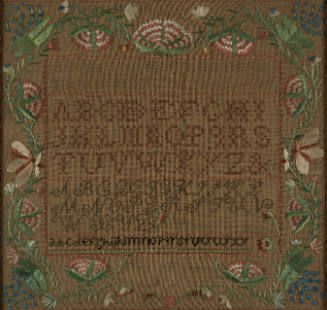
DescriptionA two-story, center hall, stone house with shutters is surmounted by a large heart-shaped flowering wreath enclosing the verse and inscription. two pairs of matching trees flank the house, while the lawn plays host to two sheep and a hen and chicks. A pink flowering rose border encircles the top and sides of the composition. The upper corners outside the border display blue and white six-point stars. A thickly stitched red flowering sprig is stitched (or attached like a slip) incongruously inside the left upper corner of the border. The verse is from a poem entitled Beauty's Grave and was published in popular collections and journals from at least as early as 1815. Thread colors are pink, red, green, white, rust, and black.
Object information is a work in progress and may be updated as new research findings emerge.
To help improve this record, please email
loebcollections@vassar.edu