
Object number1991.35.29
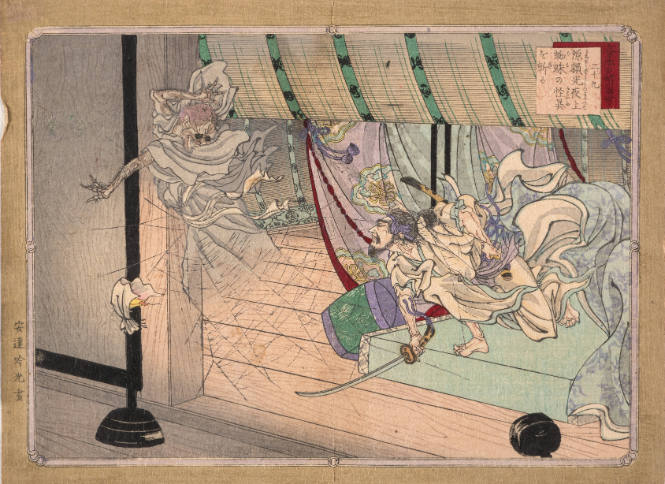
Number 29: At Night, Minamoto no Yorimitsu Slashes the Earth Spider Demon
Portfolio/Seriesfrom the series Illustrated History of Great Japan
Date1885
Artist
Adachi Ginkō(安達 吟光)
(Japanese, 1853 - 1902)
Publisher
Ōkura Magobei (大倉孫兵衛)
(Japanese)
CultureJapanese
MediumWoodblock print (nishiki-e); ink and color on paper
DimensionsImage: 6 5/16 x 8 11/16 in. (16 x 22 cm)
Sheet (Horizontal chūban): 7 1/16 x 9 7/16 in. (18 x 24 cm)
Sheet (Horizontal chūban): 7 1/16 x 9 7/16 in. (18 x 24 cm)
Credit LineGift of Justine Lewis Keidel, class of 1937
Period19th c (Meiji period)
Classification(s)
SignedOn recto, artist's signature, lower left, black ink printed in block: 安達吟光 (Adachi Ginkō)
InscribedOn recto, series title in upper right corner, in red cartouche, printed in block: 大日本史略図会 (Dai Nihon shiryaku zue (Illustrated History of Great Japan)
On recto, print title in upper right corner, in peach cartouche, printed in block: 二十九 源頼光夜土蜘蛛の怪異を斬る (Nijūkyū: Minamoto no Yorimitsu yoru tsuchigumo no kaii o kiru (Number 29: At Night, Minamoto no Yorimitsu Slashes the Earth Spider Demon)
Label TextThis print illustrates the legendary battle between the famed warrior Minamoto no Yorimitsu (948–1021) and the mythical earth-spider demon of Japanese folklore. Yorimitsu was a military commander in service to the Fujiwara clan, attaining high rank on account of his martial prowess. Over time, accounts of Yorimitsu’s real-life battles intertwined with supernatural elements, becoming the subjects of numerous legends, Noh and kabuki plays, and illustrated scrolls. In subsequent retellings, the many enemies of the state whom Yorimitsu fought were transformed into folkloric monsters.
In this image, Yorimitsu confronts the tsuchigumo, or “earth spider”: a monstrous being capable of shape-shifting and spreading illness. As the tale goes, on a summer’s night, the earth spider attempted to ambush the ailing Yorimitsu by entering his bedchamber disguised as a monk. Yorimitsu was awakened by the intruder, springing up from his slumber to slash the earth spider with his famous katana, the Hizamaru (“Knee-Cutter”), which thereafter became known as Kumokiri (“Spider-Cutter”).
In the wake of Meiji-era nationalism, Yorimitsu’s representation may be understood as projecting the bravery and strength of modern Japan. As one of the country’s most celebrated warrior figures, he likely serves here as a symbol of the imperial state’s power over its enemies.
Racine Rieke, class of 2028
Object information is a work in progress and may be updated as new research findings emerge.
To help improve this record, please email
loebcollections@vassar.edu
Adachi Ginkō(安達 吟光)
1885
Culture: Japanese
Adachi Ginkō(安達 吟光)
1885
Culture: Japanese
Adachi Ginkō(安達 吟光)
1885
Culture: Japanese
Adachi Ginkō(安達 吟光)
1885
Culture: Japanese
![[Number] 36](/internal/media/dispatcher/58726/thumbnail)
![[Number] 5](/internal/media/dispatcher/58722/thumbnail)
Adachi Ginkō(安達 吟光)
1885
Culture: Japanese
![[Number] 21](/internal/media/dispatcher/58740/thumbnail)
Adachi Ginkō(安達 吟光)
1885
Culture: Japanese
![[Number] 18](/internal/media/dispatcher/58731/thumbnail)
![[Number] 11](/internal/media/dispatcher/58728/thumbnail)
Adachi Ginkō(安達 吟光)
1885
Culture: Japanese