
Object number1991.35.6
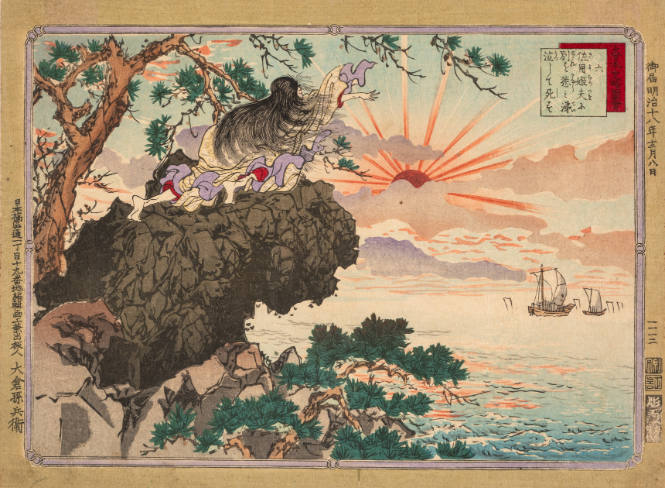
Number 6: Lady Sayo, Grieving her Husband’s Departure, Weeps Until she Dies
Portfolio/Seriesfrom the series Illustrated History of Great Japan
Date1885
Artist
Adachi Ginkō(安達 吟光)
(Japanese, 1853 - 1902)
Publisher
Ōkura Magobei (大倉孫兵衛)
(Japanese)
CultureJapanese
MediumWoodblock print (nishiki-e); ink and color on paper
DimensionsImage: 6 1/4 x 8 3/4 in. (15.88 x 22.23 cm)
Sheet: 7 x 9 7/16 in. (17.78 x 23.97 cm)
Sheet: 7 x 9 7/16 in. (17.78 x 23.97 cm)
Credit LineGift of Justine Lewis Keidel, class of 1937
Period19th c (Meiji period)
Classification(s)
InscribedOn recto, series title in upper right corner, in red cartouche, printed in block: 大日本史略図会 (Dai Nihon shiryaku zue (Illustrated History of Great Japan)
On recto, print title in upper right corner, in yellow cartouche, printed in block: 六 佐用姫夫に別を悲み涕泣して死す (Roku: Sayō-hime tsuma ni wakare o kanashimi teiritsu shite shisu (Number 6: Lady Sayo, Grieving her Husband’s Departure, Weeps Until she Dies)
MarkingsOn recto, upper right in margin, publication date, in block: 御届明治十八年十二月八日 (O-todoke Meiji jūhachinen jūnigatsu yōka (Filed/registered: Meiji 18 [1885].12.8)
On recto, lower right, carver’s mark, in block: 彫工 ムメザハ (Chōkō Mumezawa (Carver: Mumezawa)
Label TextThis image depicts the moment when Matsura Sayohime, also known as Lady Sayo, weeps as her husband, Ōtomo no Satehiko, is sent off on a military expedition to Korea. While the earliest surviving account of this episode appears in the Man’yōshū, the oldest collections of vernacular Japanese poetry, the tale may have originated from a Korean story in which the wife of the court official Park Jesang climbs a cliff to mourn her husband as he crosses the sea to Japan.
In this print, Lady Sayo reaches out over the cliff towards her husband’s ship. According to tradition, Lady Sayo waved a handkerchief as she cried out in grief, and thereafter the hill she climbed became known as “Wavescarf Hill.” In the Nihon shoki (Chronicles of Japan, 720 CE), her husband was sent to Korea twice, though it is during the first departure that Lady Sayo climbs the cliff. Over time, the episode was repeatedly adapted into genres such as Noh and puppet theater, multiplying and reshaping the many versions of this tale.
Christopher Moody, class of 2026
Object information is a work in progress and may be updated as new research findings emerge.
To help improve this record, please email
loebcollections@vassar.edu
Adachi Ginkō(安達 吟光)
1885
Culture: Japanese
![[Number] 36](/internal/media/dispatcher/58726/thumbnail)
![[Number] 5](/internal/media/dispatcher/58722/thumbnail)
Adachi Ginkō(安達 吟光)
1885
Culture: Japanese
![[Number] 21](/internal/media/dispatcher/58740/thumbnail)
Adachi Ginkō(安達 吟光)
1885
Culture: Japanese
![[Number] 18](/internal/media/dispatcher/58731/thumbnail)
![[Number] 11](/internal/media/dispatcher/58728/thumbnail)
Adachi Ginkō(安達 吟光)
1885
Culture: Japanese
![[Number] 25](/internal/media/dispatcher/58744/thumbnail)
![[Number] 26](/internal/media/dispatcher/58729/thumbnail)
Adachi Ginkō(安達 吟光)
1885
Culture: Japanese