Object number1976.75
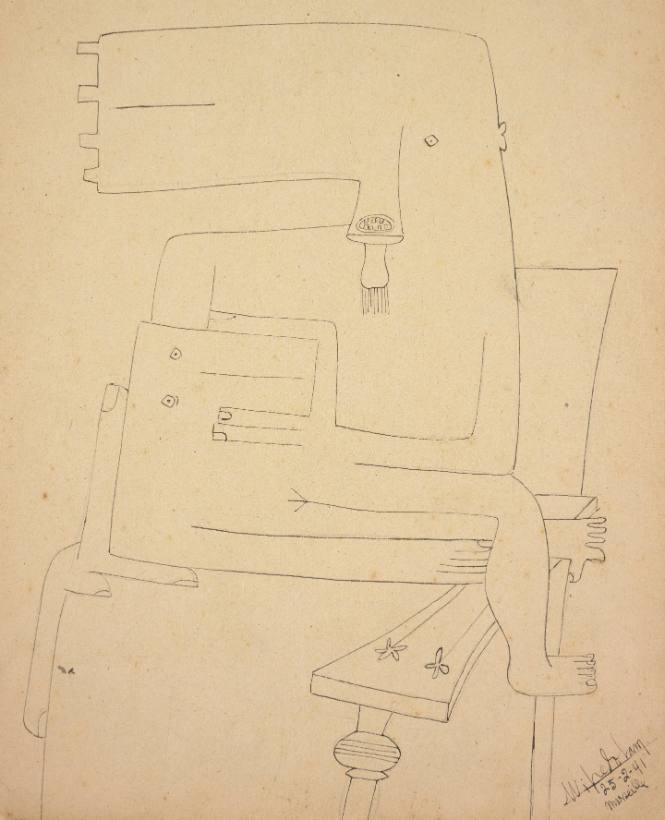
Untitled
Portfolio/Seriesfor André Breton's poem Fata Morgana
Date1941
Artist
Wifredo Lam
(Cuban, 1902-1982)
CultureCuban
MediumPen and pencil with erasing on paper
DimensionsSheet: 8 11/16 x 6 5/8 in. (22 x 16.9 cm)
Matted: 21 15/16 x 15 15/16 in. (55.7 x 40.5 cm)
Matted: 21 15/16 x 15 15/16 in. (55.7 x 40.5 cm)
Credit LinePurchase, Barbara Doyle Duncan, class of 1943, Fund for Contemporary Latin American Drawings
On View
Not on viewPeriod20th c
Classification(s)
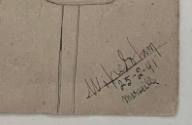
SignedOn recto, signed lower right in: Wifredo Lam
InscribedOn recto, by artist, lower right in: 25-2-41 / Marseille
BibliographyPhagan, Patricia. “Drawings at Vassar to ‘Illustrate the Loftiest Principles and Refine the Most Delighted Hearts.’” Master Drawings 42, no. 2 (2004): 133–44. http://www.jstor.org/stable/1554650. p.142Vassar Exhibitions
Exhibition HistoryWifredo Lam: A Retrospective of Works on Paper: Americas Society, New York, NY, December 1, 1992 - April 30, 1993;A Long Affair: Surrealism 1924 to Now, The Hyde Collection, Glens Falls, NY, June 22 - September 15, 2024
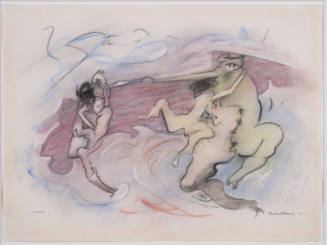
Label TextWifredo Lam's wife Helena Benítez described his collaboration with Surrealist leader André Breton as opening "her husband's art to a new realm of conceptualized archetypal images." The dozens of lyrical preparatory drawings Lam made to illustrate Brenton's poem Fata Morgana (1941) heralded Lam's mature style, which incorporated magic rituals, inventive hybrid creatures, and constellations of symbols that challenged European ideas of the primitive. In this work, Lam portrays the iconic figure of the Madonna Enthroned as an androgynous mother/father figure (a portrait, perhaps, of Breton and his beloved daughter Aube). Lam's dynamic lines seize a moment of domesticity amidst the stresses of a household in flight from Nazi pursuit, for the previous year he had fled Paris for Marseille in order to escape persecution before sailing for Martinique.
DescriptionTwo rectangular anthropomorphic forms irregularly bent mostly at 90 degree angles partially sitting on a bench-like form, all composed of narrow linework.
Object information is a work in progress and may be updated as new research findings emerge.
To help improve this record, please email
loebcollections@vassar.edu
![Untitled [Angels Holding the Arc of the Covenant]](/internal/media/dispatcher/32429/thumbnail)
![Untitled [Train]](/internal/media/dispatcher/24499/thumbnail)