Object number2025.22.2
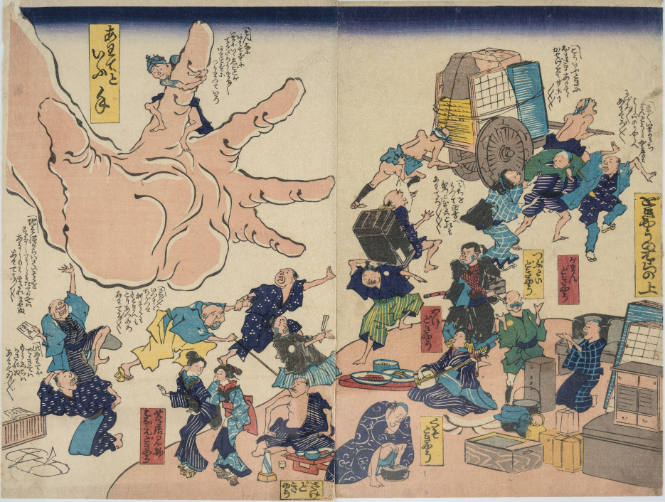
On the Belly of Courage, the Hand of Anxiety
Datec. 1864
Artist
Currently Unidentified
Publisher
Kawanabe Kyōsai (河鍋暁斎)
(Japanese)
CultureJapanese
MediumWoodblock print (nishiki-e; ôban tate-e diptych), ink and color on paper
DimensionsComposition: 14 9/16 x 20 3/16 in. (37 x 51.2 cm)
Sheet (Left): 14 1/2 x 9 11/16 in. (36.9 x 24.6 cm)
Sheet (Right): 14 7/16 x 9 5/8 in. (36.7 x 24.4 cm)
Sheet (Left): 14 1/2 x 9 11/16 in. (36.9 x 24.6 cm)
Sheet (Right): 14 7/16 x 9 5/8 in. (36.7 x 24.4 cm)
Credit LinePurchase, Betsy Mudge Wilson, class of 1956, Memorial Fund
Period19th c (Edo period)
Classification(s)
Vassar Exhibitions
Label TextAs censorship regulations loosened at the end of the Edo period, Japanese media increasingly addressed political issues and current events in woodblock prints and newspapers. Satirical prints called awate-e (hysteria pictures), which caricatured the public’s trepidation over foreign relations and reactions to disaster in the cities of Edo and Yokohama, emerged at this time. While awate-e were a news medium, the genre was also intended to entertain—like political cartoons today.
Prints like On the Belly of Courage, the Hand of Anxiety playfully captured Japanese citizens’ fears of Western invasion. Here, figures rest in various states of “courage” on top of a giant stomach, recognizable by the belly button below the shamisen player near the center of the right panel. Using a clever pun for the word awate (to panic), a hand (te) representing the “five imperial powers”—generally interpreted as England, France, Russia, Germany, the Netherlands, and/or the United States—descends toward a crowd of civilians below. A man clinging to the hand shouts, “Don’t be so hysterical! You will soon have good work, so don’t be so hysterical and let yourselves be caught!” Inscriptions in red and yellow cartouches identify the figures’ varying states of courage as they face the looming hand, such as two men chatting cheerfully who are labeled “impudent courage” and “tolerant courage,” respectively. A man surrounded by sake cups is titled “drunk courage.” Beyond the “belly of courage,” frantic figures are accompanied by speech bubbles, ordering others to hurry while complaining about landowners and debtors, their lack of items to pawn, and lenders rushing to collect interest and invest capital.
Object information is a work in progress and may be updated as new research findings emerge.
To help improve this record, please email
loebcollections@vassar.edu

Ogata Gekko
1895
Culture: Japanese
Utagawa Hiroshige, III
1881
Culture: Japanese
Mizuno Toshikata
1894
Culture: Japanese

Migita Toshihide
1895
Culture: Japanese