
Object number2023.18.2
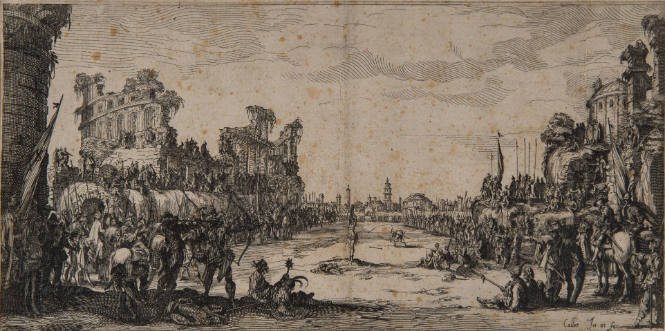
Le martyre de saint Sébastien
Datec. 1632
Artist
Jacques Callot
(French, 1592-1635)
CultureFrench
MediumEtching and engraving
DimensionsSheet: 6 1/4 x 12 1/2 in. (15.9 x 31.7 cm)
Credit LineGift of C.G. Boerner, in memory of Thomas R. Firman
On View
Not on viewPeriod17th c
Classification(s)
SignedOn recto within image, printed lower right: Callot In et fec.
InscribedOn verso, by unidentified hand within Barilli stamp in ink: 007
MarkingsOn verso, stamped lower left corner in blue ink within an oval: Fillipo Barilli
Catalogue raisonnéBibliothèque Nationale II.224.670; Lieure III.30-31.670 ii/ii; Meaume 137BibliographyÉdouard Meaume, "Volume 1," Recherches sur la vie et les ouvrages de Jacques Callot, suite au Peintre-graveur français de M. Robert-Dumesnil (Paris: V.J. Renouard, 1860)., no. 137, pp. 91–92; Jules Lieure, Jacques Callot: catalogue raisonné de l'oeuvre gravé (San Francisco: Alan Wofsy Fine Arts, 1989)., no. 670ProvenanceFillippo Barilli.C.G. Boerner
DescriptionBlack linework composition of an open landscape surrounded by ruins and filled with soldiers, many mounted on horseback. At center is a stake with Sebastian bound to it and archers in the left foreground taking aim. In the background is a walled town with many notable architectural monuments, such as Trajan's column, the arches of Titus and Septimius Severus, the Pantheon, and the tower of Nero.
St. Sebastian was a soldier who converted many to Christianity under the rule of Emperor Diocletian, noted for his persecution of Christians. Upon discovering his religious background, Diocletian ordered Sebastian to be tied up on the training field and shot with arrows. The archers left him for dead, but a Christian widow, Irene of Rome nursed him back to health.
Object information is a work in progress and may be updated as new research findings emerge.
To help improve this record, please email
loebcollections@vassar.edu

![[Mailboxes in Maine]](/internal/media/dispatcher/18618/thumbnail)