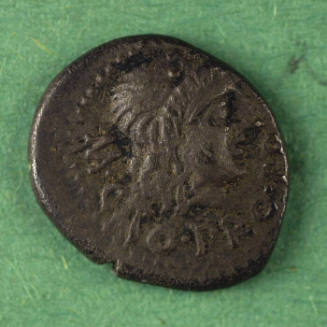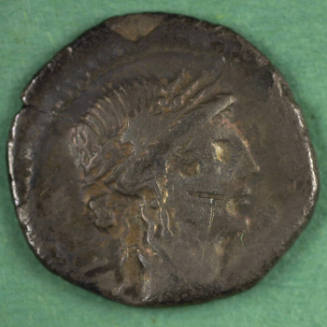
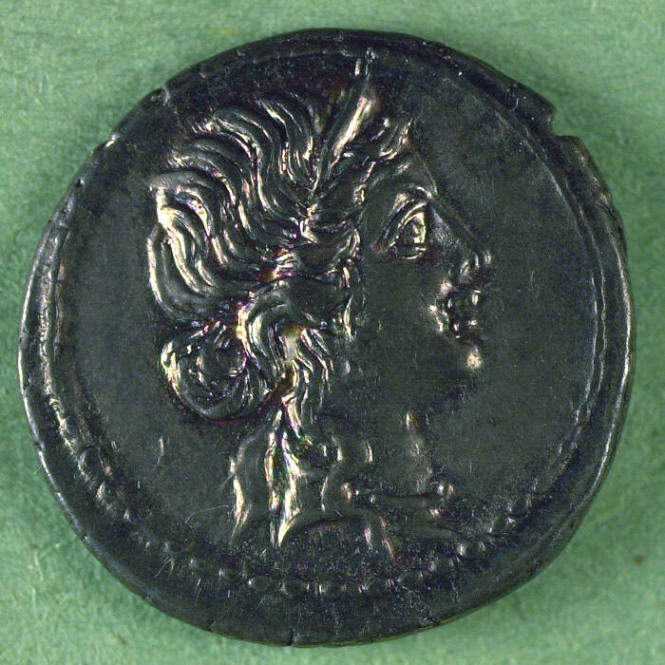
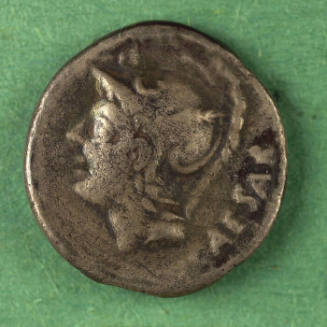
denarius, Roman Republic, 47-46 BCE
Object numberCC59.2.0628

denarius, Roman Republic, 47-46 BCE

Date47-46 BCE
CultureRoman
MediumSilver
DimensionsCoin Dimensions: 1.94 cm, 3.91 g
Credit LineTransfer from Vassar College Classics Department, 1968
On View
Not on view
PeriodRoman Republic
Classification(s)
Denomination
Language
Minting Official
Minting Location
Obverse Description
A border of dots surrounds the diademed head of Venus, looking right.
Reverse Description
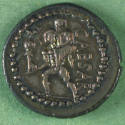
A border of dots surrounds Aeneas, facing left, with a palladium in his right hand and Anchises over his left shoulder.  CAESAR is inscribed downwards on the right.
Reverse Expanded
CAESAR
Reverse Legend
CAESAR
Reverse Translated
Caesar
BibliographyCrawford, 458.1; Mundy, James, The Frances Lehman Loeb Art Center: Vassar College The History and Collection (New York: Prestel Publishing, 2007), p. 21 repr.DescriptionThis silver denarius was issued by Julius Caesar during the civil war as part of the African campaign against Cato the Younger that ended in the battle of Thapsus. It shows on the obverse (heads) a bust of the goddess Venus facing right and wearing a diadem; on the reverse (tails) stands Aeneas holding the palladium, a wooden statue of Pallas taken from Troy, in his right hand, and carrying his father Anchises over his left shoulder. The story of Aeneas’ travels from Troy to Italy and Latium, recounted by Virgil in the Aeneid, was a central myth of the Romans, but the type is personal to Julius Caesar as well: Venus was his patron goddess, for whom he built the temple of Venus Gen- etrix, and Aeneas was his ancestor. The type of ‘traveling Aeneas’ was also appropriate to the African context of the coin since Aeneas’ abandonment of Queen Dido of Carthage and her subsequent suicide explained the historical enmity between Rome and the city in North Africa and predicted that Rome, and Caesar, would be victorious in the current struggle as well. The use of the public coinage, and public myth, for what we would call personal propa- ganda is emblematic of the downfall of the Roman Republic at the hands of ambitious politicians and generals like Caesar.
Object information is a work in progress and may be updated as new research findings emerge. To help improve this record, please email loebcollections@vassar.edu
quinarius, Roman Republic, 47-46 BCE
47-46 BCE
Culture: Italian
denarius, Triumviral, 41 BCE
41 BCE
Culture: Roman
Broome County from the Black Diamond
Arthur Garfield Dove
1932
Culture: American
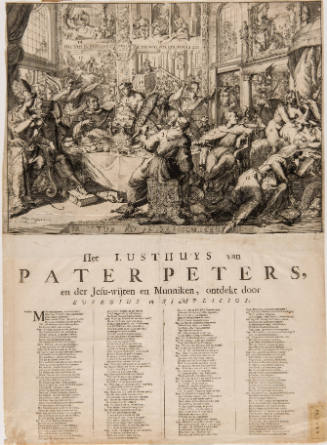
Het Lusthuys van Pater Peters
Romeyn de Hooghe
1688
Culture: Dutch
The Adventures of Ulysses: The Blinding of Polyphemus
The Master of the Johnson Assumption of the Magdalen
Early 1500s
Culture: Italian

The Adventures of Ulysses: The Battle with the Laestrygonians
The Master of the Johnson Assumption of the Magdalen
Nd
Culture: Italian
Portrait of Matthew Vassar
Charles Loring Elliott
1861
Culture: American
Portrait of Matthew Vassar
James Henry Wright
1861
Culture: American
The Octavian Gate and Fish Market
Hubert Robert
1784
Culture: French