Object number2002.30
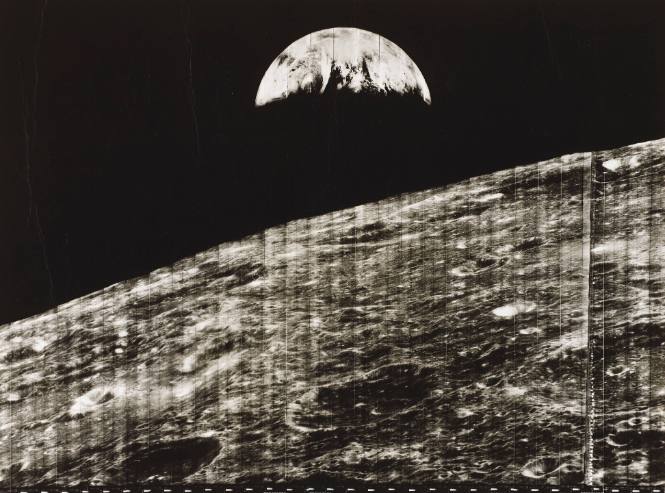
First View of the Earth from the Moon
Date1966
Artist
Lunar Orbiter 1
(American, 1966)
CultureAmerican
MediumGelatin silver print, printed later
DimensionsImage: 14 5/16 x 19 3/16 in. (36.4 x 48.8 cm)
Sheet: 16 x 19 3/4 in. (40.7 x 50.2 cm)
Sheet: 16 x 19 3/4 in. (40.7 x 50.2 cm)
Credit LinePurchase, Horace W. Goldsmith Foundation Fund
On View
Not on viewPeriod20th c
Classification(s)
Vassar Exhibitions
Exhibition HistoryHistories of Photography, Frances Lehman Loeb Art Center, Vassar College, Poughkeepsie, NY, July 5 - September 21, 2003; Photo Currents: Media, Circulation, Spectacle, Frances Lehman Loeb Art Center, Vassar College, Poughkeepsie, NY, July 10, 2021 - Sunday, October 10, 2021; Photography as Data: Augmentation, Extraction, Objectification, Frances Lehman Loeb Art Center, Vassar College, Poughkeepsie, NY, April 9 - September 15, 2024Label TextBetween 1966 and 1967, the U.S. launched five robotic, uncrewed spacecrafts to orbit the Moon. This series of successful missions was known as the Lunar Orbiter program. Altogether they mapped 99 percent of the Moon’s surface using photography, and produced the first-ever photographs of the Earth from lunar orbit. This photograph was among 229 made between August 18 and 29, 1966 by Orbiter 1, the first spacecraft in the series. Orbiter 1 was equipped with a camera using two lenses: a narrow-angle, high-resolution lens and a wide-angle, medium-resolution lens. Simultaneous exposures taken with each lens were captured on a single roll of film, causing the slight moiré effect of the resulting, composite image seen here. The film was processed and scanned on the spacecraft, and images were sent back to Earth. Photographs like this one circulated in the press, building collective anticipation for the televised landing of the Apollo 11 mission on the Moon three years later.
-Jessica D. Brier, Curator of Photography
DescriptionImage of near half the Earth as taken from the surface of the moon. Half of the foreground is taken up by the cratery surface of the moon in the lower half of the image with the Earth in the upper center.
Object information is a work in progress and may be updated as new research findings emerge.
To help improve this record, please email
loebcollections@vassar.edu

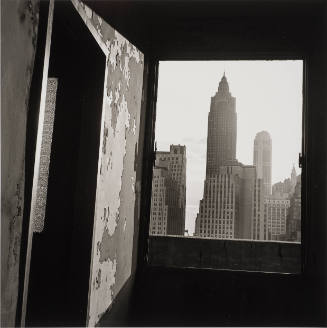
Danny Lyon
1966-1967
Culture: American
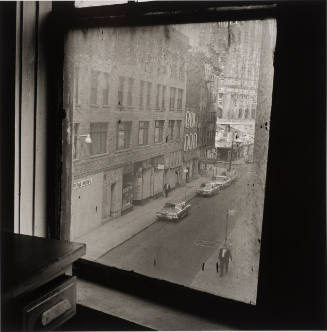
Danny Lyon
1966-1967
Culture: American