Object number1994.2.2.69
The Melun-Epinoy Hours
Datec. 1501–1520
Artist
Jean Pichore
(French, active c. 1501–1520)
CultureFrench
MediumTempera, ink and gold leaf on parchment
DimensionsSheet: 6 3/8 x 7 1/2 in. (16.19 x 19.05 cm)
Credit LineBequest of Sarah Hamlin Stern, class of 1938, in memory of her husband, Henry Root Stern, Jr.
On View
Not on viewPeriod16th c
Classification(s)
InscribedCover sheet: "Ce present lure appartient a Suzanne de Habannes dame de Lauuille 1592"
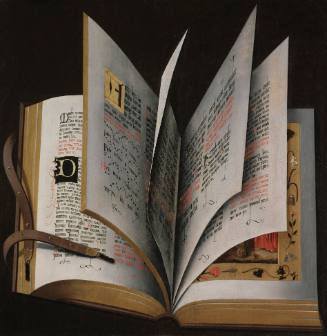
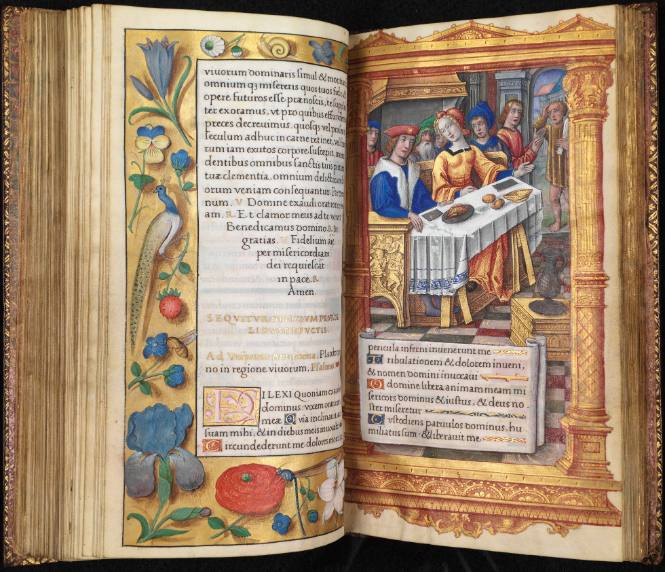
BibliographyMundy, James, The Frances Lehman Loeb Art Center: Vassar College The History and Collection (New York: Prestel Publishing, 2007), p. 28 repr.Caroline Zöhl, Jean Pichore: Buchmaler, Graphiker und Verleger in Paris um 1500, Turnhout, 2004 ProvenanceMarie de Melun-Épinoy (wife of Jean de Gruuthuse [1458-1512]; she then married Jacques II de Chabannes, who died in 1525 at Battle of Pavia; by descent to Suzanne de Chabannes (active late 16th c); Pierre Berés, Paris ca. 1958 (dealer); sold Parke-Barnet, NY, April, 1963.DescriptionThis page from a complete book of hours likely originated from the manu- script workshops of Tours. The book contains over ninety full, half, or quar- ter page illuminations following the usual cycles for such books. These begin with the sequence of calendar months, each illustrated with the appropriate labor and list of the feast days. Then there follow the prayers for the eight canonical hours—Matins, Lauds, Prime, Terce, Sext, None, Vespers, and Compline—each illustrated with a full-page illumination. Also included are prayers for other occasions, including the Mass for the dead. The illus- tration that conjoins the psalm to be said at Vespers in the evening is that depicting the rich miser, Dives. The story, from Luke 16, recounts how the rich man spurned the beggar Lazarus when he came to him asking for crumbs from his table. When they both died, the rich man was tormented in Hell by seeing Lazarus borne to Heaven by Abraham. The illustration complements the text of the psalm, which speaks of earthly sorrows and tribulations. Contrasting this message is the visual gaiety of the marginal decorations that include elegant renderings of dragonflies, snails, peacocks and numerous recognizable blooms such as iris, pansy, dogwood, and violet.
Object information is a work in progress and may be updated as new research findings emerge.
To help improve this record, please email
loebcollections@vassar.edu