Object number2003.8
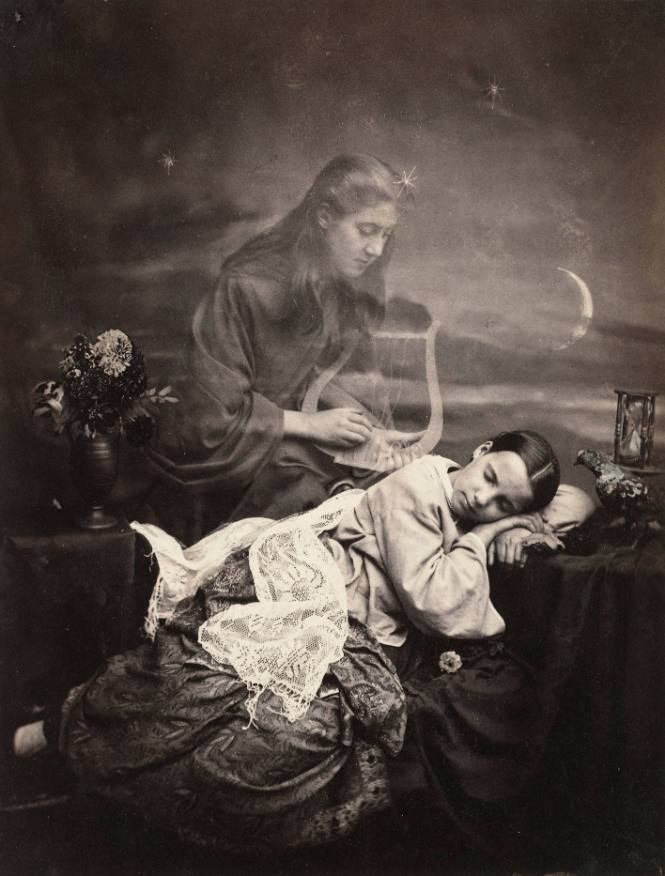
A Happy Dream
Date1862-1863
Artist
Ross and Thomson
(Scottish, active 1848 - 1864)
Artist
James Ross
(Scottish, c. 1814–1878)
Artist
John Thomson
(Scottish, c. 1808–1881)
CultureScottish
MediumAlbumen print
DimensionsImage: 7 7/8 x 6 in. (20 x 15.2 cm)
Mount: 12 3/4 x 10 1/2 in. (32.4 x 26.7 cm)
Mount: 12 3/4 x 10 1/2 in. (32.4 x 26.7 cm)
Credit LinePurchase, Horace W. Goldsmith Foundation Fund
On View
Not on viewPeriod18th c
Classification(s)
InscribedOn recto, on mount at bottom center in pencil: A Happy Dream
On verso, upper left corner in pencil: JT082
On verso, lower left corner in pencil: 300437.0527
BibliographyMundy, James, The Frances Lehman Loeb Art Center: Vassar College The History and Collection (New York: Prestel Publishing, 2007), p. 82, repr.; Lombino, Mary-Kay. Shape of Light: Defining Photographs from the Frances Lehman Loeb Art Center. Poughkeepsie, NY: Vassar College, 2019, p. 36
Lombino, Mary-Kay, "Shape of Light: Defining Photographs from the Frances Lehman Loeb Art Center, September 20 - December 15, 2019," (Poughkeepsie, NY: Vassar College, Frances Lehman Loeb Art Center), 2019.Vassar Exhibitions
Exhibition HistoryHistories of Photography, Frances Lehman Loeb Art Center, Vassar College, Poughkeepsie, NY, July 5 - September 21, 2003; Shape of Light: Defining Photographs from the Frances Lehman Loeb Art Center, Vassar College, Poughkeepsie, NY, September 20 - December 15, 2019Label TextNo sooner than photography was announced as a new invention did it simultaneously become popular as an instrument of truth and a technology of deceit. There was an insatiable public appetite in the nineteenth century for both in almost equal measure. Even while photographs were examined as evidence in courtrooms and studied as scientific data, they were also used to represent fantastical subjects like ghosts and dreams. For some, this was further evidence that the camera could see in ways that the human eye could not. For others, it was a lucrative grift or a whimsical amusement. Portraits were one of the most popular uses of photography, and mothers hid behind sheets to create the illusion—however unconvincing—that their babies could sit on their own for the camera. Yet this practice persisted in spite of its absurd premise. Being deceived by the camera was not simply tolerated; it was a popular and common pastime for entertainment and intrigue.
DescriptionIn the mid-nineteenth century, British art photographers imitated the work of academic painters through several methods: props, stock poses, painted backdrops, multiple exposures, and the manual reworking of both negative and print. All of these techniques are represented in this striking collabor- ative image. Early Edinburgh partners Ross and Thomson produced both daguerreotypes and calotypes (salted-paper prints from paper negatives), and were experimenting with albumen-based emulsions as early as 1849. James Ross operated a painting studio and might have painted the backdrop seen here, which, in a somewhat altered state, appears in genre-scene photo- graphs sold under his name in 1863. This fine example of allegorical staging and combination printing was shown at the 1863 exposition of the London Photographic Society.
Object information is a work in progress and may be updated as new research findings emerge.
To help improve this record, please email
loebcollections@vassar.edu