
My Brain Finally Broke: Between Truth and Fiction
Saturday, October 4, 2025 - Sunday, January 4, 2026
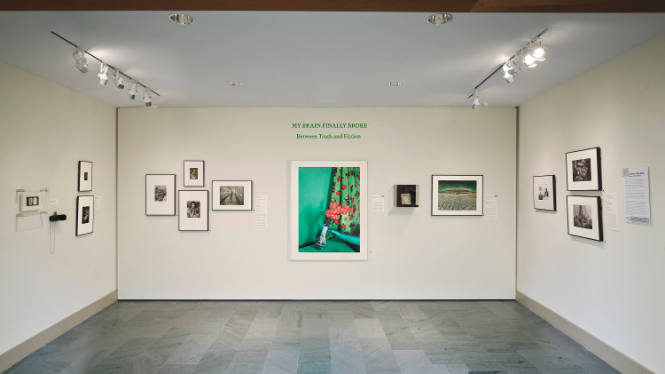
Today we are flooded with fake images that we mistake as real, and just as many real images that seem utterly unbelievable. Truth and fiction are becoming almost indistinguishable– but were they ever easy to tell apart? Borrowing its title from a recent article in The New Yorker magazine by culture writer Jia Tolentino, this single-gallery exhibition explores how, in some ways, this phenomenon has always been part of photography, even while it is dramatically amplified in the age of AI and the internet. Perfect, AI-generated portraits inspire real people to seek out cosmetic surgery to look like these fake pictures. Images of devastation wrought by climate change are so horrifying, it is nearly impossible to tell real and fake ones apart.
Looking back at our relationship to photography– which is now almost two centuries old– we might ask what has prepared us for this moment. From the beginning, photography’s truthfulness–that is, its purported ability to capture exactly what the camera sees–was its most compelling selling point. This also made it easy to manipulate. Perhaps even more interesting is that there has always been an insatiable public appetite for fake, manipulated, and sensational photographs. Curiously, this did not degrade the value of photography, but rather created a human tolerance for the inevitable slippage between truth and fiction.
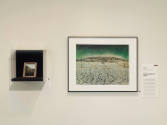
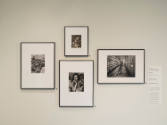
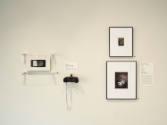
Image manipulation was commonplace in the nineteenth century and made photography more appealing for a variety of purposes. Some photographers used combination printing to depict dreams and ghosts. Others used the stereograph, an early optical device, to turn viewers into voyeurs who could access private spaces. For baby photos, so-called “hidden mothers” propped up their babies, concealed behind sheets, in portrait studios. In the twentieth century, photojournalists and documentary photographers used careful cropping, composition, and lighting to create images of real events optimized for emotional impact. These traditions established and reinforced photography’s complicated relationship to the truth. Today, as ever, artists help us make sense of things by articulating the senselessness of modern life. Contemporary artists Farah Al Qasimi, Martine Gutierrez, Patrick Nagatani, and Christina Seely explore how artifice can magnify complicated realities rather than obscuring them.
This exhibition was curated by Jessica D. Brier, Curator of Photography, and was generously supported by the Hoene Hoy Photography Fund.
Looking back at our relationship to photography– which is now almost two centuries old– we might ask what has prepared us for this moment. From the beginning, photography’s truthfulness–that is, its purported ability to capture exactly what the camera sees–was its most compelling selling point. This also made it easy to manipulate. Perhaps even more interesting is that there has always been an insatiable public appetite for fake, manipulated, and sensational photographs. Curiously, this did not degrade the value of photography, but rather created a human tolerance for the inevitable slippage between truth and fiction.
Image manipulation was commonplace in the nineteenth century and made photography more appealing for a variety of purposes. Some photographers used combination printing to depict dreams and ghosts. Others used the stereograph, an early optical device, to turn viewers into voyeurs who could access private spaces. For baby photos, so-called “hidden mothers” propped up their babies, concealed behind sheets, in portrait studios. In the twentieth century, photojournalists and documentary photographers used careful cropping, composition, and lighting to create images of real events optimized for emotional impact. These traditions established and reinforced photography’s complicated relationship to the truth. Today, as ever, artists help us make sense of things by articulating the senselessness of modern life. Contemporary artists Farah Al Qasimi, Martine Gutierrez, Patrick Nagatani, and Christina Seely explore how artifice can magnify complicated realities rather than obscuring them.
This exhibition was curated by Jessica D. Brier, Curator of Photography, and was generously supported by the Hoene Hoy Photography Fund.
Venues
Hoene Hoy Photography Gallery