Object number1941.1.67
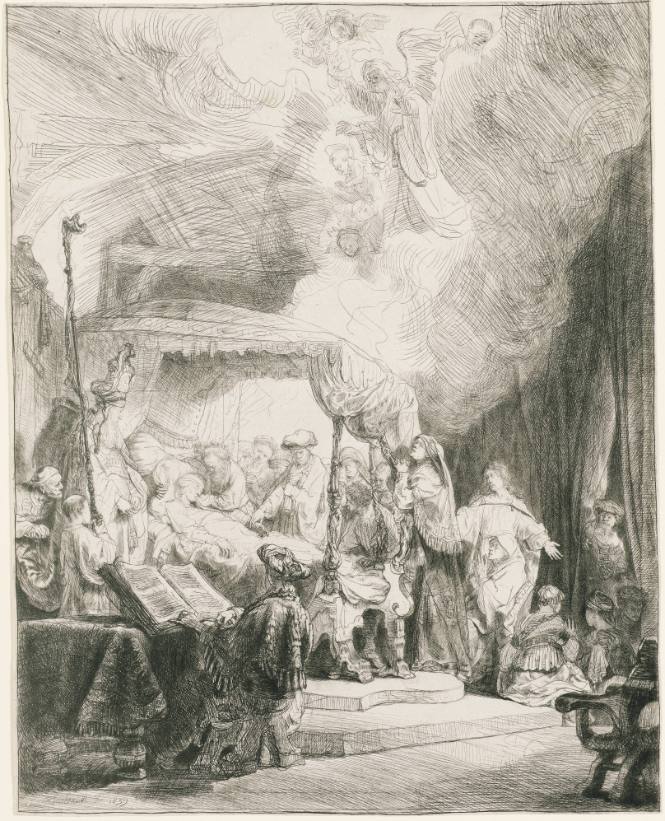
The Death of the Virgin
Date1639
Artist
Rembrandt van Rijn
(Dutch, 1606-1669)
CultureDutch
MediumEtching and drypoint in black ink on cream laid paper with fragment of an unidentified watermark
DimensionsImage: 15 5/8 x 12 5/8 in. (39.69 x 32.07 cm)
Credit LineGift of Mrs. Felix M. Warburg and her children
On View
Not on viewPeriod17th c
Classification(s)
SignedSigned: Rembrandt f
MarkingsWatermark: unidentified (fragmentary)
Catalogue raisonnéBartsch/Hollstein 99 ii/ii; Gersaint 97; Hind 161; Münz 208; Middleton 207; Biorklund/Barnard 39-ABibliographyMundy, James, The Frances Lehman Loeb Art Center: Vassar College The History and Collection (New York: Prestel Publishing, 2007), p. 48 repr.; Limouze, Dorothy and Susan Kuretsky. The Felix M. Warburg Print Collection: A Legacy of Discernment. Poughkeepsie, N. Y.: The Frances Lehman Loeb Art Center, Vassar College, 1995.
Bartsch/Hollstein 99 ii/ii; Gersaint 97; Middleton 207; Hind 161; Münz 208; Biörklund/Barnard 39-A; Limouze 56ProvenanceCollections: Felix M. and Frieda Warburg, New YorkVassar Exhibitions
Exhibition History"Master Printmakers: Rembrandt and His Contemporaries," Worcester Art Museum, Worcester, MA, 9 April 1992 - 19 July 1992.Poughkeepsie, New York, The Frances Lehman Loeb Art Center, Vassar College, "Grand Gestures: Celebrating Rembrandt", April 7-June 11, 2006
DescriptionThis etching is one of Rembrandt’s largest, grandest, and most theatrical. Unusually for the largely Protestant Netherlands, this image seems to have been meant for a Catholic audience; among whom the cult of Mary was still alive and such narrative moments as this one, drawn from apocryphal legends, were popular. While it owes a debt to similar prints by Dürer, Rembrandt invests the work with a grandiloquence that matches some of his works as a painter at a time when he was intent on demonstrating his superior talents on the grandest scale possible, whether in history painting, portraiture, or printmaking. As if to enhance the theatrical impact of the scene, Rembrandt separates the viewer from the action by creating more of a stage setting in the foreground, a distance that also allows us to appreciate the heavenly and supernatural display that occupies almost one-half of the space. This device, almost paradoxically, creates a landscape out of an interior view.
Object information is a work in progress and may be updated as new research findings emerge.
To help improve this record, please email
loebcollections@vassar.edu
Manuel Álvarez Bravo
Nd
Culture: Mexican