
Object number1991.35.17
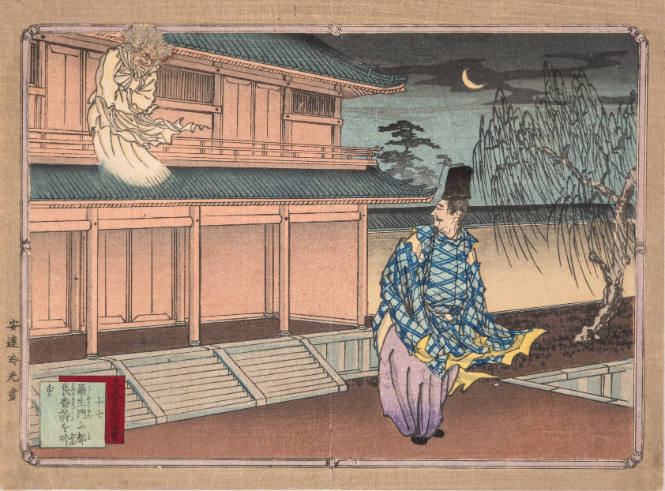
Number 17: Miyako no Yoshika Reciting Poetry at Rashōmon Gate
Portfolio/Seriesfrom the series Illustrated History of Great Japan
Date1885
Artist
Adachi Ginkō(安達 吟光)
(Japanese, 1853 - 1902)
Publisher
Ōkura Magobei (大倉孫兵衛)
(Japanese)
CultureJapanese
MediumWoodblock print (nishiki-e); ink and color on paper
DimensionsImage: 6 5/16 x 8 11/16 in. (16 x 22 cm)
Sheet (Horizontal chūban): 7 1/16 x 9 7/16 in. (18 x 24 cm)
Sheet (Horizontal chūban): 7 1/16 x 9 7/16 in. (18 x 24 cm)
Credit LineGift of Justine Lewis Keidel, class of 1937
Period19th c (Meiji period)
Classification(s)
SignedOn recto, lower left center in margin, author, printed in block: 安達吟光畫 (Adachi Ginkō kaku (Illustrated by Adachi Ginkō)
InscribedOn recto, series title in upper right corner, in red cartouche, printed in block: 大日本史略図会 (Dai Nihon shiryaku zue (Illustrated History of Great Japan)
On recto, print title in upper right corner, in yellow cartouche, printed in block: 十七 羅生門に都良香詩を吟ず (Jūshichi: Rashōmon ni Toryōkō shi o ginzu (Number 17: Miyako no Yoshika Reciting Poetry at Rashōmon Gate)
Label TextThis print illustrates the legend of the court official and scholar Miyako no Yoshika (834–879) and his encounter with a demon at Rashōmon Gate. As he passes by, Yoshika recites a Chinese poem, but upon hearing it, the demon replies with the other half of the verse. This episode first appears in a commentary on the Wakan rōeishū (Collection of Japanese and Chinese Resonant Verse, ca. 1013). Though several renditions of the tale exist, all versions present the same poem: “The weather clears, breezes comb / the hair of young willows; / the ice is melting, wavelets wash / the whiskers of old bog moss” (trans. Remer and Chaves).
In this illustration, Yoshika appears in the dead of night before the gate, the crescent moon peaking through misty clouds. He appears in blue court robes beside a willow tree, a plant commonly associated with ghosts and the supernatural in Japanese folklore. He looks back at Rashōmon, where the demon hovers in the upper-left portion of the composition, almost seeming to break through the frame itself. The subdued palette of the gate and the surrounding landscape heightens the eerie atmosphere of the scene. This episode is regarded as an early precursor to later tales of demons inhabiting Rashōmon, though the motif of supernatural beings dwelling near gates, thresholds, and liminal spaces is a common trope in Japanese literature.
Christopher Moody, class of 2026
Object information is a work in progress and may be updated as new research findings emerge.
To help improve this record, please email
loebcollections@vassar.edu
Adachi Ginkō(安達 吟光)
1885
Culture: Japanese
Adachi Ginkō(安達 吟光)
1885
Culture: Japanese
![[Number] 36](/internal/media/dispatcher/58726/thumbnail)
![[Number] 5](/internal/media/dispatcher/58722/thumbnail)
Adachi Ginkō(安達 吟光)
1885
Culture: Japanese
![[Number] 21](/internal/media/dispatcher/58740/thumbnail)
Adachi Ginkō(安達 吟光)
1885
Culture: Japanese
![[Number] 18](/internal/media/dispatcher/58731/thumbnail)
![[Number] 11](/internal/media/dispatcher/58728/thumbnail)
Adachi Ginkō(安達 吟光)
1885
Culture: Japanese
![[Number] 25](/internal/media/dispatcher/58744/thumbnail)
![[Number] 26](/internal/media/dispatcher/58729/thumbnail)