
Object number1991.35.40
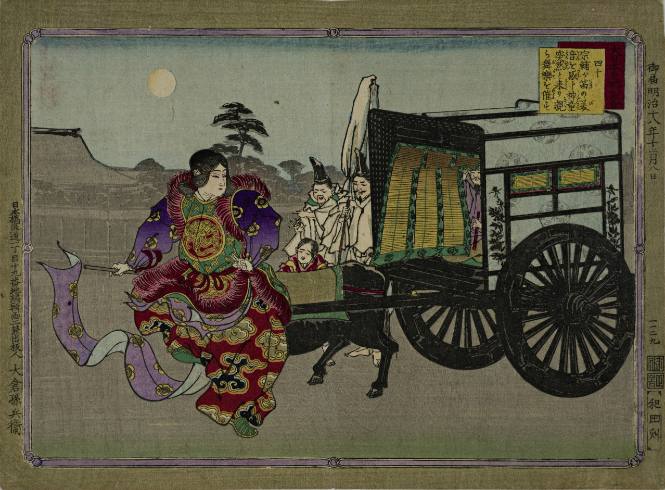
Number 40: Munesuke’s Flute Captivates a Divine Boy Who Suddenly Appears to Perform a Bugaku Dance
Portfolio/Seriesfrom the series Great Illustrated History of Japan
Date1885
Artist
Adachi Ginkō(安達 吟光)
(Japanese, 1853 - 1902)
Publisher
Ōkura Magobei (大倉孫兵衛)
(Japanese)
CultureJapanese
MediumWoodblock print (nishiki-e); ink and color on paper
DimensionsImage: 6 5/16 x 8 11/16 in. (16 x 22 cm)
Sheet (Horizontal chūban): 7 1/16 x 9 7/16 in. (18 x 24 cm)
Sheet (Horizontal chūban): 7 1/16 x 9 7/16 in. (18 x 24 cm)
Credit LineGift of Justine Lewis Keidel, class of 1937
Period19th c (Meiji period)
Classification(s)
InscribedOn recto, series title in upper right corner, in red cartouche, printed in block: 大日本史略図会 (Dai Nihon shiryaku zue (Illustrated History of Great Japan)
On recto, print title in upper right corner, in yellow cartouche, printed in block: 四十 宗輔が笛の美音を感じ神童突然と来り親ら舞楽を催す (Yonjū: Munesuke ga fue no bion o kanji jindō totsuzen to kitari mizukara bugaku o moyōsu (Number 40: Munesuke’s Flute Captivates a Divine Boy Who Suddenly Appears to Perform Bugaku)
On recto, upper right in margin, publication date, in block: 御届明治十八年十二月八日 (O-todoke Meiji jūhachinen jūnigatsu yōka (Filed/registered: Meiji 18 [1885].12.8)
MarkingsOn recto, lower right, carver’s mark, in block: 彫工 ムメザハ (Chōkō Mumezawa (Carver: Mumezawa)
On recto, lower left center in margin, publisher address and notes, printed in block: 編輯画工兼出版人 日本橋区通一丁目十九番地 大倉孫兵衛 (Henshū gakō ken shuppanjin Nihonbashi-ku dōri icchōme jūkyū banchi Ōkura Magobei (Editor-artist-publisher [at address] Nihonbashi-ku dōri icchōme 19 banchi, Ōkura Magobei)
Label TextIn this print nobleman Fujiwara no Munesuke (1077–1162) peeks out from his ox-pulled carriage as he catches sight of a celestial bugaku (Japanese court) dancer. The encounter is likely drawn from a thirteenth-century music treatise attributed to Koma no Chikazane. The episode describes Munesuke being so moved by the beauty of the moon that he performs a piece titled “Ryō-ō.”
Munesuke was an atypical courtier known for his love of the flute and bees. According to the Kokon chomonjū (A Collection of Notable Tales Old and New; ca. 1254), Munesuke reportedly said on his deathbed, “I have no resentment at dying, but being unable to play the flute is quite unbearable.” In this print, Munesuke is barely visible, with the foreground almost entirely occupied by the otherworldly dancer. He is wearing a purple robe and holding his flute, having just finished playing.
The dancer wears the costume of Ryō-ō (Ch. Ling Wang), a Chinese prince traditionally represented with a dragon mask meant to obscure his handsome look, along with a gold-brocade face cap, open-sided imperial robe, gold belt, trousers, and drumstick. Positioned prominently before Munesuke’s carriage, his figure emphasizes the supernatural quality of the apparition.
Behind stand two startled attendants alongside a child dressed in brightly colored garments. The road visually blends into the building on the left, and the ground and architecture seem to merge with the surrounding trees. In contrast, the sky appears as a pale blue expanse illuminated by a full moon.
Kathleen Langston, class of 2026
Object information is a work in progress and may be updated as new research findings emerge.
To help improve this record, please email
loebcollections@vassar.edu
Adachi Ginkō(安達 吟光)
1885
Culture: Japanese
Adachi Ginkō(安達 吟光)
1885
Culture: Japanese
![[Number] 36](/internal/media/dispatcher/58726/thumbnail)
![[Number] 5](/internal/media/dispatcher/58722/thumbnail)
Adachi Ginkō(安達 吟光)
1885
Culture: Japanese
![[Number] 21](/internal/media/dispatcher/58740/thumbnail)
Adachi Ginkō(安達 吟光)
1885
Culture: Japanese
![[Number] 18](/internal/media/dispatcher/58731/thumbnail)
![[Number] 11](/internal/media/dispatcher/58728/thumbnail)
Adachi Ginkō(安達 吟光)
1885
Culture: Japanese
![[Number] 25](/internal/media/dispatcher/58744/thumbnail)
![[Number] 26](/internal/media/dispatcher/58729/thumbnail)