
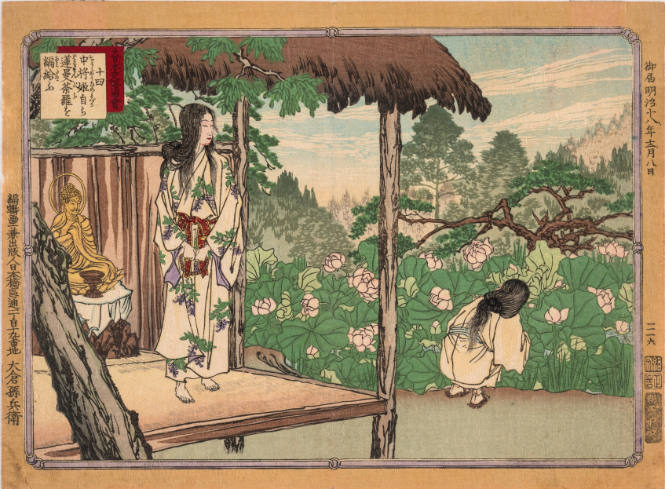
Object number1991.35.14
Number 14: The Venerable Nun Chūjōhime Herself Weaves the Lotus Mandala
Portfolio/Seriesfrom the series Great Illustrated History of Japan
Date1885
Artist
Adachi Ginkō(安達 吟光)
(Japanese, 1853 - 1902)
Publisher
Ōkura Magobei (大倉孫兵衛)
(Japanese)
CultureJapanese
MediumWoodblock print (nishiki-e); ink and color on paper
DimensionsImage: 6 1/4 x 8 3/4 in. (15.88 x 22.23 cm)
Sheet: 7 x 9 7/16 in. (17.78 x 23.97 cm)
Sheet: 7 x 9 7/16 in. (17.78 x 23.97 cm)
Credit LineGift of Justine Lewis Keidel, class of 1937
Period19th c (Meiji period)
Classification(s)
Signed
InscribedOn recto, print title in upper left corner, in yellow cartouche, printed in block: 大日本史略図会 十四 中将姫自ら蓮曼荼羅を編給ふ Transliteration (Translation): (Jūyon: Chūjōhime mizukara hasu mandara o amitamau; Number 14: The Venerable Nun Chūjōhime Herself Weaves the Lotus Mandala)
On recto, series title in upper right corner, in red cartouche, printed in block: 大日本史略
Translation (Transliteration): (Dai Nihon shiryaku zue (Illustrated History of Great Japan)
MarkingsOn recto, upper right in margin, publication date, in block: (O-todoke Meiji jūhachinen jūnigatsu yōka; Filed/registered: Meiji 18 [1885].12.8)
On recto, lower right, carver’s mark, in block: (Chōkō Mumezawa; Carver: Mumezawa)
On recto, lower left center in margin, publisher address and notes, printed in block: (Henshū gakō ken shuppanjin Nihonbashi-ku dōri icchōme jūkyū banchi Ōkura Magobei; Editor-artist-publisher [at address] Nihonbashi-ku dōri icchōme 19 banchi, Ōkura Magobei)
Label TextThis print depicts Chūjōhime, also known as Lady Chūjō, overseeing the collection of lotuses whose fibers will be spun for the weaving of the Taima Mandala, named after its home temple, Taimadera. The weaving is not depicted; instead, Chūjō appears barefoot on a raised wooden platform. In the background is a dais with a gold bodhisattva statue and an offertory vessel. Off to the right there is a young woman kneeling beside pink lotus flowers. Seen only from behind, the kneeling figure wears a white robe, light-blue sash, and grass sandals.
Chūjō holds brown prayer beads and wears a white robe patterned with blossoms and vines, lined in a soft wisteria-purple hue and tied with a red sash. Her idealized facial features resemble those of a bijin, the “beautiful women” genre of early-modern woodblock printing. Her long black hair is especially significant, as late medieval sources describe Chūjō weaving strands of her own hair into sacred Buddhist embroideries.
Through her piety, Chūjōhime is said to have inspired the bodhisattva Amida to descend to earth and oversee the weaving of a tapestry depicting the Western Pure Land. A thirteenth-century handscroll is the earliest surviving document to recount this legend. Historically, however, the Taima Mandala was likely woven in eighth-century China from silk before being brought to Japan and donated to Taimadera near the city of Nara. Over time, Chūjō’s journey to Taimadera evolved into a Japanese “Cinderella” narrative, featuring an evil stepmother who banishes her into the mountains, where she begins her spiritual quest.
Kathleen Langston, class of 2026
Object information is a work in progress and may be updated as new research findings emerge.
To help improve this record, please email
loebcollections@vassar.edu
Adachi Ginkō(安達 吟光)
1885
Culture: Japanese
![[Number] 36](/internal/media/dispatcher/58726/thumbnail)
![[Number] 5](/internal/media/dispatcher/58722/thumbnail)
Adachi Ginkō(安達 吟光)
1885
Culture: Japanese
![[Number] 21](/internal/media/dispatcher/58740/thumbnail)
Adachi Ginkō(安達 吟光)
1885
Culture: Japanese
![[Number] 18](/internal/media/dispatcher/58731/thumbnail)
![[Number] 11](/internal/media/dispatcher/58728/thumbnail)
Adachi Ginkō(安達 吟光)
1885
Culture: Japanese
![[Number] 25](/internal/media/dispatcher/58744/thumbnail)
![[Number] 26](/internal/media/dispatcher/58729/thumbnail)
Adachi Ginkō(安達 吟光)
1885
Culture: Japanese