
Object number1991.35.1
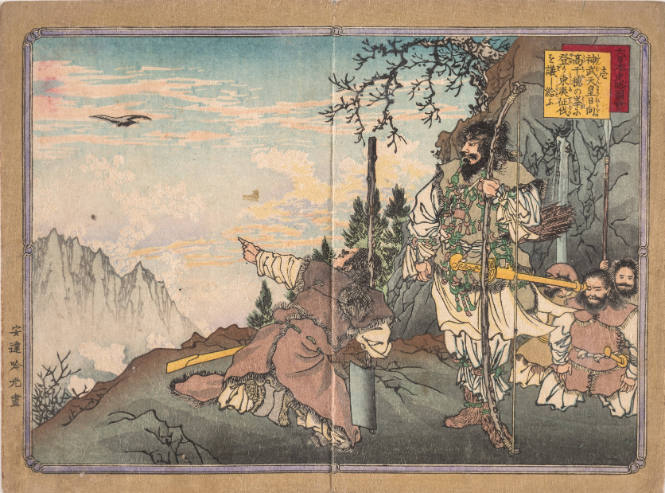
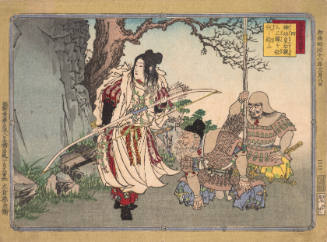
Number 1: Emperor Jinmu, Having Climbed to the Peak of Takachiho in Hyuga, Conferred on the Campaign to Subdue the Eastern Regions
Portfolio/Seriesfrom the series Illustrated History of Great Japan
Date1885
Artist
Adachi Ginkō(安達 吟光)
(Japanese, 1853 - 1902)
Publisher
Ōkura Magobei (大倉孫兵衛)
(Japanese)
CultureJapanese
MediumWoodblock print (nishiki-e); ink and color on paper
DimensionsImage: 6 5/16 x 8 11/16 in. (16 x 22 cm)
Sheet (Horizontal chūban): 7 1/16 x 9 7/16 in. (18 x 24 cm)
Sheet (Horizontal chūban): 7 1/16 x 9 7/16 in. (18 x 24 cm)
Credit LineGift of Justine Lewis Keidel, class of 1937
Period19th c (Meiji period)
Classification(s)
SignedOn recto, lower left, artist's signature in margin, in block: 安達吟光書
InscribedOn recto, upper right, series title in red cartouche, in block: 大日本史略圖會 (Dai nihon ryaku shi zue; Illustrated History of Great Japan)
On recto, print title in upper right corner, in yellow cartouche, printed in block: 壱 神武天皇日向高千穂の峯に登り東夷征伐を議し給ふ
Transliteration (Translation): Ichi Jinmu tennō Hyuga Takachiho no mine ni nobori tōi seibatsu wo gishitamau
(Number 1: Emperor Jinmu, Having Climbed to the Peak of Takachiho in Hyuga, Conferred on the Campaign to Subdue the Eastern Regions)
Vassar Exhibitions
Label TextCreated amidst the nation-building efforts of the Meiji Restoration (1868–1889), this print depicts Emperor Jinmu, traditionally regarded as the first emperor of Japan, during his Eastern Expedition. According to the legend, the Yatagarasu, a mythical three-legged crow-god, was sent by the sun goddess Amaterasu to guide him from Kumano to Nara, where he would establish Japan’s first capital. The scene is structured so that the soldier’s gesture and the emperor’s gaze direct the viewer’s attention to the Yatagarasu in the distance. Jinmu, the sole standing figure, is portrayed in attire and accouterments that indicate his noble and divine status. The jewelry is none other than magatama (comma-shaped beads), one of the three Imperial Regalia, adorning his body around his neck, wrists, and legs.
Suspended from Jinmu’s left side is a sword in a gold sheath, possibly the Futsu-no-mitama. According to the Nihon shoki (Chronicles of Japan; 720 CE), Takakuraji, one of Jinmu’s men, dreamed of Amaterasu and Takemikazuchi, the god of thunder and swords. Takemikazuchi offered him the very sword he had used to pacify the land and instructed Takakuraji to retrieve it from a storehouse once awake and present it to Jinmu to aid him in his campaign.
Monique D’Almeida, Deknatel Curatorial Fellow in Japanese Works on Paper (2023–2026)
Object information is a work in progress and may be updated as new research findings emerge.
To help improve this record, please email
loebcollections@vassar.edu
Adachi Ginkō(安達 吟光)
1885
Culture: Japanese
Adachi Ginkō(安達 吟光)
1885
Culture: Japanese
Adachi Ginkō(安達 吟光)
1885
Culture: Japanese
![[Number] 36](/internal/media/dispatcher/58726/thumbnail)
![[Number] 5](/internal/media/dispatcher/58722/thumbnail)
Adachi Ginkō(安達 吟光)
1885
Culture: Japanese
![[Number] 21](/internal/media/dispatcher/58740/thumbnail)
![[Number] 18](/internal/media/dispatcher/58731/thumbnail)
![[Number] 11](/internal/media/dispatcher/58728/thumbnail)
Adachi Ginkō(安達 吟光)
1885
Culture: Japanese
![[Number] 25](/internal/media/dispatcher/58744/thumbnail)
![[Number] 26](/internal/media/dispatcher/58729/thumbnail)