
Object number1991.35.8
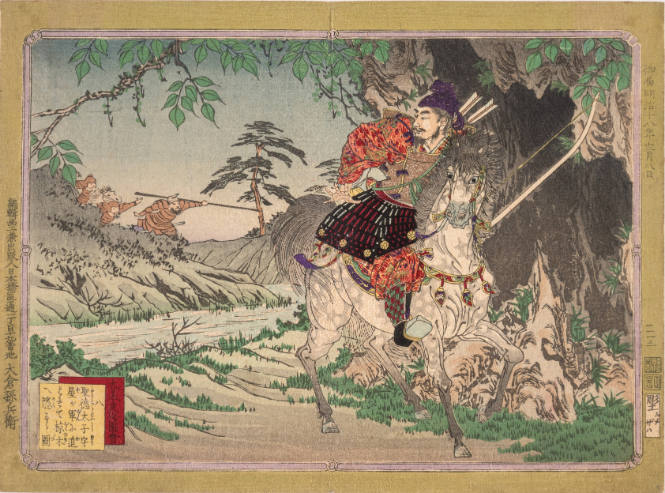
Number 8: Prince Shōtoku Escapes the Enemy by Hiding in a Muku Tree, While Pursued by an Army
Portfolio/Seriesfrom the series Illustrated History of Great Japan
Date1885
Artist
Adachi Ginkō(安達 吟光)
(Japanese, 1853 - 1902)
Publisher
Ōkura Magobei (大倉孫兵衛)
(Japanese)
CultureJapanese
MediumWoodblock print (nishiki-e); ink and color on paper
DimensionsImage: 6 1/4 x 8 3/4 in. (15.88 x 22.23 cm)
Sheet: 7 x 9 7/16 in. (17.78 x 23.97 cm)
Sheet: 7 x 9 7/16 in. (17.78 x 23.97 cm)
Credit LineGift of Justine Lewis Keidel, class of 1937
Period19th c (Meiji period)
Classification(s)
Vassar Exhibitions
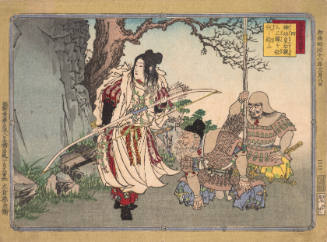
Label TextThis print illustrates the legend of Empress Jingū’s conquest of the three kingdoms of the Korean peninsula in the third century CE. By the Meiji period, scholars removed Empress Jingū from the list of emperors in the History of Great Japan, instead relegating her as an interim ruler after the death of her husband, Emperor Chuai, and the ascension of her son Ojin. However, her legend was used to situate Japan as a peer of Western imperialist nations. Originating in the eighth century, the Jingū narrative in literature was embellished upon in the fourteenth century, simultaneously emphasizing a supernatural masculine appearance and the trope of a virtuous wife. In this image, Jingū is dressed in masculine garb, with a white robe over armor and red pants and her hair partially pulled into a top knot. As with other depictions of the empress, she has a bow, sword, and quiver of arrows. Over her garments the empress is adorned in magatama, ancient comma-shaped jade beads, which are one of the Imperial Regalia of Japan. While the historians have not found evidence of this conquest occurring, the depiction of Empress Jingū conquering the Korean kingdoms served two purposes for the Meiji nation-state, signaling Japan’s interest in conquering lands and situating the country on par with other Western imperial countries.
Object information is a work in progress and may be updated as new research findings emerge.
To help improve this record, please email
loebcollections@vassar.edu
Adachi Ginkō(安達 吟光)
1885
Culture: Japanese
Adachi Ginkō(安達 吟光)
1894
Culture: Japanese
Adachi Ginkō(安達 吟光)
1885
Culture: Japanese
Adachi Ginkō(安達 吟光)
1885
Culture: Japanese
![[Number] 36](/internal/media/dispatcher/58726/thumbnail)
![[Number] 5](/internal/media/dispatcher/58722/thumbnail)
Adachi Ginkō(安達 吟光)
1885
Culture: Japanese
![[Number] 21](/internal/media/dispatcher/58740/thumbnail)
Adachi Ginkō(安達 吟光)
1885
Culture: Japanese
![[Number] 18](/internal/media/dispatcher/58731/thumbnail)
![[Number] 11](/internal/media/dispatcher/58728/thumbnail)
![[Number] 25](/internal/media/dispatcher/58744/thumbnail)