Object number2024.29.1
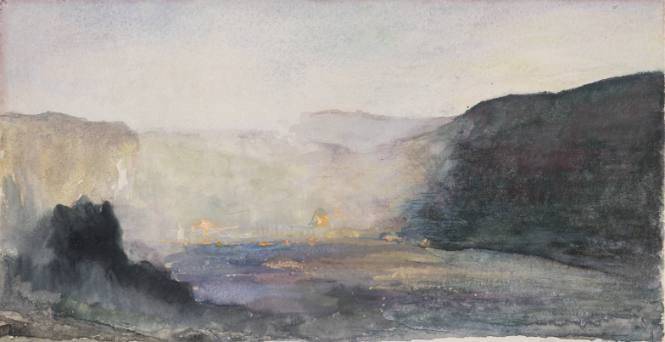
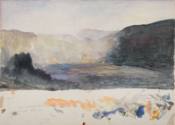
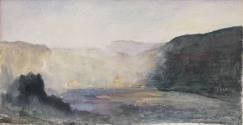
Crater of Kilauea, Sunrise
Date1890
Artist
John La Farge
(American, 1835-1910)
CultureAmerican
MediumGouache and watercolor on paper
DimensionsImage: 7 1/4 x 14 1/8 in. (18.4 x 35.9 cm)
Framed: 16 1/2 x 23 1/4 x 1 1/2 in. (41.9 x 59.1 x 3.8 cm)
Framed: 16 1/2 x 23 1/4 x 1 1/2 in. (41.9 x 59.1 x 3.8 cm)
Credit LineMuseum Purchase, Gift of Ellen G. Milberg, class of 1960
On View
Not on viewPeriod19th c
Classification(s)
Sothebys, New York, December 5, 1991, lot 28;
Purchased by Richard and Leah Waitzer, Norfolk, VA;
Alexandre Fine Art Inc., New York, NY;
Vassar Exhibitions
Exhibition HistoryRecords of Travel, Paul Durand Ruel Gallery, New York, NY, 1895Exhibition of Paintings, Watercolors & Drawings by John La Farfe (1835-1910) From His Travels in the South Seas, 1890-1891, Peabody Museum, Salem, MA, February 1 - May 1, 1978
Recreation and Idleness: The Pacific Travels of John La Farge, Vance Jordan Fine Art Inc., New York, NY, April 30 - June 9, 1998
John La Farge’s Second Paradise: Voyages in the South Seas, 1890–1891, Yale University Art Gallery, New Haven, CT, October 19, 2010 - January 2, 2011; Addison Gallery of American Art, Phillips Academy, Andover, MA, January 22 - March 27, 2011
Watercolor: An American Medium, Chrysler Museum, Norfolk, VA, Feb. 21 - June 23, 2019
Label TextJohn La Farge’s watercolor technique prioritized atmospheric effect over topographical documentation. At Kīlauea, the shield volcano on the island of Hawaii’s southeastern shore, he layered gouache over watercolor washes, the thicker paint holding its shape while the washes bloom beneath. The result demonstrates his mastery of fluid color effects and luminous transparency. This work belongs to a series painted at the crater; La Farge described Kīlauea: “A slight radiance from these surfaces of molten black glass gives a curious sheen . . . and fills the eye with imaginary suggestions.”
La Farge’s 1890 expedition with historian Henry Adams occurred as American sugar interests expanded their hold on Hawaiian land and politics prior to the 1893 overthrow of the monarchy. Both men sought respite from personal and professional losses, and La Farge had prepared extensively, reading explorer Captain James Cook’s eighteenth-century Pacific voyages and imagining himself following in their wake. Adams and La Farge found Hawaii already modernized beyond their romantic expectations, with tourist development that disappointed their search for cultural authenticity. His encounter with Kīlauea offered what Elizabeth Childs terms “an exoticism of the geological sublime.” The volcano, though
sublime, remained accessible only through the very colonial networks that had displaced and marginalized Native Hawaiian culture.
Object information is a work in progress and may be updated as new research findings emerge.
To help improve this record, please email
loebcollections@vassar.edu
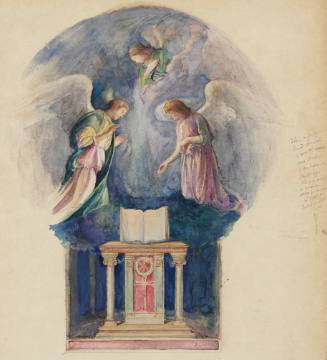
John La Farge
c. 1899
Culture: American