Object number2024.4.1
Dreaming
Date2022
Artist
Dyani White Hawk
(Sičáŋǧu Lakota, born 1976)
Printer
Judith Baumann
CultureSičáŋǧu Lakota
MediumEighteen color lithograph, published November 2023
EditionEdition 3 of 20, plus 1 bon a tirer, 2 artist's proofs, 1 printer proof, 2 press impressions, 2 color trial proofs
DimensionsImage: 25 x 25 in. (63.5 x 63.5 cm)
Sheet: 30 1/4 x 30 in. (76.8 x 76.2 cm)
Sheet: 30 1/4 x 30 in. (76.8 x 76.2 cm)
Credit LinePurchase, gift of Mrs. Frederick Ferris Thompson, by exchange
On View
Not on viewPeriod21st c
Classification(s)
SignedOn recto, signed lower right in margin in pencil: Dyani White Hawk
InscribedOn recto, by artist, lower left in margin in pencil: 3/20; middle margin: Dreaming. On verso, by unidentified hand, lower right corner in pencil: CPS 22-108 / SOMSAT Wh
MarkingsOn recto, blind stamped lower left corner: Crow's Shadow Press chop. On verso, stamped lower right corner in yellow: collaborating printer's chop [image of cat arching back]
Vassar Exhibitions
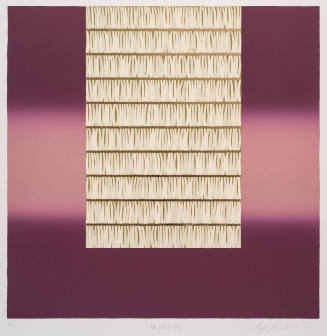
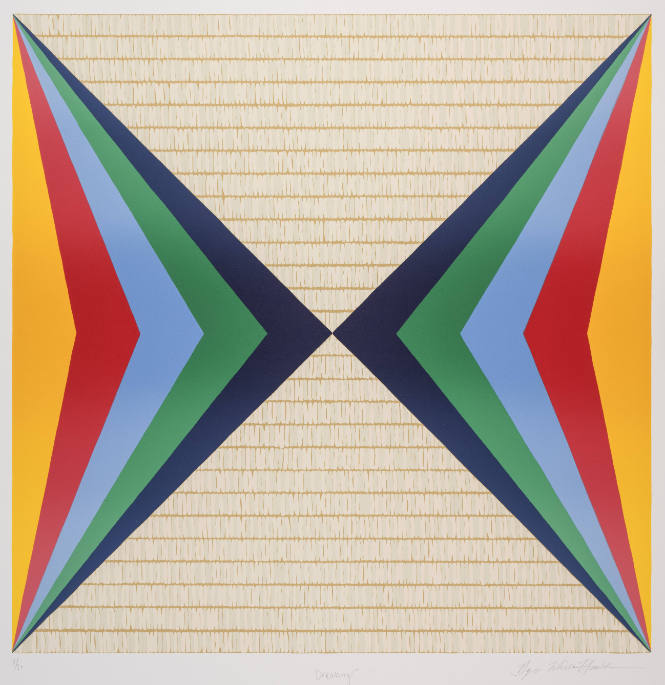
Label TextArtist Dyani White Hawk’s Dreaming is a symbol of strength, ingenuity, and ancestral lineage. The print represents not only women of the Lakota people but also those who paved the way for Indigenous artists, like herself. Her abstract design features two triangular outlines that are often used to symbolize the connection between the sun and the earth. Detailed in the middle are gold beaded lines and white stick-like brushstrokes. These white marks take the form of dentalium shells, also known as dentalium pretiosum. The shells were once used as a form of currency and sign of wealth amongst several Native American tribes.
Through the geometric nature of the composition, White Hawk combines knowledge of abstract artistic practices and her ancestral connections to convey larger symbolic meanings. The artist states, “We have long-standing artistic practices—traditions—that are of utmost importance to continue to practice, nurture, and learn from. These practices bring with them teachings that ground us in who we are, that directly connect us to our ancestors, our relatives, and the land.”
As White Hawk thinks of the community and traditional figuration of the Lakota women, she also uses the materiality of the piece to urge us, as audience members, to engage with the work of Indigenous women artists. This artwork becomes self reflective of the dreams and presentations of the future for Indigenous artists. Many of those artists, like Dyani White Hawk, are making narratives and histories visible that too often form patterns of erasure elsewhere when it comes to Indigenous artists and their work.
Object information is a work in progress and may be updated as new research findings emerge.
To help improve this record, please email
loebcollections@vassar.edu