Object number2024.4.2
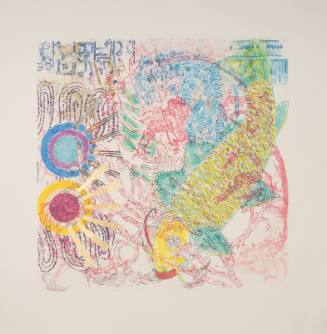
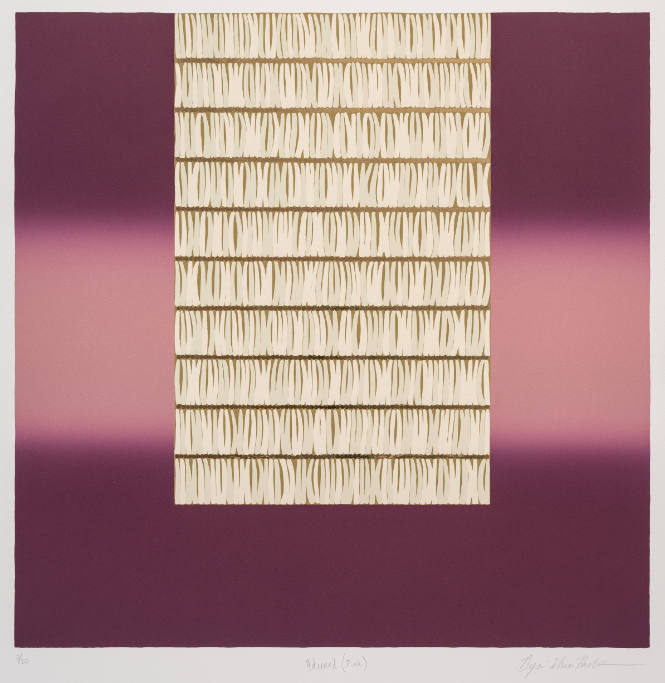
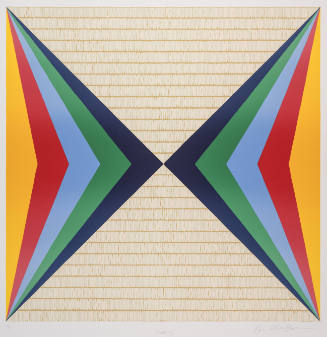
Adorned (Pink)
Date2022
Artist
Dyani White Hawk
(Sičáŋǧu Lakota, born 1976)
Printer
Judith Baumann
CultureSičáŋǧu Lakota
MediumSix color lithograph with gold leaf, published November 2023
EditionEdition 3 of 20, plus 1 bon a tirer, 2 artist's proofs, 1 printer proof, 2 press impressions, 2 color trial proofs
DimensionsImage: 20 x 20 in. (50.8 x 50.8 cm)
Sheet: 25 x 25 in. (63.5 x 63.5 cm)
Sheet: 25 x 25 in. (63.5 x 63.5 cm)
Credit LinePurchase, gift of Mrs. Frederick Ferris Thompson, by exchange
On View
Not on viewPeriod21st c
Classification(s)
SignedOn recto, signed lower right in margin in pencil: Dyani White Hawk
InscribedOn recto, by artist, lower left in margin in pencil: 3/20; middle margin: Adorned (Pink). On verso, by unidentified hand, lower right corner in pencil: CPS 22-111 / SOMSAT Wh
MarkingsOn recto, blind stamped lower left corner: Crow's Shadow Press chop. On verso, stamped lower right corner in yellow: collaborating printer's chop [image of cat arching back]
Vassar Exhibitions
Label TextThis color lithograph is composed of several techniques that White Hawk uses within her work, like porcupine quillwork, beadwork, and parfleche painting. Traditionally, these practices are female led and upheld through generational and matrilineal practices of Lakota women. White Hawk relies on the lineage of Lakota aesthetics to juxtapose colors within each work through transitional tones of pink and blue, while urging consideration of how the artworks communicate through their contrasting colors.
While White Hawk takes inspiration from both Native and non-Native sources, her practice is rooted in all things that push her communities and people forward in an effort to preserve ancestral lineage and knowledge. The artist states, “I was simultaneously practicing our long-standing artistic practices while also forging my own voice as a practicing studio artist. All of this helped heal the pain in my own heart of our removal from our family and the realities of what it means to grow up being a mixed kid.” White Hawk’s work therefore is not merely an act of reclamation or resistance, but advocacy for the voices and people that don’t hear or see themselves in “mainstream art.” She speaks to future generations with an implicit message to rely on one’s past as an ever-evolving continuation of one’s present and future.
Object information is a work in progress and may be updated as new research findings emerge.
To help improve this record, please email
loebcollections@vassar.edu
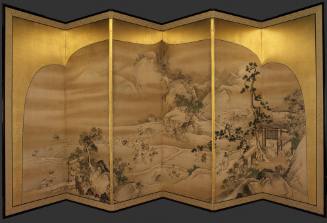
Kano Eino
17thc
Culture: Japanese
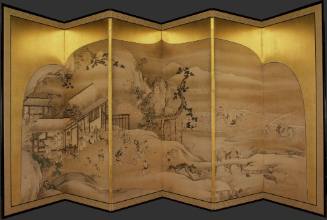
Kano Eino
17th c
Culture: Japanese