Object number2023.4.4
Junges Paar
Date1913
Artist
Emil Nolde
(German, 1867-1956)
CultureGerman
MediumColor lithograph printed in black, blue, and red ink from three stones, on Japan paper
EditionEdition of 68 color variations, plus 112 known proofs, impression number 2 of 2 in this color variation
DimensionsImage: 24 x 19 3/4 in. (61 x 50.2 cm)
Sheet: 26 1/2 x 22 1/8 in. (67.3 x 56.2 cm)
Mount: 30 1/4 x 25 9/16 in. (76.8 x 64.9 cm)
Sheet: 26 1/2 x 22 1/8 in. (67.3 x 56.2 cm)
Mount: 30 1/4 x 25 9/16 in. (76.8 x 64.9 cm)
Credit LineBequest of Lynn Gross Straus, class of 1946
Period20th c
Classification(s)
SignedOn recto, signed lower right margin in pencil: Emil Nolde
InscribedOn recto, possibly by artist, lower right margin corner in pencil: 960 1/2 [possibly gell]; lower left margin: Von 2 Dr. dieser Fassung / No. 2
Catalogue raisonnéSchiefler L52 D.I.9; Schiefler-Mosel L52; Bartrum 80BibliographyAckley, Clifford S., Timothy O. Benson, and Victor Carlson. Nolde: The Painter’s Prints. Boston: Museum of Fine Arts Boston, 1995, pp. 235-237Vassar Exhibitions
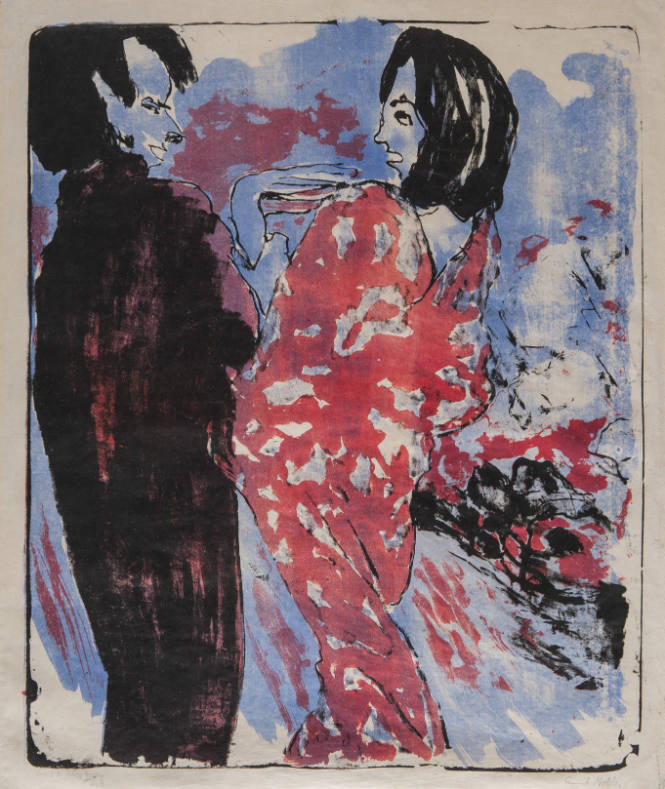
Label TextInspired by some of Edvard Munch’s color woodcuts, Emil Nolde printed Young Couple by overlaying translucent colors, a technique uncommon in early-twentieth-century German lithographs. With sixty-eight different color combinations, he was highly experimental in rendering these prints and was never satisfied with a particular combination. Relying on color symbolism to demonstrate emotional depth, each color combination communicates different interpretations of the couple’s relationship. For Nolde, the subject of the male and female figures epitomized polarity, asserting “duality assumed an important place in my paintings and also in my graphic art. Together or opposed to each other: man and woman, joy and pain, divinity and devil. The colors were also placed in opposition to each other: cold and warm, light and dark, weak and strong.”
DescriptionA near full double portrait of a man and woman in conversation, viewed from the back with their faces in profile. The man is dressed in all black and the woman wears a red dress. The print composition has a flat dimensionality and has a feeling of quick brushstrokes of watercolor and ink with undulating linework.
Object information is a work in progress and may be updated as new research findings emerge.
To help improve this record, please email
loebcollections@vassar.edu